I am doing this because I want the nuance of language in important books to be heard by beginners, not just by people who have been philologists for 20 years (god bless them for keeping the language alive at its fullest) — but I want to steal a little bit of Prometheus's fire for the beginner, to help surface insight in these texts that would be hard to find in a flattened translation or in the confusing pure text that has no context.
We are trying to provide the context as best we can and help you integrate it into the fun of reading a story in flow. This is for the reader who cares about the story, but also wants to learn as much as they can from following the experience.
time machines
These books are mostly time-travel machines. They resurrect the dead. They put you in a conversation with someone who lived 2400 years ago. That's the logos — the full account, in details and emotions and concepts. Plugging yourself into all of that feed, directly. It's a resurrection.
berry picking
For me one of the joys is going berry picking in the lush pastures of beautiful text. Sometimes it's to stop at beautiful vistas and sometimes it's to reach down and find a particularly juicy word and pick it and put it in your pocket. I aim to make that easy too. To fall in love with a word. Some words contain whole worlds. Especially if you go berry picking in an ancient Greek text you will possibly pick a few magic mushrooms — words that blow your whole mind open with the concept it is trying to transmit. That's why we have broken down those words. We want you to know how to say them, where they come from, all the meanings associated with them. In Greek, the language spans across millennia. There is encapsulated wisdom from the whole history in some of those shiny star words. So please go berry picking.
how it works
Every book here is presented interlinearly: the original text on top, and under each word, its pronunciation and its meaning in that spot. Tap any word and it opens — the full range of what it meant, where it came from, what got lost on the way to English.
The words are also weighted. Most words in any sentence are ordinary. Some are layered. And a few are carrying the whole passage on their back. The reader marks which is which, so your attention goes where the depth is — the difference between looking a word up and knowing which words are worth looking up.
Something happens when you read this way that a flat translation never accomplishes: you learn the language while you are reading. Not the usual bargain — study grammar for two years, then earn the right to open the book. You open the book on day one, read the real thing from the first minute, and the language accrues the way it actually accrues: through meaning you care about, one weighted word at a time.
standing on shoulders
We do this because we want to take the insight of a 20-year philologist and put it in the hands of the beginner. We stand on the shoulders of people who have done this by hand and we bow our heads low in respect. There is nothing like a hand-translated text — the thought put into it, the choice, everything with the thread of human intuition and analysis behind it. It is a true art and we aspire to make more people who can know the full meanings of the words. We aim to assist and to make it more plentiful.
origin
I built this because this is how I wanted to read Plato — to really understand him as best I could in the register of his time. I also have to give due thanks to interlinearbooks.com. I fell in love with their Cooljugator — which helps me learn conjugations. They create a series of interlinear books and I purchased an interlinear copy of O Alienista — and it was the first Portuguese book that I ever read. I fell in love with the characters. What a great concept, to link tools that help people learn the words and the mechanics that they need to internalize the language. It's so much more fun learning by reading a book. I also love Duolingo, but many of the sentences don't apply to my life; they don't offer me the rich palette of jewel-tones you find in the adjectives of great novels — the invocations of power, the voice of character that you find in a book. After O Alienista I wanted to read everything in interlinear. Why not learn all the time.
hi, I'm Eric
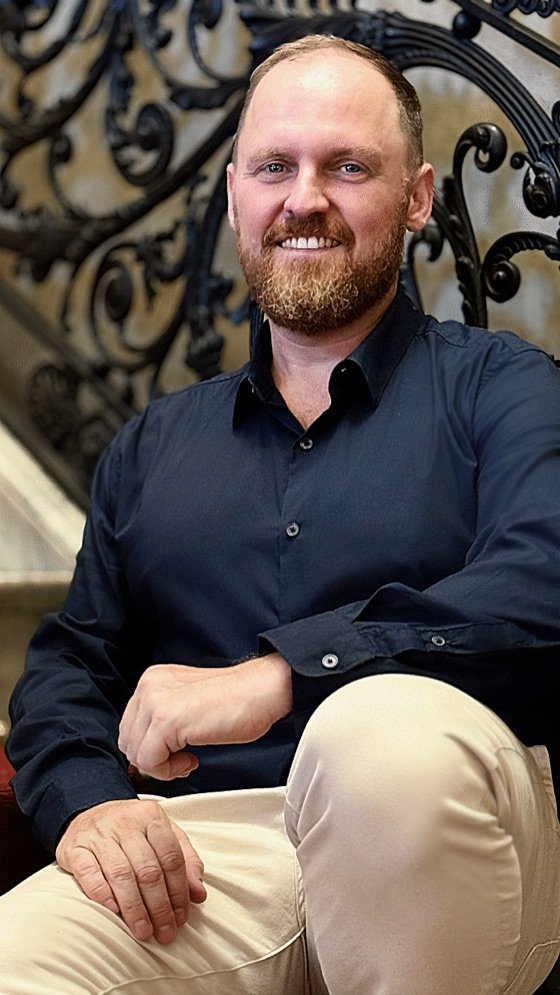
I'm not a classical philologist. I'm a reader who wanted this to exist.
I've spent eighteen years as a coach, made homes on four continents, and spent my life chasing one question — the pattern language underneath things. I read Plato because I wanted to hear him, not a summary of him.
So I'm doing this in the open, one book at a time, with whatever compute I can afford — and I would rather be corrected than be impressive.
handling sacred text
We recognize that we are going as far as we can as beginners with tools. We don't want to propagate bad translations. We are always seeking input to improve our translation and to create a process for that. This is what we have built from sources. This was our thought process.
the public domain
Much of this translation is built wiring in source texts that are in the public domain. That means it misses discourse in the current private domain. We welcome all input and try to make it easy to give it.
the record
Our goal is to recreate the biggest context of classical literature. I want it to be possible for anyone to go in there and investigate the record. This is about exploring the context around these books we know.
Not just the text — everything standing around it. The critical editions and where they disagree. The translators who came before, and the places they split. The ancient dictionaries and commentators who were already arguing about a word a thousand years ago. All of it public domain, all of it cited, so you can follow any thread back to its source yourself.
Two witnesses, fifteen centuries apart, on a single word — and you can read them both.
what it costs you
Nothing. Reading is free, with no account and no wall, and it stays that way. The offering plate goes out and never comes back. What is on this shelf is given away, and stays given away — there is nothing to join, and nothing to pay back.
working through compute
We work through compute. I am maxing out my Claude account and use a few other APIs to speed things along. Contributing money helps me buy more API power and move books forward faster. I will try to get to all of them, but I am also putting some aspiration books out there that are incomplete but that would give someone a taste. Following a book or contributing to a book is signal. I will grow fastest where there is signal. Sometimes it takes about $5–10 of compute to press a book. Century-old Romance-language text is quite easy; the most ancient classical Greek texts are steeper peaks. Translating Plato or Homer takes far more care and far more humility. I have to keep the little computer gnomes carrying their buckets of logos. Some of these books are sacred grounds — we bow our heads and tread lightly, ears wide for feedback.
Every one of these is free to read right now, however far it has come.
Money here buys compute and nothing else — it moves the bar, not the wall.
help the whole library instead →
where this goes
The shelf starts with ancient Greek because that is where I started. It does not end there. Classic literature in Portuguese, Italian, classical Chinese — and, importantly, texts in languages fighting to stay alive, like K'iche' Maya and Tupi-Guarani, where an interlinear edition is not a reading aid but an act of preservation.
thanks
We give thanks to those who came before. Those who wrote. Those who interpreted and kept the language and meaning alive.
Every source text here is in the public domain, frozen from a named scholarly edition and checked against it — Greek after Burnet (OCT) and Diels-Kranz, and each book's own edition credited on its page. Dictionaries, commentators, and earlier translators are consulted as witnesses and cited, never copied.
The interlinear layers are built with AI and reviewed against the sources. Where a book is still growing, it says so. The gates never loosen.
With thanks to interlinearbooks.com and Cooljugator, who showed the way.