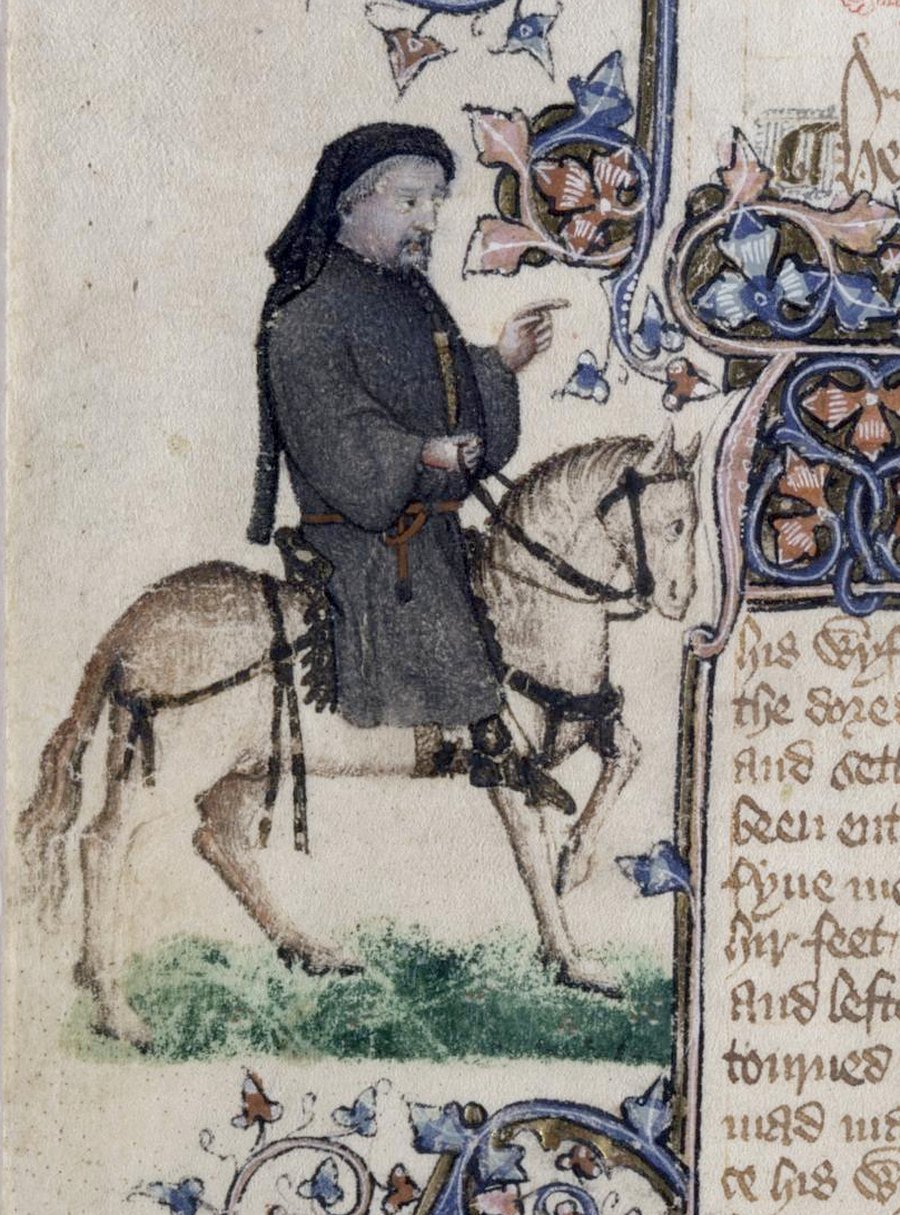
The Canterbury Tales
Twenty-nine pilgrims meet at a London inn and agree to tell stories all the way to Canterbury.
Press this book. Your gift commissions the Great Library’s word-by-word interlinear The Canterbury Tales, and the day it is made, it is free for everyone, forever. You are not buying a copy; you are paying for it to exist.
Press this book
Give what you like. A few dollars helps, or fund the whole of the General Prologue and become its Founder. Every contribution presses it closer to real.
This is how every Great Library book reads, word beneath word. The Canterbury Tales’s own first lines appear here the day its pilot is pressed.
About this book
Why read it
Chaucer's book of stories told on the road. Twenty-nine pilgrims meet at an inn in Southwark and ride together to the shrine of Thomas Becket at Canterbury, and the innkeeper proposes a game: each of them will tell tales on the way, and the best teller wins a supper paid for by the rest. A knight, a miller, a prioress, a cook and a much-married widow from Bath all speak in their own voices, from courtly romance to some of the bawdiest stories in English. We are pressing it from the first line, in Chaucer's own Middle English with the modern word under each of his. The opening of the General Prologue is live as a beta, and a gift of any size helps press the rest.
The lore
Geoffrey Chaucer (c. 1343–1400) was the son of a London wine merchant and spent his working life in royal service: page, soldier, diplomat in France and Italy, and Controller of Customs for the port of London. He began the Tales around 1387 and was still at work on them when he died in 1400, leaving about two dozen tales of the many more the Host's plan called for. He wrote in the English of London in his day, Middle English, when the court still read French and scholars wrote Latin. He was buried in Westminster Abbey, in what later became Poets' Corner.
What’s juicy
When the drunken Miller insists on telling his tale straight after the noble Knight's, Chaucer stops to warn us that it is a churl's tale, and if we would rather not hear it: 'Turne over the leef, and chese another tale.' Turn the page and choose another. The Miller's story of a carpenter, his young wife, a lodger and a window is one of the funniest things in English.
Why pressing it matters
Making an interlinear The Canterbury Tales is real work: freezing a scholarly source text, aligning every word to its dictionary form, glossing what resists translation, and proofing it all to a hard quality bar. Pressing a book is how that work gets funded. When enough readers press it, the General Prologue gets made, and then it is free to read forever, for you and for everyone who comes after.
This isn’t a purchase. It’s a commission. You’re not buying a copy; you’re paying for the thing to exist, and putting your name (if you like) on the first true The Canterbury Tales that anyone can read for free.
Not ready to give? Follow it.
Leave your email and we’ll write to you the day the The Canterbury Tales opens. No other mail, ever.
Read our finished collection · the library · The Great Library Project
Reading is always free. Patrons and founders are the ones who keep it that way.