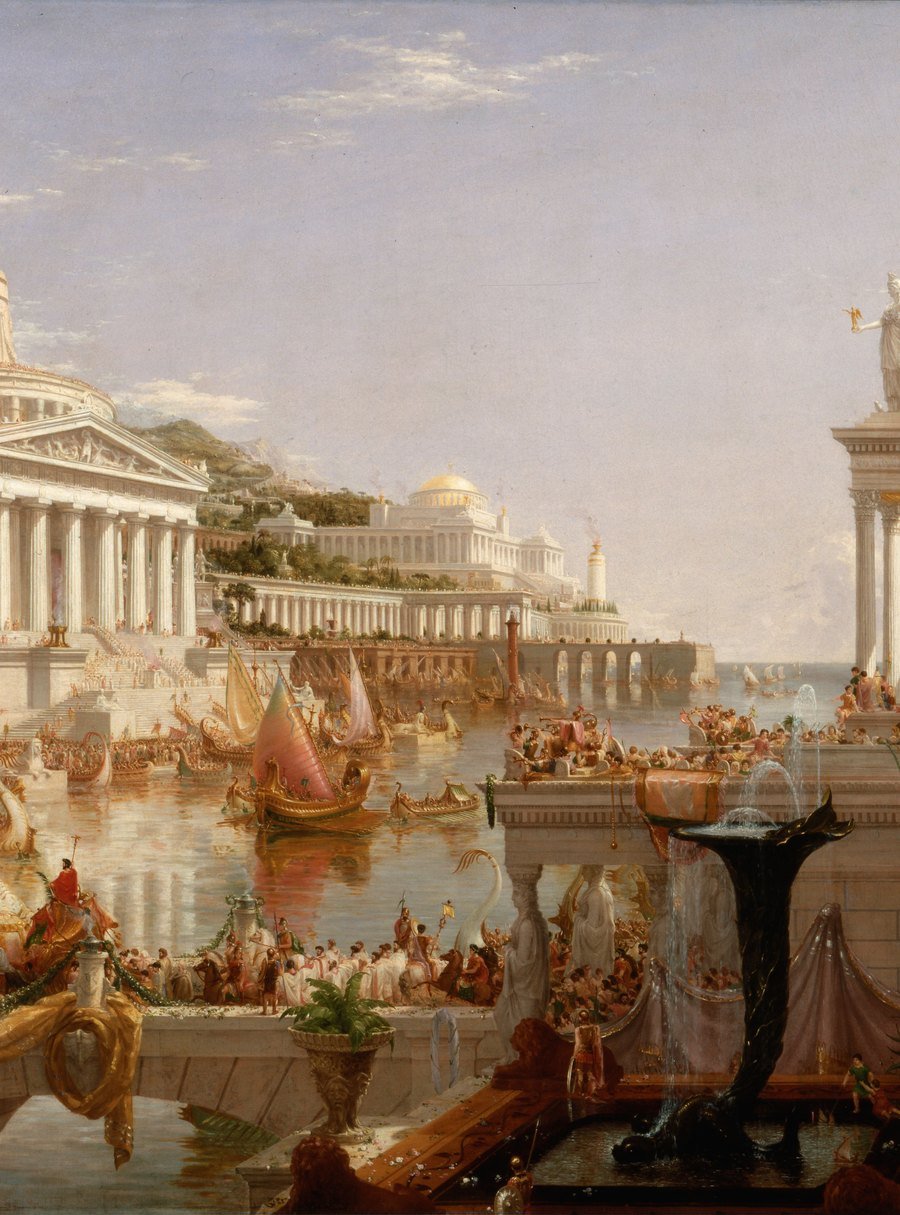
Critias
Poseidon falls in love with a mortal girl on a hill by the sea, and to keep her he cuts rings of water and land around the hill. Their eldest son is Atlas, and the island is named for him. Nine thousand years later, Zeus calls the gods together to punish his descendants, opens his mouth to speak, and the book ends.
Read it now
An excerpt, not the whole book: Poseidon's island (113b–114d) and the last page (120d–121c), in Plato's Attic Greek, word by word, with transliteration, in-context gloss, flowing English with the supplied words in brackets, the LSJ lexicon and deep notes. Citation ID: urn:cts:greekLit:tlg0059.tlg032.
❦ Read the Critias in GreekA taste of the format. Open the reader above to read all of Critias word by word.
About this book
Why read it
Plato's unfinished sequel to the Timaeus in the Attic Greek he wrote, one Stephanus section at a time: the Greek line, its pronunciation, the reading in bold, the literal sense beneath it, the flowing English, and a lexicon on every word.
The lore
Plato wrote the Critias around 360 BC as the second of three planned dialogues; the third would have belonged to Hermocrates, and there is no sign it was ever written. The Critias stops in the middle of a sentence, at the moment Zeus begins to speak. Every later picture of Atlantis, from Athanasius Kircher's map of 1665 to the novels and films, starts from these pages and the few in the Timaeus.
What’s juicy
Plato gives the island's first king the name Atlas and says the whole island and the Atlantic were named after him. His twin brother's Greek name is Eumelus, but in the island's own language, Plato says, he was Gadeirus, and his share, at the tip of the island facing the Pillars of Heracles, gave its name to the Gadeiric country, the land of Gadeira, which is the Greek name for Cádiz.
How it might change you
In English the description of Atlantis reads like a travel guide. Word by word you can see Plato building it like an architect, ring by ring, with numbers, and then letting the whole thing fall silent mid-sentence.
Core vocabulary
The words that carry the book. Learn these and most of the text opens up; each links, in the reader, to its full entry. Counts are how often the word appears.
- εἰμί to be20×
- πᾶς all14×
- γίγνομαι to become11×
- πολύς much10×
- θεός god8×
- νῆσος island8×
- ὄνομα name6×
- τότε then6×
- γῆ earth6×
- λέγω to say5×
- τόπος place5×
- μέσος middle5×
- βασιλεύς king5×
- ἀρχή beginning4×
- λῆξις allotment, lot, share by lot4×
- πρέσβυς old, aged, venerable4×
- πρότερος former4×
- ὅσος as many as4×
- οἷος such as3×
- ἔχω to have3×
- πρόσθεν before, in front, ahead3×
- μέγας great3×
- κατασκευάζω furnish, equip, prepare, provide3×
- ἔκγονος born of3×
- γεννάω to beget, bring forth, give birth to3×
- θάλαττα the sea3×
- πεδίον a plain, flat open country, level field3×
- ἀρετή excellence3×
- πάντῃ everywhere, on every side3×
- χώρα room, space, place3×
- γενεά generation, age of a man, descent3×
- τίμιος honoured, held in honour, valued3×
- γένος race3×
- καθοράω to behold3×
Read our finished collection · the library · The Great Library Project
Reading is always free. Patrons and founders are the ones who keep it that way.