De Materia Medica
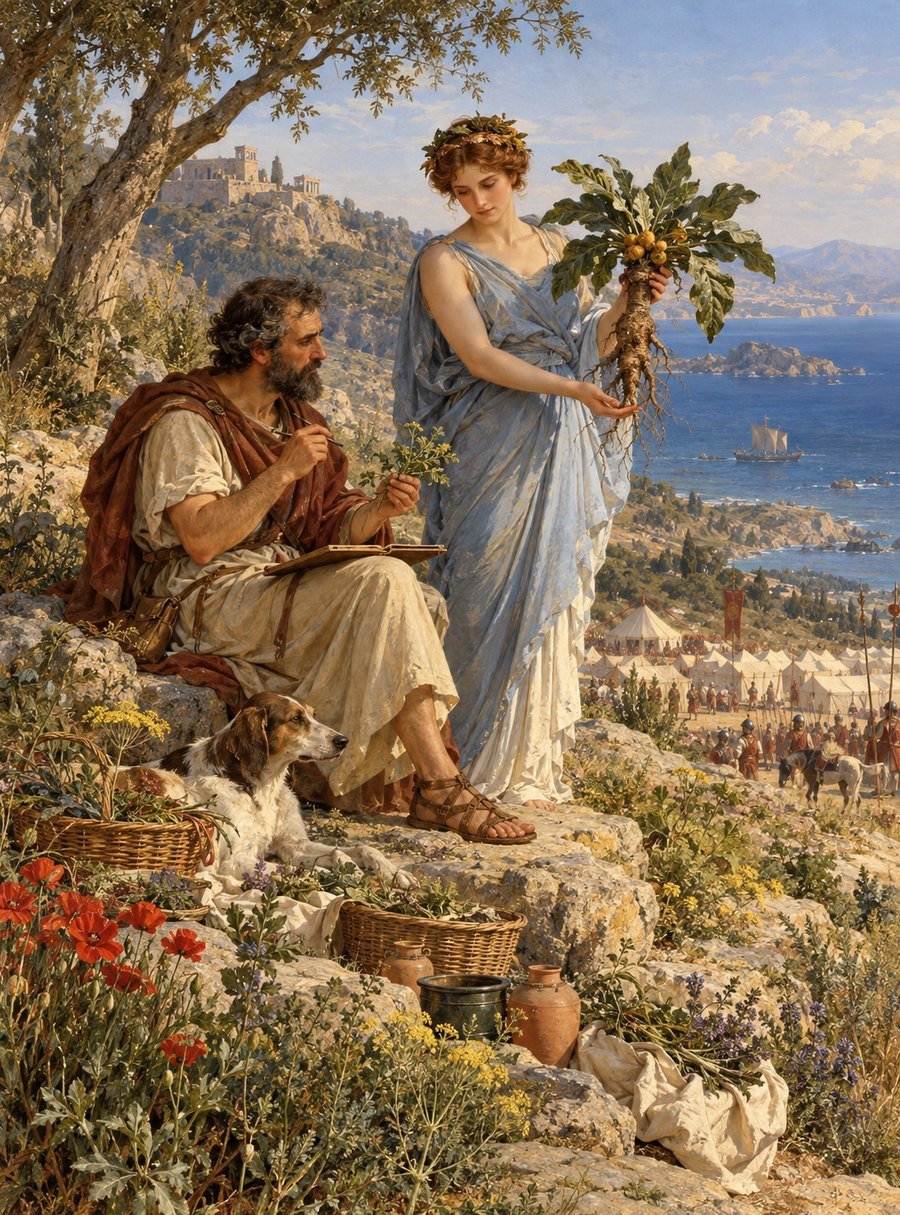
Six hundred plants and what ancient doctors did with each one. Its mandrake entry describes a sleeping wine given to patients before surgery, and warns that a bigger cup kills.
and use one cup for the sleepless and those in great pain,
and for patients about to be cut or cauterized whom they wish to make insensible.
Press this book. Your gift commissions the Great Library’s word-by-word interlinear De Materia Medica — and the day it is made, it is free for everyone, forever. You are not buying a copy; you are paying for it to exist.
Press this book
Give what you like — a few dollars helps, or fund the whole of Book 4: the mandrake and become its Founder. Every contribution presses it closer to real.
About this book
Why read it
Five books on the medicines of the ancient world: about six hundred plants, along with animal parts, minerals, wines and oils. For each one Dioscorides says what it looks like, where it grows, how to gather and keep it, and what doctors used it for. For the next fifteen hundred years, doctors from Constantinople to Baghdad to Renaissance Italy learned their drugs from this book. It is being pressed now. The mandrake entry is in the reader already, word by word, read as history. Support it and the rest opens sooner.
The lore
Pedanius Dioscorides came from Anazarbus, in Cilicia, in what is now southern Turkey. In his preface he says he lived a soldier's life, and he is usually taken to have served as a doctor with the Roman army, which would explain how he came to see so many plants in so many places. He wrote in Greek around AD 60 to 70, in the reign of Nero. The most famous copy, the Vienna Dioscorides, was painted for the princess Anicia Juliana in Constantinople around AD 512 and is still in Vienna. Our Greek text is Max Wellmann's edition, published in Berlin between 1906 and 1914.
What’s juicy
The mandrake entry (Book 4, chapter 75) is the one people remember. Some called the plant Circaea, after Circe the witch, because the root was thought to make love potions. Doctors boiled the root in wine and gave a cup to patients who were about to be cut or cauterized, and Dioscorides writes that they felt no pain, because they were carried off into sleep. In the same entry he warns that a larger dose kills. Mandrake is a poisonous plant. This book is a record of what ancient doctors believed and did, and nothing in it should be tried at home.
Why pressing it matters
Making an interlinear De Materia Medica is real work — freezing a scholarly source text, aligning every word to its dictionary form, glossing what resists translation, and proofing it all to a hard quality bar. Pressing a book is how that work gets funded. When enough readers press it, Book 4: the mandrake gets made — and then it is free to read forever, for you and for everyone who comes after.
This isn’t a purchase. It’s a commission. You’re not buying a copy — you’re paying for the thing to exist, and putting your name (if you like) on the first true De Materia Medica that anyone can read for free.
Not ready to give? Follow it.
Leave your email and we’ll write to you the day the De Materia Medica opens — no other mail, ever.
Read our finished collection · the library · The Great Library Project
Reading is always free. Patrons and founders are the ones who keep it that way.