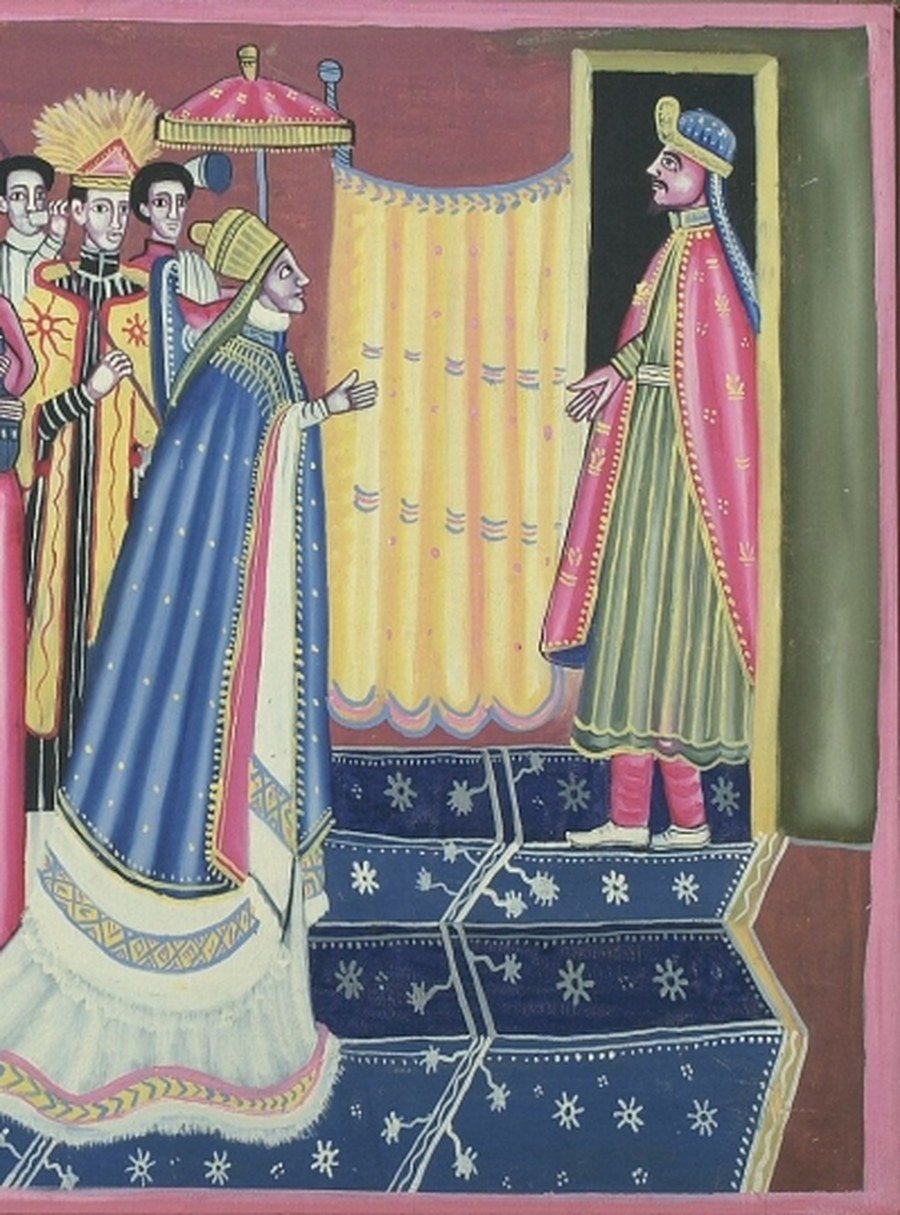
The Kebra Nagast
The Bible's queen of the South, the book says, was the queen of Ethiopia. She visits Solomon, goes home carrying his son, and that son brings the Ark of the Covenant to Aksum.
And where it says “queen of the South”, she is the queen of Ethiopia.

Press this book. Your gift commissions the Great Library’s word-by-word interlinear The Kebra Nagast, and the day it is made, it is free for everyone, forever. You are not buying a copy; you are paying for it to exist.
Press this book
Give what you like. A few dollars helps, or fund the whole of Solomon and the Queen of Sheba and become its Founder. Every contribution presses it closer to real.
About this book
Why read it
The Kebra Nagast, 'the Glory of the Kings', tells how the queen of Ethiopia, Makeda, travels to Jerusalem to learn from Solomon's wisdom. She goes home pregnant. Their son Menelik grows up, visits his father, and returns to Ethiopia with the Ark of the Covenant, which the book says never went back. The press starts with the queen's story, in Ge'ez, the classical language of Ethiopia, word by word. Nothing is readable here yet beyond the taste below; support it and it will be.
The lore
It was put into its present form in the early 14th century, when Ethiopia's new Solomonic dynasty needed a founding story, and it drew on far older traditions. For seven centuries it underwrote the claim that Ethiopia's emperors descended from Solomon and Sheba, down to Haile Selassie, the 'Lion of Judah', deposed in 1974. Selassie was a devout Ethiopian Orthodox Christian and never claimed to be divine; the Rastafari movement that honours him reads this book as its own history.
What’s juicy
The Ethiopian church still says the Ark rests in a chapel at Aksum, seen by one guardian monk only. The Kebra Nagast is the book that put it there.
Why pressing it matters
Making an interlinear The Kebra Nagast is real work: freezing a scholarly source text, aligning every word to its dictionary form, glossing what resists translation, and proofing it all to a hard quality bar. Pressing a book is how that work gets funded. When enough readers press it, Solomon and the Queen of Sheba gets made, and then it is free to read forever, for you and for everyone who comes after.
This isn’t a purchase. It’s a commission. You’re not buying a copy; you’re paying for the thing to exist, and putting your name (if you like) on the first true The Kebra Nagast that anyone can read for free.
Not ready to give? Follow it.
Leave your email and we’ll write to you the day the The Kebra Nagast opens. No other mail, ever.
Read our finished collection · the library · The Great Library Project
Reading is always free. Patrons and founders are the ones who keep it that way.