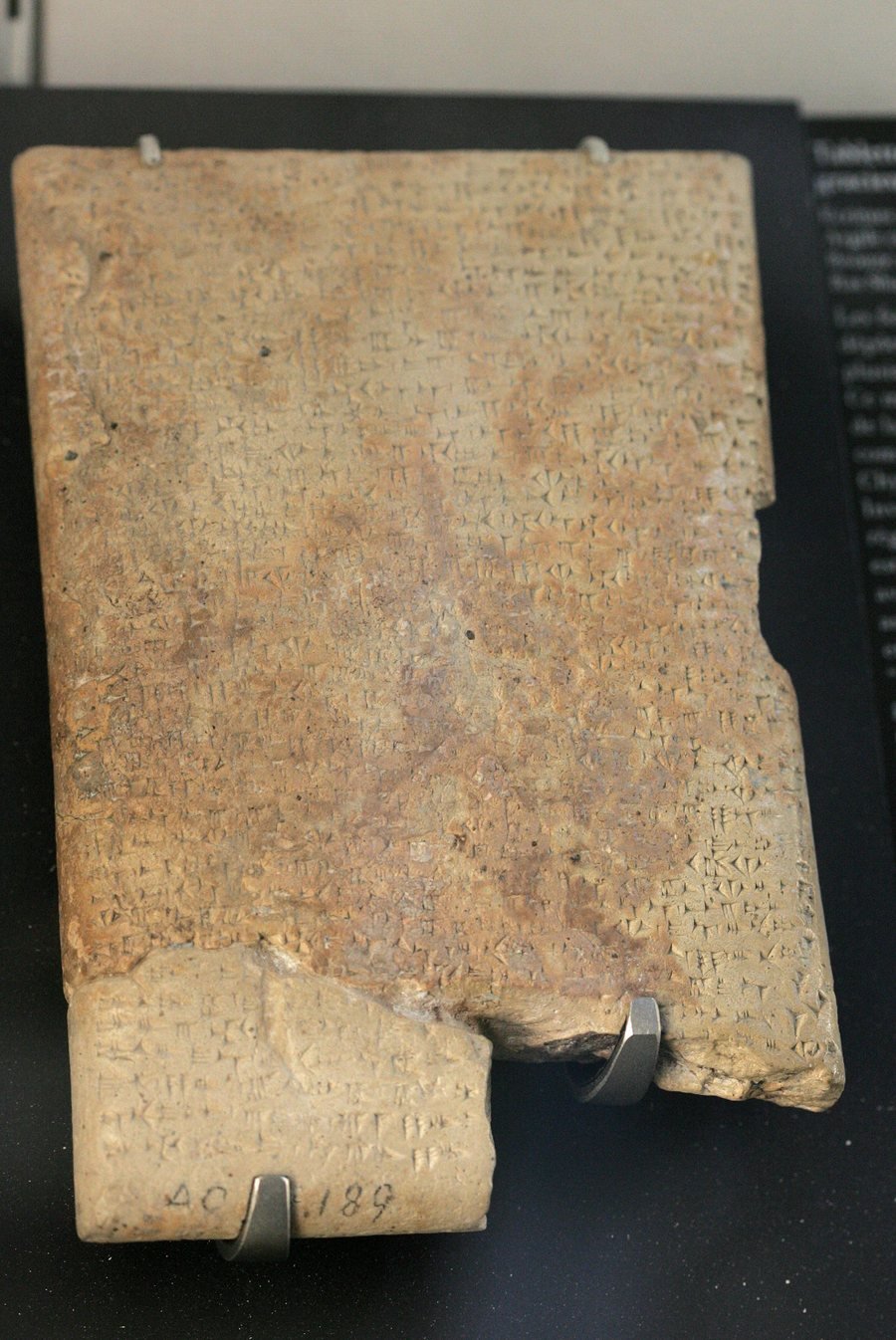
The Birth of the Gracious Gods
Old El goes down to the shore of the sea and meets two women. They bear him two sons, Dawn and Dusk, gods so hungry that one lip touches the earth and the other the sky.
Press this book. Your gift commissions the Great Library’s word-by-word interlinear The Birth of the Gracious Gods, and the day it is made, it is free for everyone, forever. You are not buying a copy; you are paying for it to exist.
Press this book
Give what you like. A few dollars helps, or fund the whole of KTU 1.23 and become its Founder. Every contribution presses it closer to real.
Card, Apple Pay or Google Pay, by secure Stripe checkout. More ways to give
This is how every Great Library book reads, word beneath word. The Birth of the Gracious Gods’s own first lines appear here the day its pilot is pressed.
About this book
Why read it
KTU 1.23 is a ritual and a myth written on one clay tablet. The front is a liturgy: the poet calls on the gracious gods, the priests sing over bread and wine, a vine is pruned and bound, and the field of the gods is named again and again. The back tells the story the ritual points to: El at the seashore, two women, and the birth of Dawn and Dusk, who are sent into the desert for seven years until a farmer lets them in to eat. The press starts with the front, the face in the Louvre’s free photographs.
The lore
The tablet was found at Ugarit, a port on the Syrian coast, in the second season of the French excavations, 1930, and Charles Virolleaud published it in the journal Syria in 1933. Its lines are divided by ruled lines into sections, with notes for the singers, so scholars have long read it as the script of a rite, perhaps for the new wine.
What’s juicy
Isaiah 14:12 mocks a fallen king as “Helel son of Shachar”, the shining one, son of the dawn. Jerome put it into Latin as Lucifer. The dawn god behind that verse is born on this tablet.
Core vocabulary
The words that carry the book. Learn these and most of the text opens up; each links, in the reader, to its full entry. Counts are how often the word appears.
- il El5×
- šd field5×
- ʿrb enter4×
- šbʿ seven4×
- nʿm gracious, pleasant3×
- šlm ⁚ 1.23-a peace3×
- gpn vine3×
- aṯrt Athirat3×
- rḥm Rahmay3×
Why pressing it matters
Making an interlinear The Birth of the Gracious Gods is real work: freezing a scholarly source text, aligning every word to its dictionary form, glossing what resists translation, and proofing it all to a hard quality bar. Pressing a book is how that work gets funded. When enough readers press it, KTU 1.23 gets made, and then it is free to read forever, for you and for everyone who comes after.
This isn’t a purchase. It’s a commission. You’re not buying a copy; you’re paying for the thing to exist, and putting your name (if you like) on the first true The Birth of the Gracious Gods that anyone can read for free.
Not ready to give? Follow it.
Leave your email and we’ll write to you the day the The Birth of the Gracious Gods opens. No other mail, ever.
Read our finished collection · the library · The Great Library Project
Reading is always free. Patrons and founders are the ones who keep it that way.