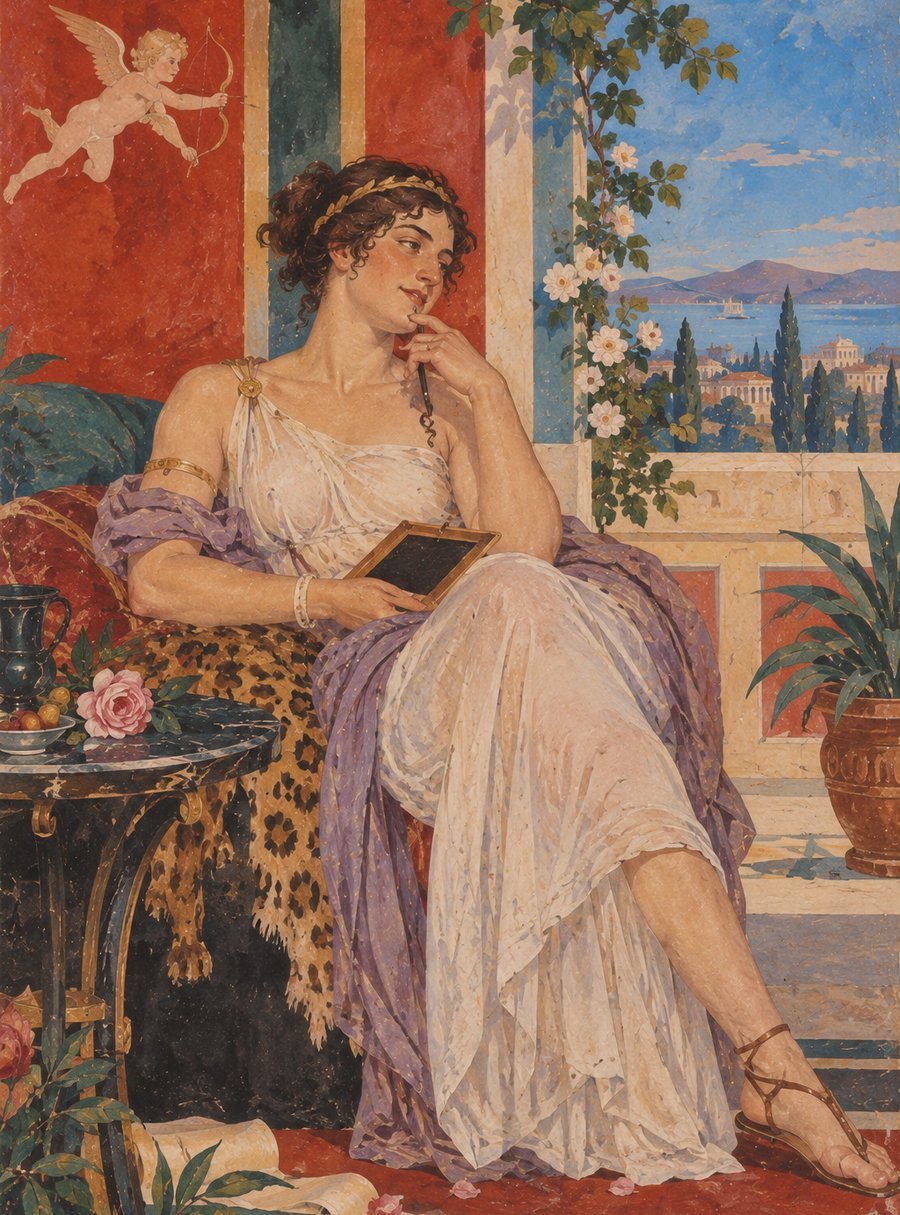
The Six Elegies
The only surviving love poetry by a woman in all of Latin. “At last love has come,” she begins — and says that hiding it would shame her more than telling.
Read it now
All six elegies — complete. The original Latin, a word-by-word gloss, fluent English, and a clickable dictionary, in four reading stages.
❦ Read Sulpicia's elegiesA taste of the format. Open the reader above to read all of The Six Elegies word by word.
About this book
Why read it
Two thousand years ago a young Roman woman wrote six poems about being in love — and against every odd, they survived. This is the only love poetry by a woman that Latin literature kept. You are holding her actual words.
The lore
She was Sulpicia, niece of Messalla — one of the richest, most powerful patrons of the age, the man Tibullus and Ovid wrote for. She had the education and the standing to write, and she wrote about Cerinthus: the birthday her guardian nearly ruined by hauling her off to the country, the fever that frightened her, the rival who stung her pride, the night she left him and wished she had not. Six small poems, forty lines, tucked for centuries into another man's book — where scholars kept half-assuming a woman could not have written them.
What’s juicy
She opens by throwing out the rulebook: love has come, she says, and the only shame would be in hiding it. Elsewhere she tells the most powerful man in her world to be quiet; she sneers at a wool-working rival as beneath “Servius's daughter”; she admits she would not even fight to survive an illness unless she thought he wanted her to. And she ends the whole book apologizing — not for wanting him, but for once pretending she did not.
How it might change you
Read her word by word, in her own Latin, and she stops being a footnote and becomes a person — funny, proud, wounded, entirely alive. There were surely thousands of women like her who wrote. This is one whose voice made it through — her I, two thousand years on, still saying exactly what she meant.
Read our finished collection · the library · The Great Library Project
Reading is always free. Patrons and founders are the ones who keep it that way.