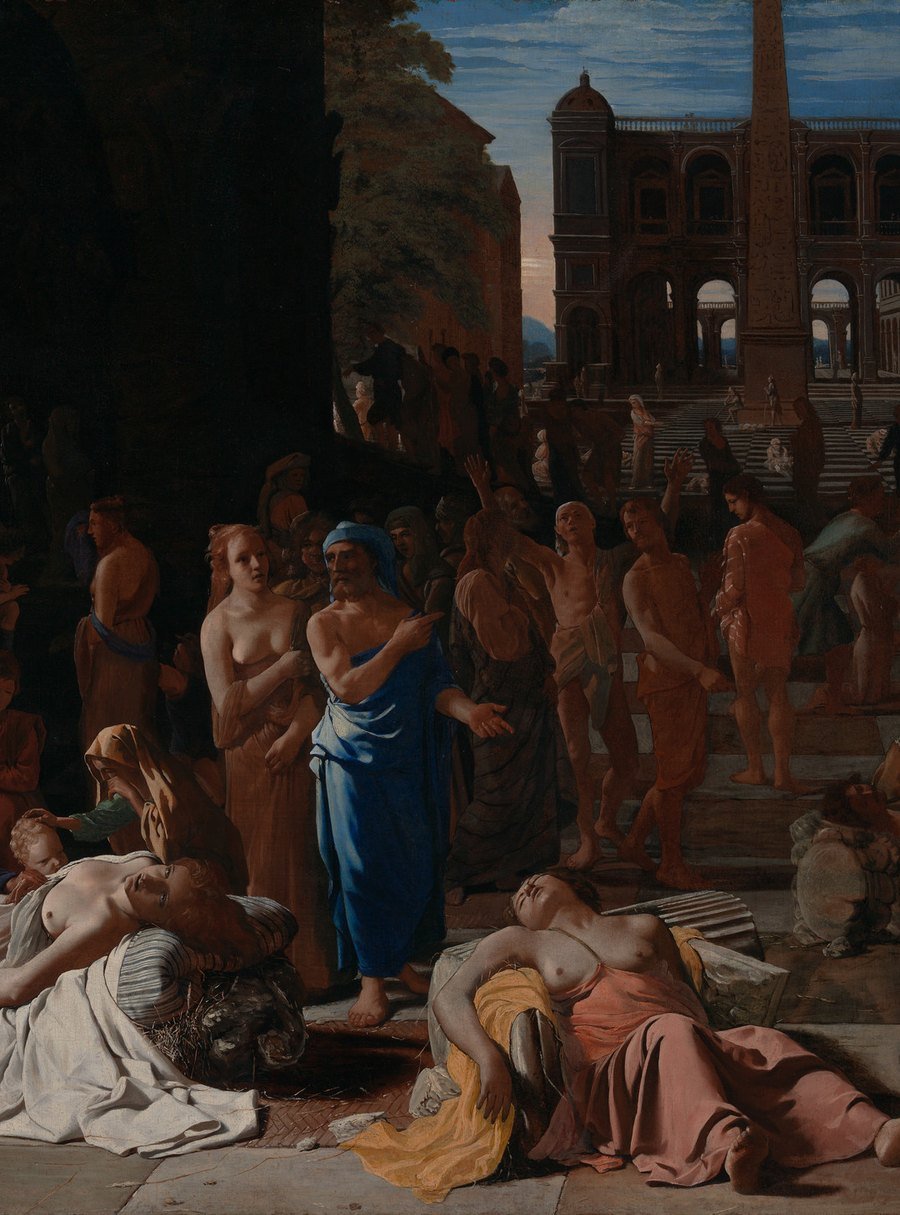
History of the Peloponnesian War
An Athenian general who lost a battle and was exiled for twenty years spent them writing the war that ruined his city. In its second year a plague came into Athens through the harbour. He caught it, lived, and wrote down what it did.
Read it now
Beta: the opening (1.1) and the plague of Athens (2.47–2.54), in Thucydides' Attic Greek, word by word, with transliteration, in-context gloss, flowing English with the supplied words in brackets, the LSJ lexicon, the medical senses of the symptom words, and the plates. Pericles' funeral oration (2.34–2.46) comes next. Citation ID: urn:cts:greekLit:tlg0003.tlg001.
❦ Read Thucydides in GreekA taste of the format. Open the reader above to read all of History of the Peloponnesian War word by word.
About this book
Why read it
Thucydides' history in the Attic Greek he wrote, one section at a time: the Greek line, its pronunciation, the reading in bold, the literal sense beneath it, the flowing English, and a lexicon on every word.
The lore
Thucydides called his book a possession for all time, not a piece written to win applause for a single hearing (1.22). He wrote it after Athens had exiled him, and he spent the exile gathering accounts from both sides. Thomas Hobbes's first published book was an English translation of it, made straight from the Greek in 1629. Historians still argue about the speeches he puts in his generals' mouths, which he admits are what each man would most likely have said.
What’s juicy
At the end of the plague he records an old verse the elders remembered: a Dorian war will come, and a loimos with it. Loimos is plague. Some said the verse had really said limos, famine, a difference of one letter. Thucydides says people shape their memories to what they are suffering, and that if another Dorian war ever comes with a famine, they will sing it the other way.
How it might change you
In English the plague reads like a report. Word by word you can hear the doctors' vocabulary he chose, the words for the fever, the blisters and the crisis on the seventh day, and you can see how much of each sentence he leaves for the reader to supply.
Core vocabulary
The words that carry the book. Learn these and most of the text opens up; each links, in the reader, to its full entry. Counts are how often the word appears.
- εἰμί to be24×
- πολύς much21×
- γίγνομαι to become20×
- πᾶς all14×
- ἄνθρωπος human being10×
- λέγω to say9×
- πρῶτος first9×
- ἄρχω to rule7×
- εὐθύς straight7×
- θνήσκω die7×
- μέγας great6×
- μάλα very6×
- κακός bad6×
- ἔχω to have6×
- διαφθείρω to corrupt6×
- Ἀθηναῖος Athenian5×
- πόλεμος war5×
- ὁράω sees5×
- χρόνος time5×
- νόσος disease, sickness, plague5×
- ὅσος as many as5×
- ἤδη already5×
- ὅστις whoever5×
- σῶμα body5×
- Πελοποννήσιος a Peloponnesian, an inhabitant of the Peloponnese4×
- καθίστημι to set in place4×
- τελευτάω to end4×
- λοιμός plague, pestilence4×
- θεραπεύω to serve4×
- πρόσειμι to belong to4×
- ἔπειτα then4×
- εἰκός likelihood4×
- ἰσχυρός strong4×
- ὅμοιος like4×
- νόσημα disease4×
- ἕτερος other4×
- πολεμέω to make war, wage war, fight3×
- ἔτι still3×
- νομίζω to consider3×
- ἔτος year3×
Read our finished collection · the library · The Great Library Project
Reading is always free. Patrons and founders are the ones who keep it that way.