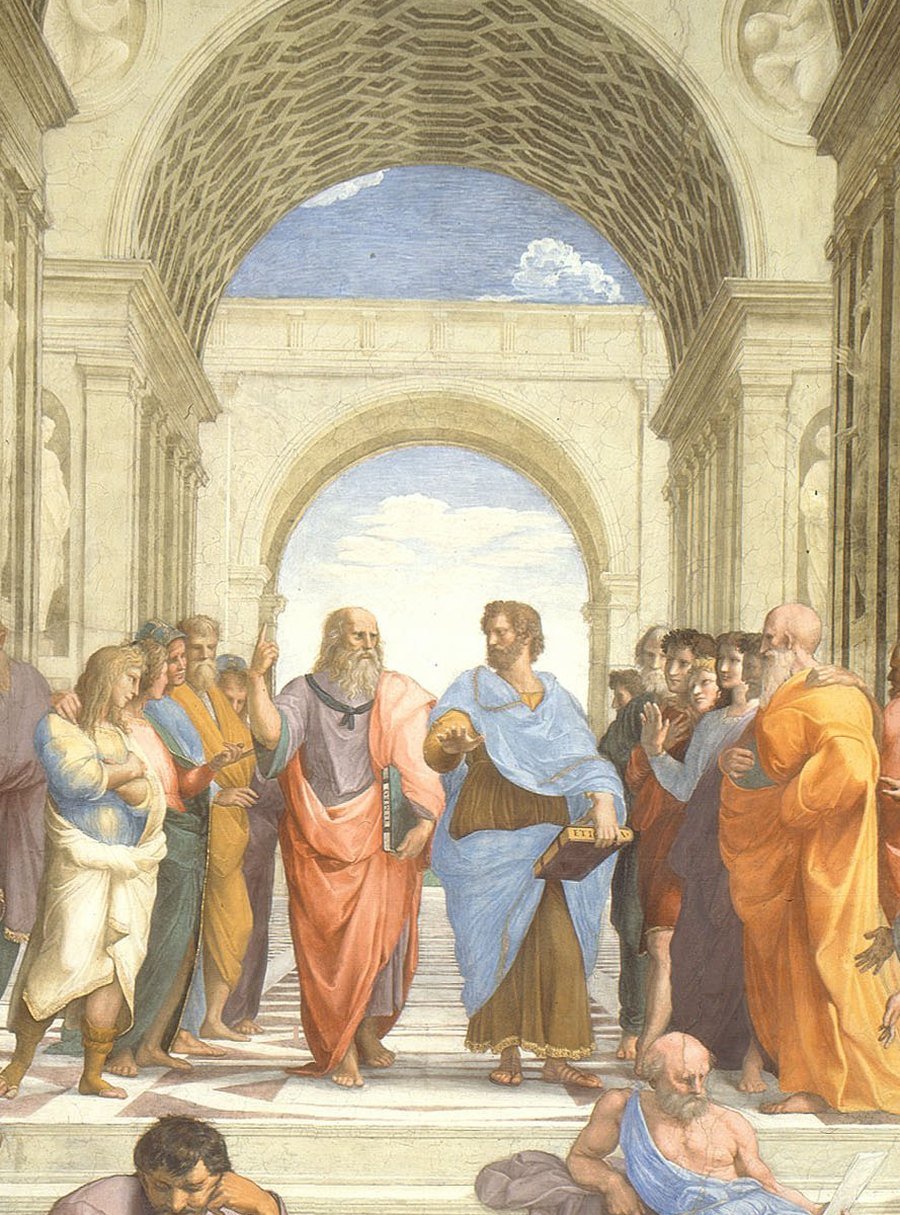
Timaeus
An Egyptian priest tells the wisest man in Athens that the Greeks are children with no old stories, because floods keep wiping out their memory. Then he tells him one: an island beyond the Pillars of Heracles, a war with Athens, and a single day and night in which the island sank into the sea.
Read it now
Beta: the opening (17a–17b) and the whole Atlantis account (20c–25d), in Plato's Attic Greek, word by word, with transliteration, in-context gloss, flowing English with the supplied words in brackets, the LSJ lexicon, deep notes on the loaded words, maps and plates. The Critias' fuller Atlantis comes next. Citation ID: urn:cts:greekLit:tlg0059.tlg031.
❦ Read the Timaeus in GreekA taste of the format. Open the reader above to read all of Timaeus word by word.
About this book
Why read it
Plato's dialogue in the Attic Greek he wrote, one Stephanus section at a time: the Greek line, its pronunciation, the reading in bold, the literal sense beneath it, the flowing English, and a lexicon on every word.
The lore
Plato wrote the Timaeus around 360 BC, one of his last works. Cicero translated part of it into Latin, and Calcidius translated the first half in the fourth century AD with a long commentary; through the Middle Ages that half was most of what the Latin West knew of Plato. Plutarch says Solon really did begin a poem about Atlantis and gave it up, and that Plato tried to finish it.
What’s juicy
The first commentator on the Timaeus, Crantor, was said to have taken the Atlantis story as plain history, and Proclus reports that Egyptian priests told Crantor it was written on pillars that still stood. Proclus never says Crantor saw them. Strabo, three centuries after Plato, records the geographer Posidonius suggesting the story might not be a fiction.
How it might change you
In English the story sounds like a legend told by a campfire. Word by word you can hear how carefully Critias builds his chain of witnesses, and how the priest's word for the Greeks, paides, is the word for small children.
Core vocabulary
The words that carry the book. Learn these and most of the text opens up; each links, in the reader, to its full entry. Counts are how often the word appears.
- εἰμί to be38×
- λέγω to say27×
- πᾶς all25×
- γίγνομαι to become16×
- ὅσος as many as13×
- Σόλων Solon, the Athenian lawgiver and poet13×
- πόλις city13×
- πολύς much12×
- τότε then11×
- παλαιός old, ancient10×
- φημί to say10×
- λόγος word9×
- μέγας great9×
- νῆσος island9×
- νῦν now8×
- χρόνος time8×
- θεός god8×
- τῇδε here8×
- εἷς one7×
- Κριτίας Critias, the speaker who will tell the story of the ancient war7×
- γῆ earth7×
- τόπος place7×
- ἔργον work, task, deed6×
- βραχύς short, brief6×
- ἄνθρωπος human being6×
- ἔτος year6×
- φέρω to carry6×
- πρῶτος first6×
- ἔχω to have6×
- δύναμις power5×
- ἔτι still5×
- ἀκοή hearing5×
- φθορά destruction, ruin, death5×
- παῖς child5×
- ἱερεύς priest5×
- γένος race5×
- ἅπας all5×
- νόμος law5×
- Σωκράτης Socrates, the Athenian philosopher4×
- μᾶλλον more4×
Read our finished collection · the library · The Great Library Project
Reading is always free. Patrons and founders are the ones who keep it that way.