In the spring of 1928 a farmer ploughing near the Syrian coast, at a place called Minet el-Beida, broke into a stone tomb. The French sent an archaeologist, Claude Schaeffer, and on the mound of Ras Shamra nearby he found a city that had burned around 1185 BC and a library of clay tablets written in an alphabet nobody had seen. It was deciphered within a year. The city was Ugarit, and its poems named gods every reader of the Bible already knew: El, Baal, Asherah, and a sea serpent called Lotan.
This page reads four of the oldest texts on our shelves beside the Bible: the Baal Cycle and the birth of Dawn and Dusk from Ugarit, written down a few centuries before the oldest books of the Bible; and two poems from Sumer, a thousand years older again, Enheduanna's hymn to Inanna and Inanna's descent to the dead. All four are complete on the shelf, and every excerpt opens into its book.
It begins with a storm god and the sea.
The storm and the sea

Baal is the storm, the god of the rain that the farms of the Levant lived on. His enemy is Yam, the Sea, also called Judge River, who has been given kingship by El, the old father of the gods. The craftsman god Kothar makes Baal two clubs and names them, and the second one does the work.
Yagrush, drive Yam, drive Yam from his throne…
Kothar brings down two clubs, and Hasis proclaims their names: “Your name is Yagrush. Yagrush, drive Yam, drive Yam from his throne… the story goes on in the book ›
All six tablets are on the shelf, gaps and all, from the quarrel with the Sea to the last fight with Death.
and fall to the earth!” The club swoops from Baal’s hand like…
The club flies like a falcon. The Sea is a person, with a skull and joints that give way.
and fall to the earth!” The club swoops from Baal’s hand like a falcon from his fingers; it strikes the skull of Prince Yam, between the eyes of Judge River. Yam collapses, he falls to the earth; his joints shake, and his frame gives way… the story goes on in the book ›
Mighty Baal is ashamed of him, and… “Yam…
Mighty Baal is ashamed of him, and… “Yam is surely dead! Baal shall be king!”… the story goes on in the book ›
Read the Psalms after this and the sea is everywhere, and so is a god who beats it. The Hebrew word for sea is the same word, yam.
“The floods have lifted up, O LORD, the floods have lifted up their voice; the floods lift up their waves. The LORD on high is mightier than the noise of many waters, yea, than the mighty waves of the sea.” (Psalm 93:3–4, King James Version)
Athtart's rebuke gives Baal a title, Rider of the Clouds. The Bible gives it to its own God: "the LORD rideth upon a swift cloud" (Isaiah 19:1), "who maketh the clouds his chariot" (Psalm 104:3).
Shame, O Rider of the Clouds…
“Shame, O Rider of the Clouds! For Prince Yam is our captive, Judge River is our captive.” And he goes out…… the story goes on in the book ›
Lotan, the fleeing serpent
Behind the Sea there is a monster. Anat, Baal's sister, boasts that she has killed it, and later Death taunts Baal with the same deed. Its name is Lotan, and it has seven heads.
Did I not muzzle Tunnan…
of El, Yam? Did I not finish off Nahar, the great god? Did I not muzzle Tunnan? I destroyed him. I smote the twisting serpent, the tyrant with seven heads… the story goes on in the book ›
When you smote Lotan, the fleeing serpent, and finished off the twisting serpent, the mighty one with seven heads, the heavens will wilt and droop…
When you smote Lotan, the fleeing serpent, and finished off the twisting serpent, the mighty one with seven heads, the heavens will wilt and droop like the loops… the story goes on in the book ›
In Hebrew the name is Leviathan. When Isaiah describes the end of days, he uses the Ugaritic phrases nearly word for word: in both languages the beast is the fleeing serpent and the twisting serpent, and beside it stands Tunnan, the Hebrew tannin, the dragon.
“In that day the LORD with his sore and great and strong sword shall punish leviathan the piercing serpent, even leviathan that crooked serpent; and he shall slay the dragon that is in the sea.” (Isaiah 27:1, King James Version)
“Thou didst divide the sea by thy strength: thou brakest the heads of the dragons in the waters. Thou brakest the heads of leviathan in pieces.” (Psalm 74:13–14, King James Version)
The voice in the clouds

Baal wins a palace, and after a long argument with its builder he lets it have a window. Through the window, a rift in the clouds, he speaks, and the earth shakes. The tablet is broken here, but the voice comes through.
His holy voice … Baal … gives…
His holy voice … Baal … gives; Baal repeats the utterance … of his lips. His voice … shakes the earth; the utterance … of his lips, the mountains …… the story goes on in the book ›
Psalm 29 sounds the same note seven times. Frank Moore Cross, in Canaanite Myth and Hebrew Epic (1973), was one of many scholars to read it as an old Canaanite storm hymn taken over for Israel's God. Others see the Psalm answering Baal on his own ground: the voice is real, and it belongs to someone else.
“The voice of the LORD is upon the waters: the God of glory thundereth: the LORD is upon many waters. The voice of the LORD is powerful; the voice of the LORD is full of majesty. The voice of the LORD breaketh the cedars.” (Psalm 29:3–5, King James Version)
Death swallows the storm
Then Baal meets an enemy he cannot club. Mot, Death, opens his mouth.
a lip to the earth, a lip to the heavens…
… a lip to the earth, a lip to the heavens, and a tongue to the stars. Baal shall enter his innards, shall go down into his mouth like… the story goes on in the book ›
Baal goes down, and the rain goes with him. El hears that Baal is dead and comes down from his throne to sit in the dust. Anat goes looking for her brother, and when she finds Death she takes him apart like a harvest.
Mighty Baal is dead…
ground. Mighty Baal is dead, the Prince, lord of the earth, has perished.”… the story goes on in the book ›
Like the heart of a cow for her calf, like the heart of a ewe for her lamb…
Like the heart of a cow for her calf, like the heart of a ewe for her lamb, so is the heart of Anat for Baal. She seizes the son of El, Mot. With a blade… the story goes on in the book ›
she splits him…
she splits him; with a sieve she winnows him; with fire she burns him; with millstones she grinds him; in the field she sows him. His flesh they eat… the story goes on in the book ›
Then El has a dream. If Baal is alive, the sky will rain oil and the dry riverbeds will run with honey. They do.
the heavens rained oil, the wadis ran with honey…
the heavens rained oil, the wadis ran with honey… the story goes on in the book ›
for Mighty Baal is alive…
for Mighty Baal is alive, for the Prince, lord of the earth, is there… the story goes on in the book ›
Israel's prophet turns the image round. In Baal's story Death swallows the god. In Isaiah, God swallows Death.
“He will swallow up death in victory; and the Lord GOD will wipe away tears from off all faces.” (Isaiah 25:8, King James Version)
Dawn and Dusk
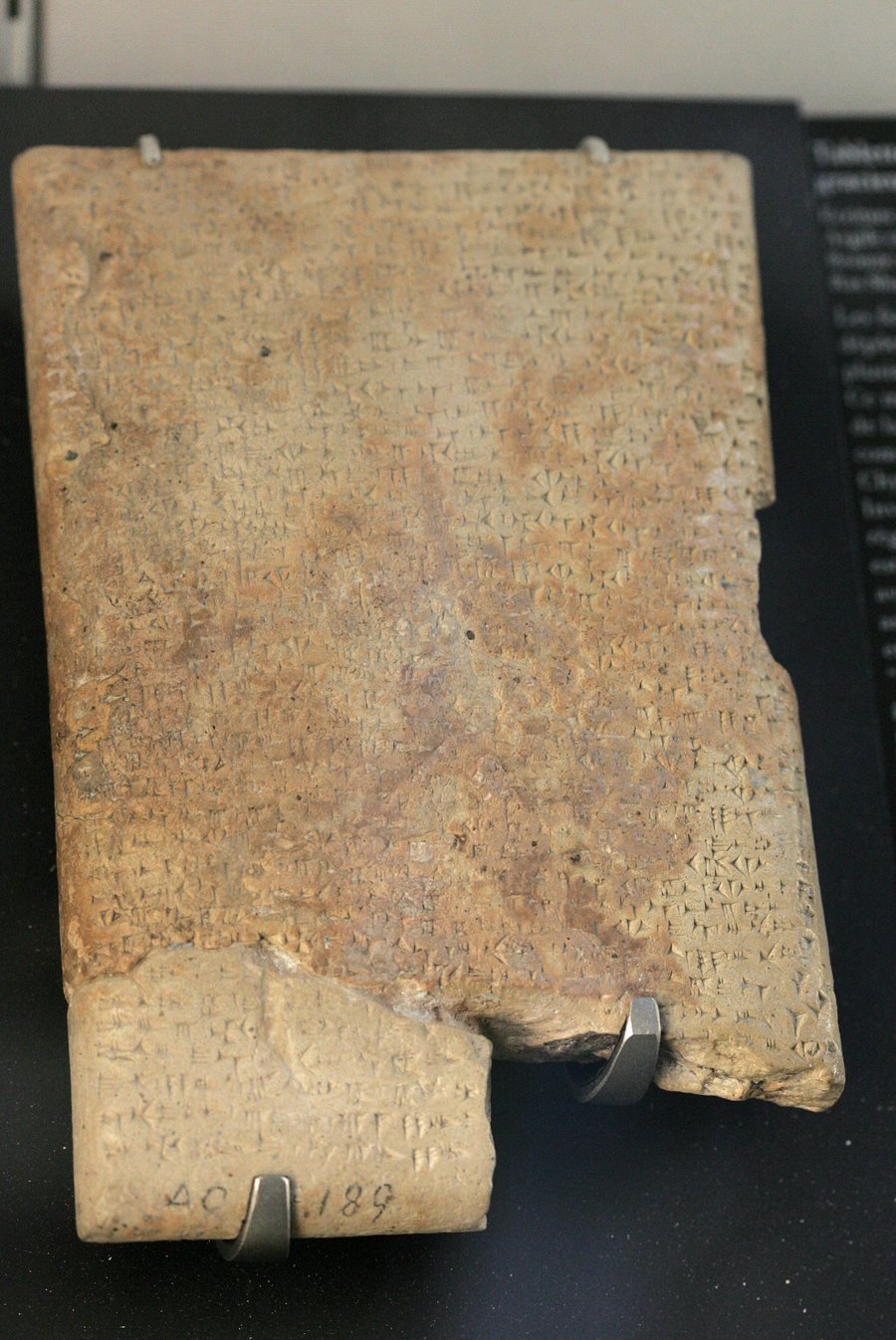
The second poem from Ugarit is a liturgy with a story in the middle. Old El walks by the sea, takes two women home, roasts a bird for them, and they give birth to two gods, Shachar and Shalim, Dawn and Dusk.
In kissing, conception…
In kissing, conception; in embracing, heat. They… give birth to Dawn and Dusk. Word is brought to El: “The wives… of El have given birth.” “What have they borne?” “Two children, Dawn and Shal…” Lift up, prepare an offering for Shapash the great, and for the stars fixed in place… the story goes on in the book ›
The whole tablet is on the shelf.
Shachar turns up in Isaiah, in the taunt over the fallen king of Babylon. The Hebrew calls him Helel ben Shachar, "shining one, son of Dawn". The Septuagint put it into Greek as ὁ ἑωσφόρος, the dawn-bringer, and Jerome's Latin as lucifer, the light-bringer. That is how a Canaanite morning star became the name of the devil. The name Jerusalem, Urusalim in Egyptian letters of the 14th century BC, may hold Shalim, the god of dusk.
“How art thou fallen from heaven, O Lucifer, son of the morning!” (Isaiah 14:12, King James Version)
The same tablet has an instruction for the rite: a kid cooked in milk. When it was first read in the 1930s, scholars took it as the Canaanite custom behind the strange law of Exodus 23:19, "Thou shalt not seethe a kid in his mother's milk". Later readings of the broken line made that much less certain, and the link is now doubted.
a good kid in milk…
And the field is the field of the gods, the field of Athirat (Asherah) and Rahmay. Over the fire, seven times, the lads… a good kid in milk, mint in butter… the story goes on in the book ›
The first author

Go back another thousand years, to Ur in southern Mesopotamia around 2300 BC. Sargon of Akkad had made the first empire, and he set his daughter Enheduanna in Ur as high priestess of the moon god Nanna. She wrote hymns, and she signed them. She is the first author in history whose name we know.
In the Exaltation of Inanna she praises the goddess of love and war as a storm that flattens mountains. Then the hymn turns. A rebel named Lugal-ane has taken the temple and driven her out, and she speaks in her own voice.
I entered my holy gipar, I, the high…
I entered my holy gipar, I, the high priestess, I, Enheduanna. I carried the ritual basket, I sang the song of joy… the story goes on in the book ›
All 154 lines are on the shelf, in Sumerian with the English under every word.
Must I die for my holy songs…
Must I die for my holy songs? As for me, my Nanna has not asked after me. He has wrecked me in a place of murder… the story goes on in the book ›
He made me fly from the window like a swallow…
He made me fly from the window like a swallow; my life is eaten away. He made me walk through the thorn bushes of the mountains. He tore from me the true crown of the high priestess. He gave me a dagger and a sword. These suit you, he said to me… the story goes on in the book ›
She ends with praise, and the goddess takes her back. The shape will be familiar to anyone who knows the Psalms: praise, then the complaint of someone wronged and abandoned, a plea, and praise again. Nobody claims the psalmists read her. Her hymns were copied in Mesopotamian schools for centuries after her death, and the form she used lasted.
The holy heart of Inanna has turned back to its place…
The powerful lady, respected in the assembly, accepted her offerings. The holy heart of Inanna has turned back to its place… the story goes on in the book ›
The goddess who went down

The last poem is Sumerian too, copied on tablets from Nippur around 1800 BC. Inanna decides to go down to the land of the dead, ruled by her sister Ereshkigal. At each of seven gates she has to give up one of her powers, a crown, a necklace, a ring, until she comes in naked.
From the great above she set her mind on the great below…
From the great above she set her mind on the great below. The goddess: from the great above she set her mind on the great below. Inanna: from the great above she set her mind on the great below… the story goes on in the book ›
The whole poem is on the shelf, from her setting out to the half-year sentence of Dumuzi.
someone took the pala robe, the garment of ladyship, from her body…
When she entered the seventh gate, someone took the pala robe, the garment of ladyship, from her body. “What is this?” “Hush, Inanna. A power of the underworld is being carried out. Inanna, do not open your mouth against the rites of the underworld.”… the story goes on in the book ›
The stricken woman was turned into a corpse, and someone hung…
The stricken woman was turned into a corpse, and someone hung the corpse on a hook… the story goes on in the book ›
After three days and three nights had passed…
After three days and three nights had passed, her minister Ninshubur paid heed to the word of her lady. She made for her a lament on the ruin mounds. She beat the drum in the assembly. She went round for her the houses of the gods… the story goes on in the book ›
Her servant Ninshubur goes from god to god, and the clever Enki makes two small creatures from the dirt under his fingernails and sends them down with the plant of life and the water of life.
They were given the corpse hanging from the hook…
They were given the corpse hanging from the hook. One sprinkled the plant of life on it, the other the water of life, and Inanna stood up… the story goes on in the book ›
Readers have noticed the three days and three nights, and the goddess who rises. Most scholars warn against reading the Gospels into a Sumerian poem two thousand years older, and the story has a price the Gospels do not: someone must take her place. Inanna gives up her husband, the shepherd Dumuzi, and in the end he and his sister share the sentence, half the year each.
You: half the year. Your sister: half the year…
[…] wept tears. She came to the sister and took him by the hand: “Now, alas, […] my […]. You: half the year. Your sister: half the year. The day you are demanded, on that day you shall stay. The day your sister is demanded, on that day you shall go free.”… the story goes on in the book ›
Dumuzi became Tammuz in the later languages of the region, and women were still mourning him in the time of Ezekiel, at the gate of the Temple in Jerusalem.
“Then he brought me to the door of the gate of the LORD'S house which was toward the north; and, behold, there sat women weeping for Tammuz.” (Ezekiel 8:14, King James Version)
What the Bible owes
Hebrew and Ugaritic are close cousins, both Canaanite languages, and the poets of Israel and of Ugarit shared a stock of words, pairs and pictures. El is the ordinary Hebrew word for God. Most scholars today, Mark S. Smith in The Early History of God (1990) among them, think Israel's God took on titles and deeds that belonged first to El and to Baal: the father enthroned among the gods, the rider of the clouds, the one who beats the sea. Mesopotamian stories reached the Bible too, the flood above all, along a longer road.
That is a historian's reading, and there are others. Jewish and Christian readers have long seen the Bible's use of these images as a polemic: the prophets take Baal's titles and Leviathan's heads to say that what the neighbours gave to many gods belongs to one. The Bible itself remembers the rivalry. Elijah's contest with the prophets of Baal on Mount Carmel is a contest over who sends the rain.
Ugarit · Aqhat and Kirta · about 1200 BCread the whole text › · help press it ›
The books that tell her story
 The Exaltation of InannaEnheduannaabout 2300 BC · Ur · the first named author100% printedRead the whole book ›
 The Descent of Inannathe poets of Sumercopied about 1800 BC · Sumer · the goddess goes down100% printedRead the whole book ›
 The Baal CycleUgarit · the scribe Ilimilkuabout 1200 BC · Ugarit · Baal, the Sea and Death100% printedRead the whole book ›
 The Birth of the Gracious GodsUgaritabout 1200 BC · Ugarit · Dawn and Dusk100% printedRead the whole book ›