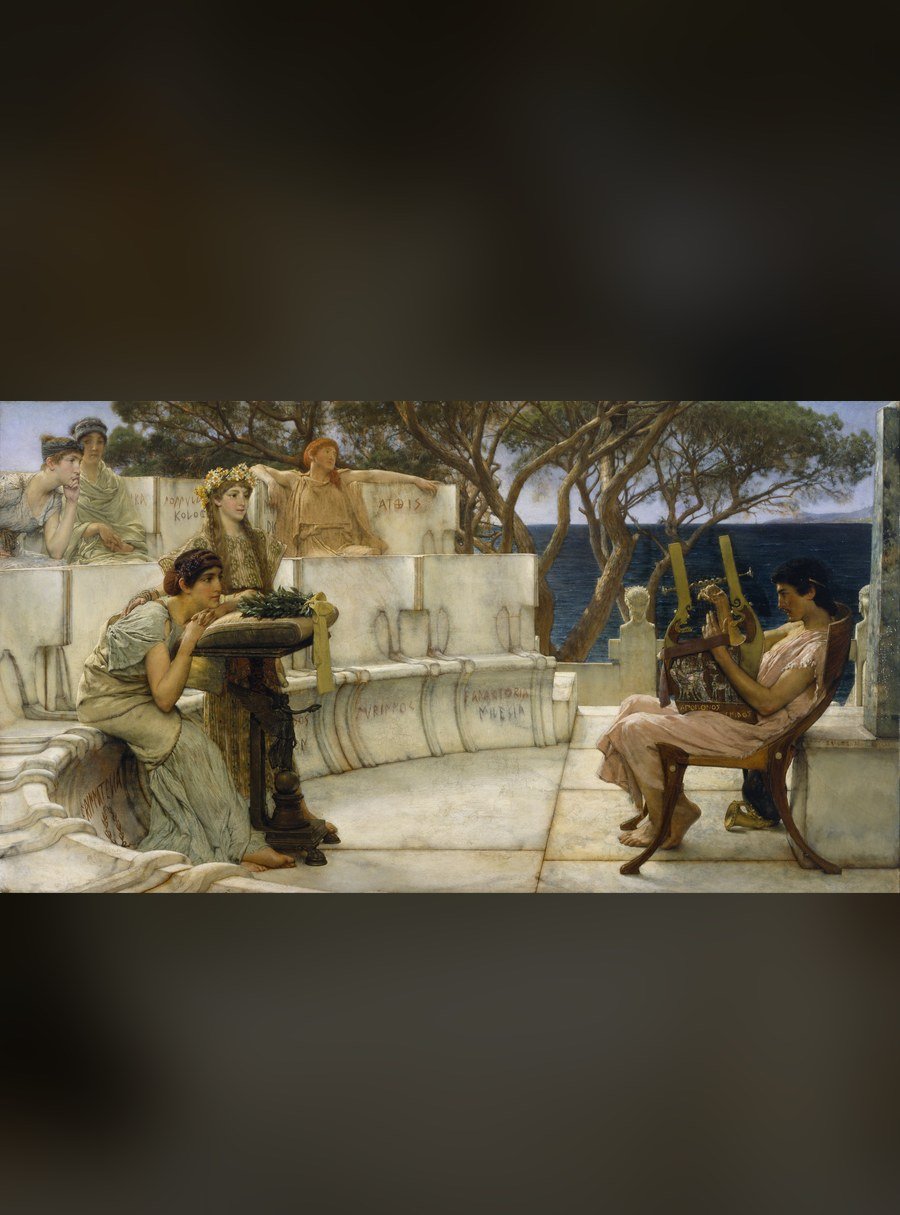
The Learned Banqueters
A dinner party in Rome around AD 200 where the guests have read everything and quote all of it. Book 13, in the Greek Athenaeus wrote, is their evening on love: famous courtesans and their jokes, the trial of Phryne, and Sophocles flirting with the boy who pours the wine.
Read it now
Beta: Book 13, on women and love, in Kaibel's Greek, word by word: the opening (555a–b), the whole story of Phryne (590d–591f), and the talk of love between men and boys with the two Sophocles stories (601a–604f). Transliteration, in-context gloss, flowing English with the supplied words in brackets, the LSJ entry on every word, joke notes and plates. More of Book 13 comes next, in order. Citation ID: urn:cts:greekLit:tlg0008.tlg001.
❦ Read Athenaeus in GreekA taste of the format. Open the reader above to read all of The Learned Banqueters word by word.
About this book
Why read it
Book 13 of Athenaeus' Learned Banqueters in the Greek he wrote, one page of Casaubon's 1597 edition at a time: the Greek line, its pronunciation, the reading in bold, the literal sense beneath it, the fluent English, and a lexicon with the real LSJ entry on every word. This is an excerpt, not the whole book: the opening of Book 13, the whole story of Phryne and the Sophocles stories, with more of Book 13 on its way.
The lore
Athenaeus came from Naucratis, a Greek town in the Nile delta, and wrote in Greek in Rome around AD 200. His fifteen books retell, for a friend called Timocrates, the talk at a run of dinners in the house of Larensis, a rich Roman who collected books. The guests are scholars, lawyers, doctors and one rude Cynic philosopher, and every dish that comes to the table sets them quoting. They quote hundreds of earlier writers, and for many of those writers the quotations are all we have. The full text comes down to us in a single manuscript of the 10th century, now in Venice.
What’s juicy
Phryne, the most famous courtesan of 4th-century Athens, is on trial for her life. Her lawyer, who is also her lover, is losing the case, so he brings her out before the jury and tears open her dress, and they acquit her. A guest then quotes the poet Ion of Chios, who once dined with Sophocles and watched him coax the boy pouring the wine into a kiss, then tell the table he was practising to be a general. In another story Sophocles loses his cloak to a boy outside the city walls, and Euripides makes fun of him for it.
How it might change you
In English, Book 13 can read like a list of names. Word by word you can hear what the guests are doing with the Greek: the line they draw between a hetaira, a courtesan, and a pornē, a woman in a brothel; the nicknames the courtesans went by; the puns in their jokes, each marked with a 🎭 and explained. The words for love between men and boys are glossed plainly, as the Greek says them.
Core vocabulary
The words that carry the book. Learn these and most of the text opens up; each links, in the reader, to its full entry. Counts are how often the word appears.
- εἰμί to be41×
- φημί to say38×
- λέγω to say18×
- παῖς child17×
- ποιέω to make15×
- ἔρως love14×
- γίγνομαι to become13×
- Φρύνη Phryne of Thespiae, the most famous courtesan of 4th-century BC Athens13×
- Σοφοκλῆς Sophocles (c. 497–406 BC), Athenian tragic poet, twice elected general13×
- ἑταίρα companion9×
- ἐρωτικός erotic9×
- λόγος word9×
- καλός beautiful9×
- βασιλεύς king8×
- ἐράω to love8×
- ἔχω to have7×
- πολύς much7×
- οὕτως thus7×
- Ἀλέξανδρος Alexander (of Cotiaeum), a Greek grammar and literary tutor6×
- γυνή woman5×
- Ἀφροδίτη Aphrodite, goddess of love5×
- χράομαι to use5×
- πᾶς all5×
- Ἔρως Eros, the god of love5×
- ἁρπάζω to seize5×
- Ἀθηναῖος Athenian5×
- πολλάκις often4×
- λαμβάνω to take4×
- δίδωμι to give4×
- Χαλκιδεύς of Chalcis, the chief city of Euboea4×
- ἄγω to lead4×
- ἱστορέω to inquire, learn by inquiry, observe, examine, record4×
- θάνατος death4×
- ἔτι still4×
- ἐπιγράφω to write upon, inscribe, mark with an inscription4×
- Ἕλλην Greek4×
- καλέω to call4×
- παρθένος maiden4×
- ποιητής poet4×
- ὥρα season4×
Read our finished collection · the library · The Great Library Project
Reading is always free. Patrons and founders are the ones who keep it that way.