Herodotus, Histories 1.32.1 · 1.32.1
"The divine is wholly jealous"
Read the full text in our reader
Herodotus — Σόλων μὲν δὴ εὐδαιμονίης δευτερεῖα ἔνεμε τούτοισι, Κροῖσος δὲ σπερχθεὶς εἶπε
Croesus — ὦ ξεῖνε Ἀθηναῖε, ἡ δʼ ἡμετέρη εὐδαιμονίη οὕτω τοι ἀπέρριπται ἐς τὸ μηδὲν ὥστε οὐδὲ ἰδιωτέων ἀνδρῶν ἀξίους ἡμέας ἐποίησας;
Herodotus — ὁ δὲ εἶπε
Solon — ὦ Κροῖσε, ἐπιστάμενόν με τὸ θεῖον πᾶν ἐὸν φθονερόν τε καὶ ταραχῶδες ἐπειρωτᾷς ἀνθρωπηίων πρηγμάτων πέρι.
So Solon awarded the second prize for happiness to these; but Croesus, angered, said: "Stranger from Athens, is my happiness so thrown away as nothing that you have not made me equal even to private men?" He said: "Croesus, you ask me about human affairs, me, who know that the divine is wholly jealous and loves to trouble us."
Word by word
The setting
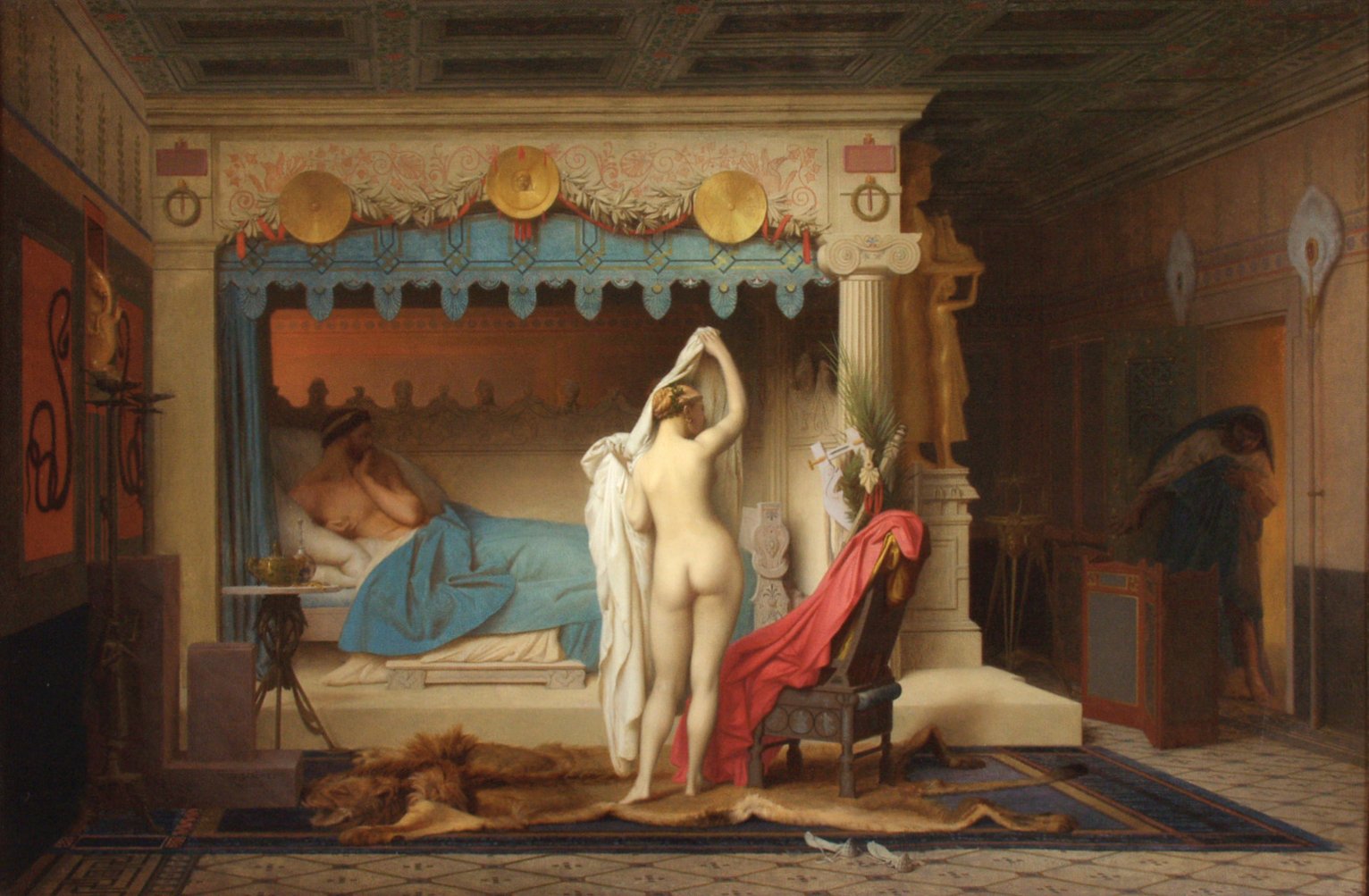
Croesus has been ranked below an Athenian citizen and two Argive boys. He loses his temper.
A note on this passage
Croesus changes his word. He had asked about <em>olbos</em>, blessedness; now, stung, he speaks of "<em>our</em> <em>eudaimoniē</em>," his happiness, as if it were one more thing in the treasury that Solon has tossed on the floor. And he cannot bear to be ranked below <em>idiōtai</em>, "private men," people with no office. <em>Idiōtēs</em> is the ancestor of English "idiot": first a private person, then a layman, then a fool. To a king it is the bottom of the scale.
Solon's reply names the theology under the whole conversation: <em>to theion pan eon phthoneron te kai tarachōdes</em>, "the divine is altogether envious and fond of upheaval." This is the <em>phthonos theōn</em>, the "envy of the gods," that Herodotus returns to throughout the Histories. It is less a portrait of petty gods than a law of balance: whatever rises too high draws a correction. Croesus is asking the one man at his court who believes that about the one thing he is proudest of.
Read the full commentary — and tap any word for its dictionary entry — in the interlinear reader.
Open Herodotus, Histories 1.32.1 in the full reader
Always open passages in the reader
From the Great Library
You are reading a page of the Herodotus, Histories — the whole book is free in our interlinear reader.
The Great Library Project presses the classics in their original languages, glossed word by word — free to read, always. Browse the whole library.
Also on our shelves:
Herodotus, Histories 1.32.1 — The Great Library Project interlinear edition · greatlibraryproject.com/book/herodotus/1.32.1/