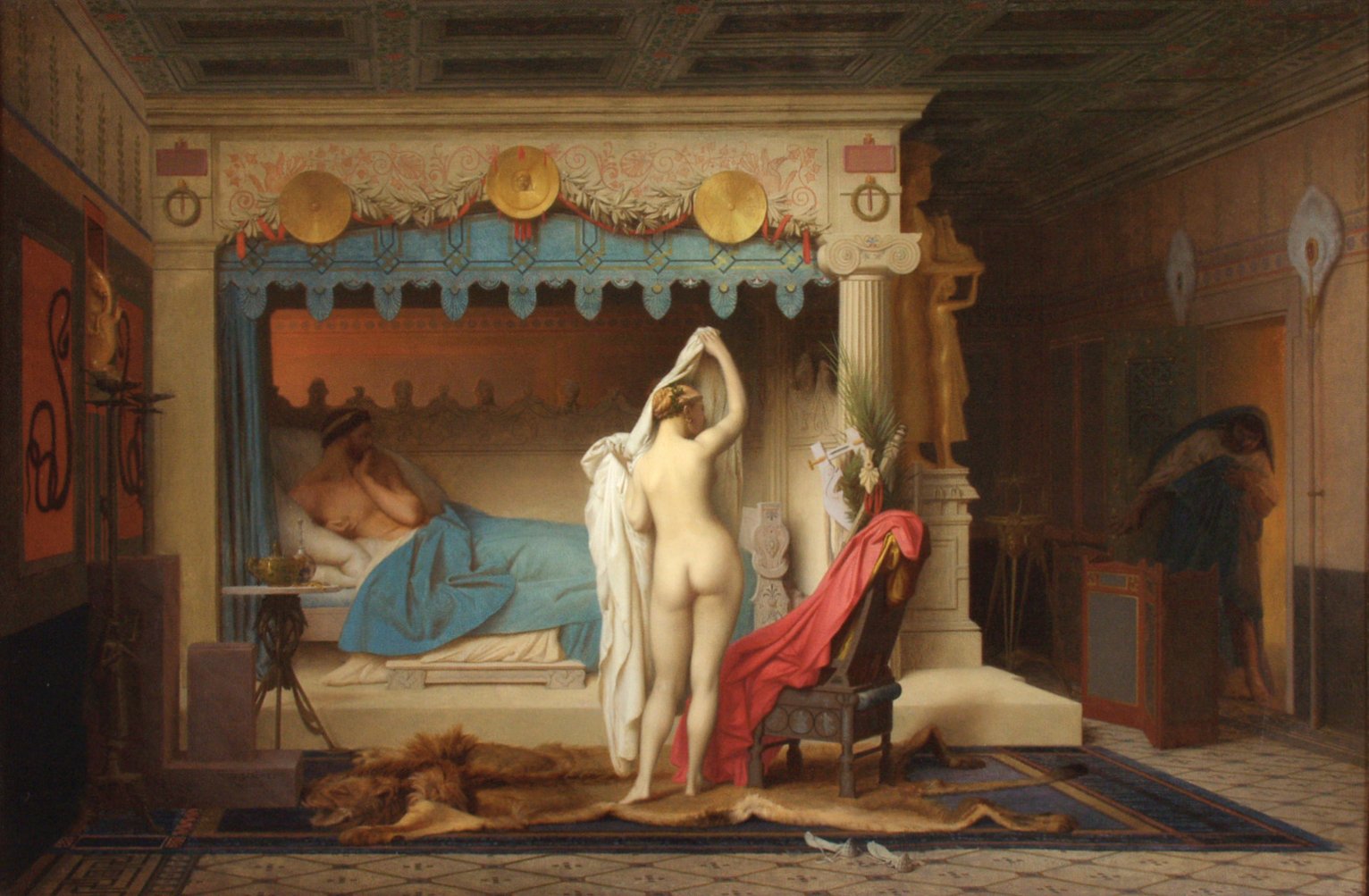
Herodotus, Histories 1.32.5 · 1.32.5
Rich, or lucky?
Read the full text in our reader
Solon — ἐμοὶ δὲ σὺ καὶ πλουτέειν μέγα φαίνεαι καὶ βασιλεὺς πολλῶν εἶναι ἀνθρώπων· ἐκεῖνο δὲ τὸ εἴρεό με, οὔκω σε ἐγὼ λέγω, πρὶν τελευτήσαντα καλῶς τὸν αἰῶνα πύθωμαι. οὐ γάρ τι ὁ μέγα πλούσιος μᾶλλον τοῦ ἐπʼ ἡμέρην ἔχοντος ὀλβιώτερος ἐστί, εἰ μή οἱ τύχη ἐπίσποιτο πάντα καλὰ ἔχοντα εὖ τελευτῆσαι τὸν βίον. πολλοὶ μὲν γὰρ ζάπλουτοι ἀνθρώπων ἀνόλβιοι εἰσί, πολλοὶ δὲ μετρίως ἔχοντες βίου εὐτυχέες.
"To me you seem both very rich and king of many people; but the thing you asked me, I do not yet call you so, until I learn that you ended your life well. For the very rich man is not at all more blessed than the man who has enough for the day, unless fortune attends him so that he ends his life well with all good things. For many very rich men are unblessed, and many of moderate means are lucky."
Word by word
The setting
Solon grants Croesus his wealth and refuses him the title.
A note on this passage
Solon gives Croesus everything he can see: he is very rich, he is king of many peoples. What he will not give yet is the word Croesus asked for, and he tells him why in one clause: <em>prin teleutēsanta kalōs ton aiōna pythōmai</em>, "before I learn that you ended your life well." The word for life here is <em>aiōn</em>, a lifetime taken as a whole span, which cannot be judged until it is complete.
Then he separates two words English tends to run together. The very rich man may be <em>anolbios</em>, "unblessed," and the man with only "enough for the day" may be <em>eutychēs</em>, "lucky." Luck belongs to the present tense: things are going well now. Blessedness is a judgement on the finished life. Everything in the rest of Solon's speech rests on keeping those two apart.
Read the full commentary — and tap any word for its dictionary entry — in the interlinear reader.
Open Herodotus, Histories 1.32.5 in the full reader
Always open passages in the reader
From the Great Library
You are reading a page of the Herodotus, Histories — the whole book is free in our interlinear reader.
The Great Library Project presses the classics in their original languages, glossed word by word — free to read, always. Browse the whole library.
Also on our shelves:
Herodotus, Histories 1.32.5 — The Great Library Project interlinear edition · greatlibraryproject.com/book/herodotus/1.32.5/