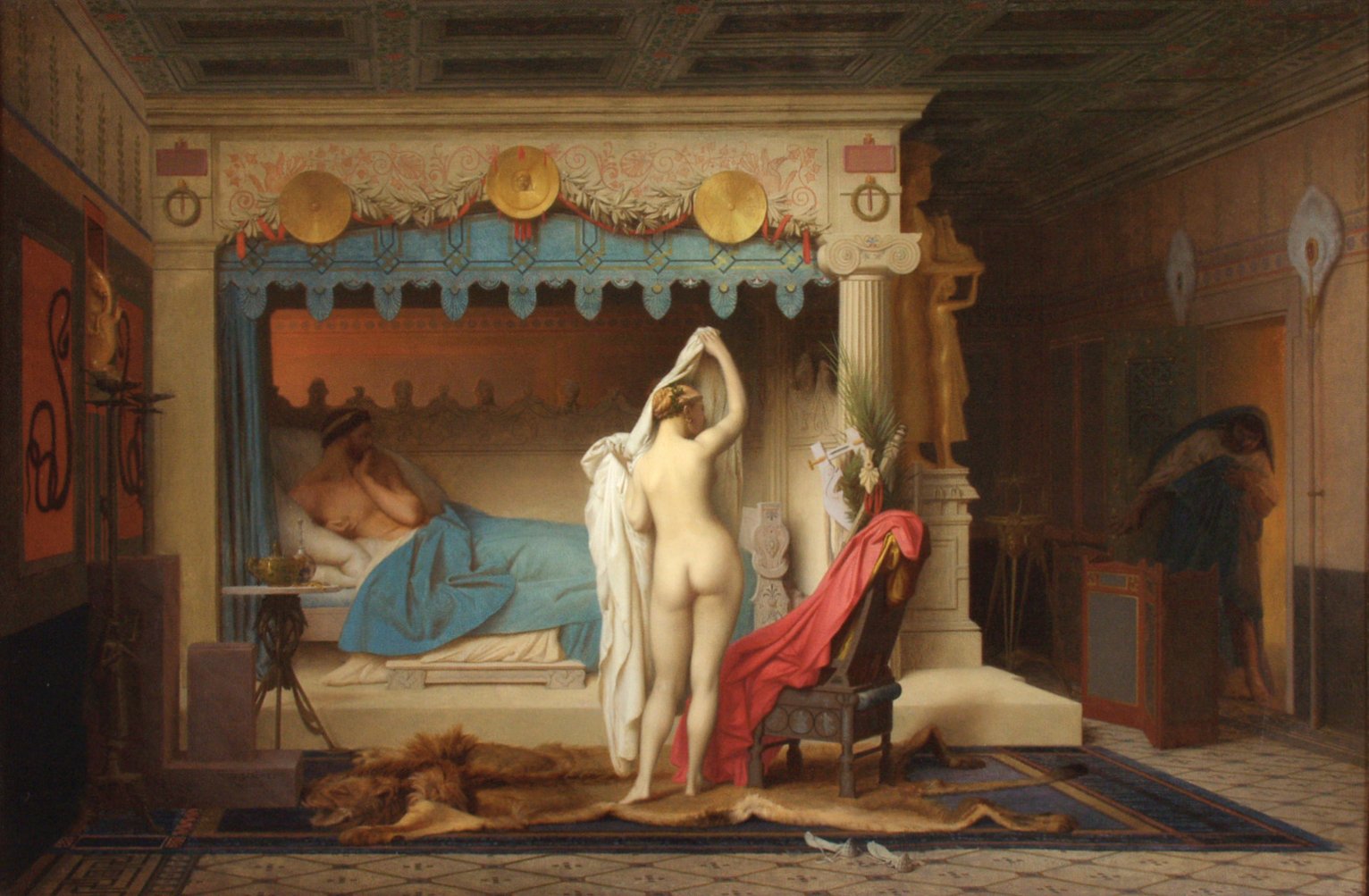
Herodotus, Histories 1.33.1 · 1.33.1
Croesus sends Solon away
Read the full text in our reader
Herodotus — Ταῦτα λέγων τῷ Κροίσῳ οὔ κως οὔτε ἐχαρίζετο, οὔτε λόγου μιν ποιησάμενος οὐδενὸς ἀποπέμπεται, κάρτα δόξας ἀμαθέα εἶναι, ὃς τὰ παρεόντα ἀγαθὰ μετεὶς τὴν τελευτὴν παντὸς χρήματος ὁρᾶν ἐκέλευε.
Saying this to Croesus, he did not please him at all; Croesus made nothing of him and sent him away, thinking him very much a fool, a man who let go the good things before him and told him to look to the end of everything.
Word by word
The setting
The conversation ends, and Herodotus gives Croesus's verdict on his guest.
A note on this passage
The dismissal is in the present tense, apopempetai, "he sends him off," and Croesus's verdict is one word: amathēs. It means "unlearned," one who has not learned (the root is manthanō, "learn"), and Croesus pins it on the wise man. Herodotus does not argue. He simply reports what the king thought, and lets the next chapters answer.
They answer at once. The very next sentence of the Histories (1.34) says that after Solon left, "a great nemesis from god took Croesus, as one may guess, because he thought himself the most blessed of all men." Even there Herodotus hedges, hōs eikasai, "as one may guess." But the reader has heard Solon, and knows what is coming: a dream, a dead son, a war, and a pyre.
Read the full commentary — and tap any word for its dictionary entry — in the interlinear reader.
Open Herodotus, Histories 1.33.1 in the full reader
Always open passages in the reader
From the Great Library
You are reading a page of the Herodotus, Histories — the whole book is free in our interlinear reader.
The Great Library Project presses the classics in their original languages, glossed word by word — free to read, always. Browse the whole library.
Also on our shelves:
Herodotus, Histories 1.33.1 — The Great Library Project interlinear edition · greatlibraryproject.com/book/herodotus/1.33.1/