Herodotus, Histories 1.57.1 · 1.57.1
What language did the Pelasgians speak?
Read the full text in our reader
Ἥντινα δὲ γλῶσσαν ἵεσαν οἱ Πελασγοί, οὐκ ἔχω ἀτρεκέως εἰπεῖν. εἰ δὲ χρεόν ἐστι τεκμαιρόμενον λέγειν τοῖσι νῦν ἔτι ἐοῦσι Πελασγῶν τῶν ὑπὲρ Τυρσηνῶν Κρηστῶνα πόλιν οἰκεόντων, οἳ ὅμουροι κοτὲ ἦσαν τοῖσι νῦν Δωριεῦσι καλεομένοισι ( οἴκεον δὲ τηνικαῦτα γῆν τὴν νῦν Θεσσαλιῶτιν καλεομένην),
What language the Pelasgians spoke I cannot say for certain. But if I must guess and judge by those Pelasgians who still remain today, dwelling in the town of Creston above the Tyrrhenians (who were once neighbors of the people now called Dorians, when those Dorians were living in the land now called Thessaliotis),
Word by word
The setting
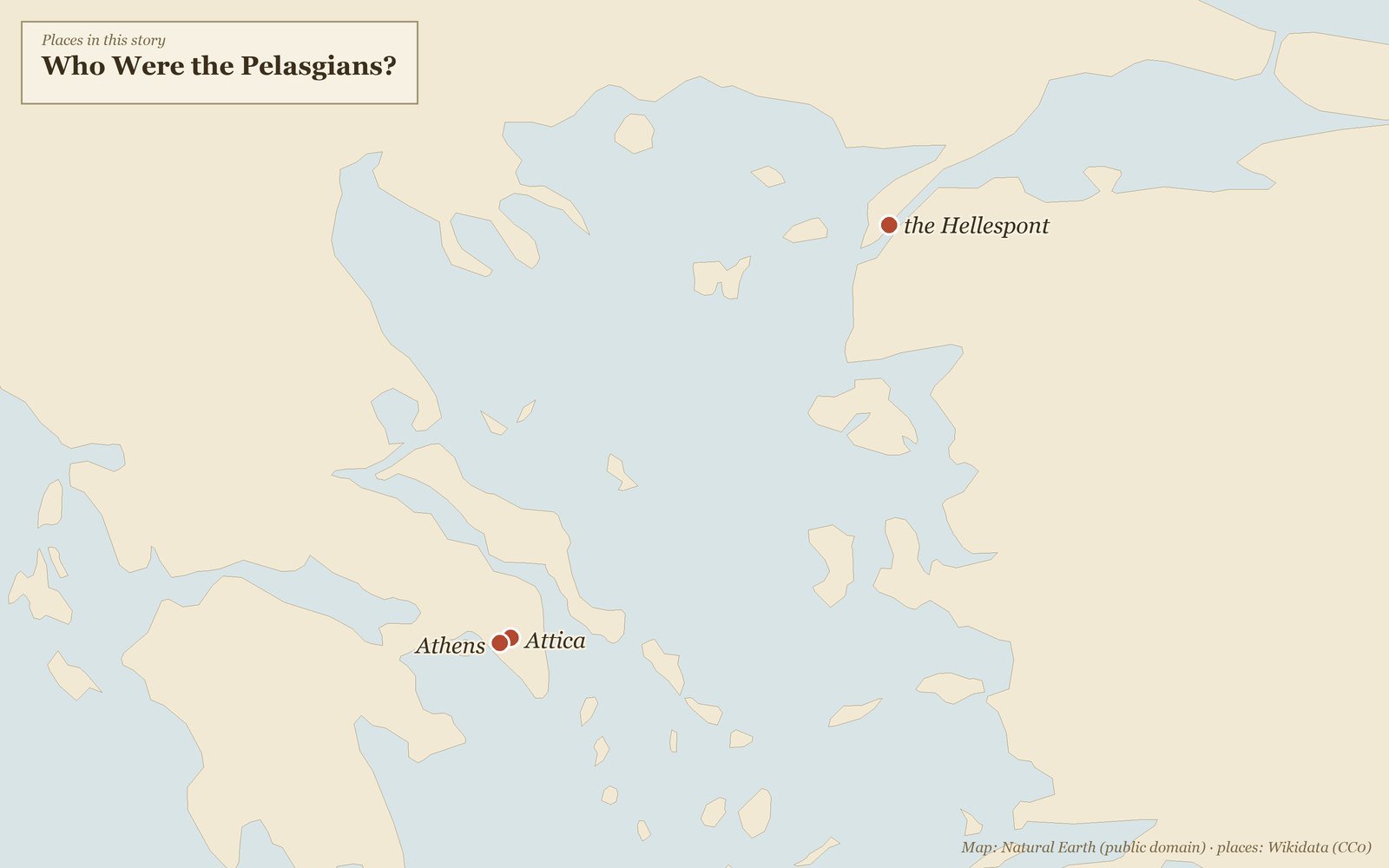
Herodotus turns to the deepest layer of Greek prehistory: before there were Hellenes, there were Pelasgians, and he admits he cannot be certain what language they spoke.
A note on this passage
Herodotus opens his sentence with a disclaimer, and the disclaimer is itself a method. Atrekeōs, "for certain," is a favorite word of his for the edge of what inquiry can actually establish; he uses it to mark the line between what he can report as fact and what he must guess. The verb for "spoke" is hieson, from hiēmi, "send forth," the same root used for throwing a spear or shooting an arrow; a language, in this image, is something a people sends out into the world, not just an interior possession. Even the grammar of his first sentence, an indirect question hanging on "I am not able to say," puts the uncertainty first and the content of the uncertainty second.
His method, once he admits he cannot simply know, is to argue from survivors: he reaches for the one Pelasgian town he can still point to on a map, Krēstōna, Creston, sitting above the Tyrrhenians, people he can still locate. The qualification tucked into the parenthesis, that these Crestonians were once neighbors of the people now called Dorians when the Dorians still lived in Thessaliotis, does real work: it pins a moving, renamed population to a fixed point in time and space before he gives his answer. Herodotus is building a case the way a detective would, witness by witness, and Creston is his first witness.
Read the full commentary — and tap any word for its dictionary entry — in the interlinear reader.
Open Herodotus, Histories 1.57.1 in the full reader
Always open passages in the reader
From the Great Library
You are reading a page of the Herodotus, Histories — the whole book is free in our interlinear reader.
The Great Library Project presses the classics in their original languages, glossed word by word — free to read, always. Browse the whole library.
Also on our shelves:
Herodotus, Histories 1.57.1 — The Great Library Project interlinear edition · greatlibraryproject.com/book/herodotus/1.57.1/