Herodotus, Histories 1.62.1 · 1.62.1
Back at Marathon
Read the full text in our reader
Ἐξ Ἐρετρίης δὲ ὁρμηθέντες διὰ ἑνδεκάτου ἔτεος ἀπίκοντο ὀπίσω, καὶ πρῶτον τῆς Ἀττικῆς ἴσχουσι Μαραθῶνα. ἐν δὲ τούτῳ τῷ χώρῳ σφι στρατοπεδευομένοισι οἵ τε ἐκ τοῦ ἄστεος στασιῶται ἀπίκοντο ἄλλοι τε ἐκ τῶν δήμων προσέρρεον, τοῖσι ἡ τυραννὶς πρὸ ἐλευθερίης ἦν ἀσπαστότερον.
Setting out from Eretria, in the eleventh year they came back, and they reached Marathon first of all Attica. While they were encamped in this place, partisans from the city came to them, and others flocked in from the country districts, men to whom tyranny was more welcome than freedom.
Word by word
The setting
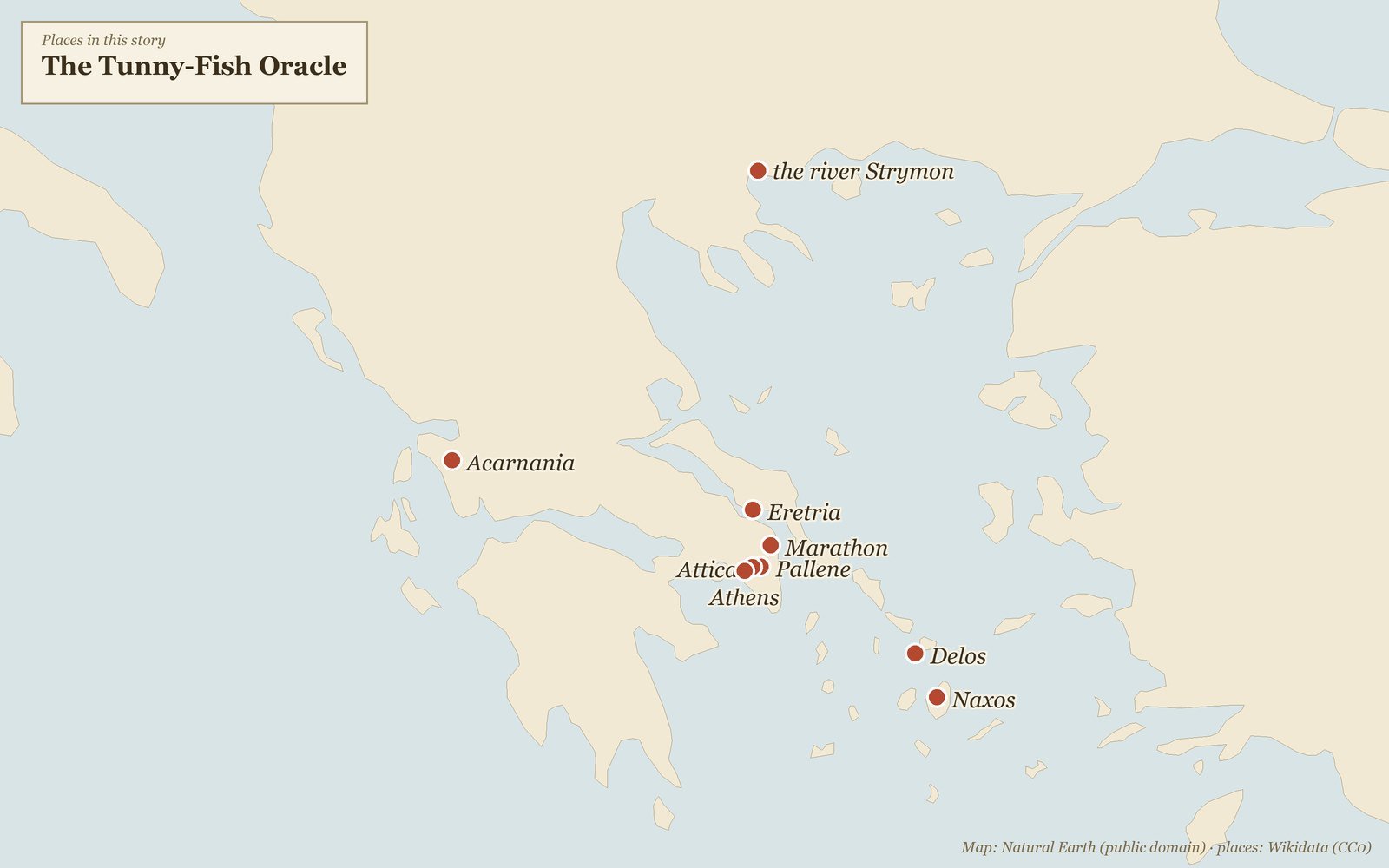
In the eleventh year the exiles sail back from Eretria and land first at Marathon.
A note on this passage
Herodotus counts the exile in years, di' hendekatou eteos, "in the eleventh year," the same patient arithmetic he uses elsewhere for sieges and reigns. The landing spot matters: Marathon, a plain on the far side of Attica from the city, gives Pisistratus room to gather strength before anyone in Athens has to decide anything.
Herodotus splits the welcome into two kinds of men, stasiōtai from the city itself, his old partisans, and others who simply proserreon, "flowed in," from the country demes. His closing line is blunt about why they come: tyrannis pro eleutheriēs aspastoteron, tyranny was simply more welcome to them than freedom. Herodotus does not soften the judgment or explain it away.
Read the full commentary — and tap any word for its dictionary entry — in the interlinear reader.
Open Herodotus, Histories 1.62.1 in the full reader
Always open passages in the reader
From the Great Library
You are reading a page of the Herodotus, Histories — the whole book is free in our interlinear reader.
The Great Library Project presses the classics in their original languages, glossed word by word — free to read, always. Browse the whole library.
Also on our shelves:
Herodotus, Histories 1.62.1 — The Great Library Project interlinear edition · greatlibraryproject.com/book/herodotus/1.62.1/