Herodotus, Histories 1.87.1 · 1.87.1
A prayer to Apollo
Read the full text in our reader
Ἐνθαῦτα λέγεται ὑπὸ Λυδῶν Κροῖσον μαθόντα τὴν Κύρου μετάγνωσιν, ὡς ὥρα πάντα μὲν ἄνδρα σβεννύντα τὸ πῦρ, δυναμένους δὲ οὐκέτι καταλαβεῖν, ἐπιβώσασθαι τὸν Ἀπόλλωνα ἐπικαλεόμενον, εἴ τί οἱ κεχαρισμένον ἐξ αὐτοῦ ἐδωρήθη, παραστῆναι καὶ ῥύσασθαι αὐτὸν ἐκ τοῦ παρεόντος κακοῦ.
Thereupon, it is said by the Lydians, Croesus, having learned of Cyrus's change of mind, when he saw every man trying to quench the fire but no longer able to check it, cried out, invoking Apollo, that if anything he had given had been pleasing to the god, Apollo should stand by him and save him from the evil now upon him.
Word by word
The setting
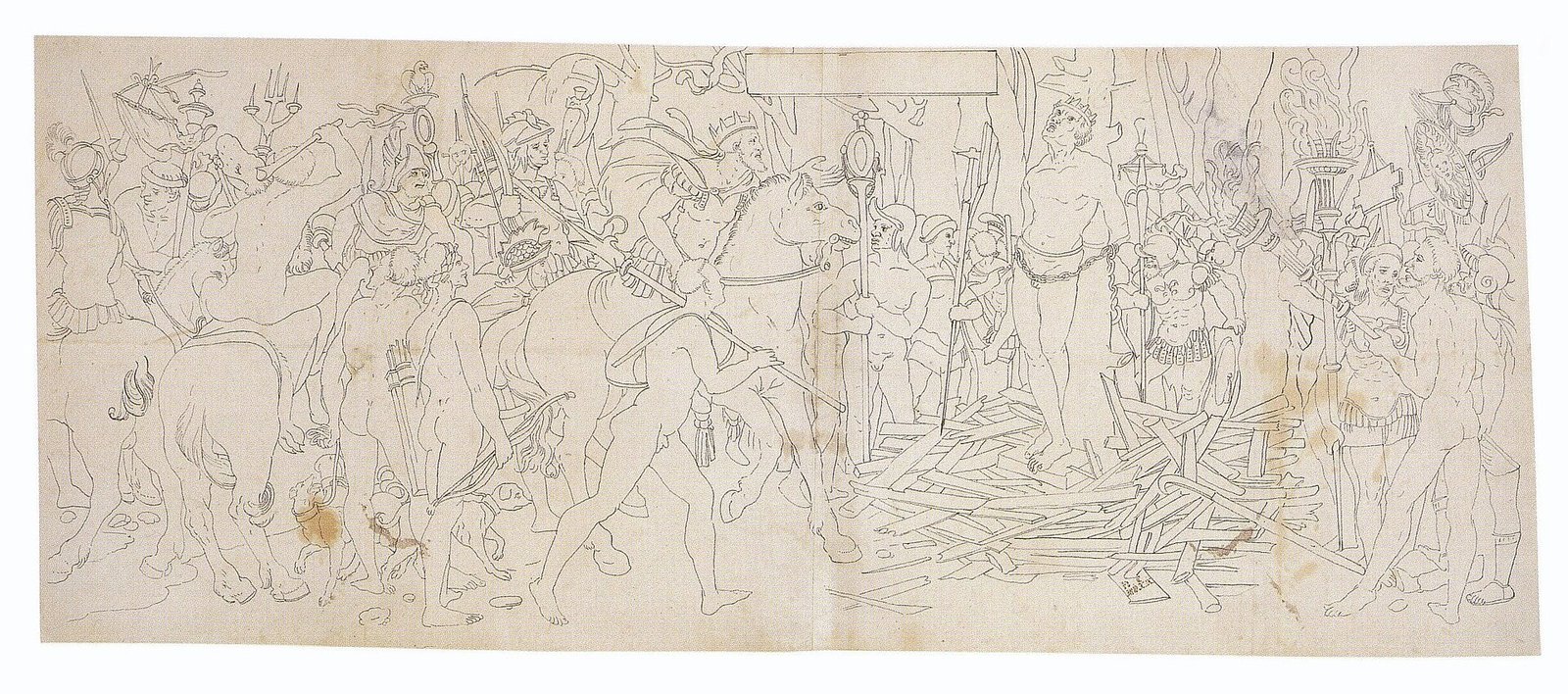
The fire cannot be checked. Croesus, seeing Cyrus's men failing to put it out, cries out to Apollo.
A note on this passage
Herodotus frames the whole scene as hearsay with four words, legetai hypo Lydōn, "it is said by the Lydians": the coming rain and the saved king arrive stamped as a story the Lydians told about their own king, not a claim Herodotus makes in his own voice. Inside that frame Croesus does not call on Apollo once. Herodotus doubles the appeal, epibōsasthai and then epikaleomenon, "cried out" and "invoking," two separate verbs built on the same idea of shouting toward a god, as if one word alone might not carry far enough from the middle of a burning pyre.
The prayer itself is a transaction, not a plea. Ei ti hoi kecharismenon ex autou edōrēthē, "if anything pleasing to him had been given by him," runs on the verb charizomai, "to do a favor, to please," the root behind charis, the reciprocal gift-debt that bound a Greek worshiper to a god. Croesus is not asking for mercy out of nothing; he is calling in an account, reminding Apollo of the gold and silver sent to Delphi a few chapters back, gifts Herodotus described with the same verb, dōreomai. A king who tested the god with tortoises now tests the god's memory of gratitude.
Read the full commentary — and tap any word for its dictionary entry — in the interlinear reader.
Open Herodotus, Histories 1.87.1 in the full reader
Always open passages in the reader
From the Great Library
You are reading a page of the Herodotus, Histories — the whole book is free in our interlinear reader.
The Great Library Project presses the classics in their original languages, glossed word by word — free to read, always. Browse the whole library.
Also on our shelves:
Herodotus, Histories 1.87.1 — The Great Library Project interlinear edition · greatlibraryproject.com/book/herodotus/1.87.1/