
Odyssey 1.356 · Book 1, lines 356–359
Go back to your loom
Read the full text in our reader
ἀλλʼ εἰς οἶκον ἰοῦσα τὰ σʼ αὐτῆς ἔργα κόμιζε, ἱστόν τʼ ἠλακάτην τε, καὶ ἀμφιπόλοισι κέλευε ἔργον ἐποίχεσθαι· μῦθος δʼ ἄνδρεσσι μελήσει πᾶσι, μάλιστα δʼ ἐμοί· τοῦ γὰρ κράτος ἔστʼ ἐνὶ οἴκῳ.
But go into the house and attend to your own tasks, the loom and the distaff, and bid the handmaids ply their work; but speech will be the concern of men, of all, and mine most of all; for mine is the authority in this house.
Word by word
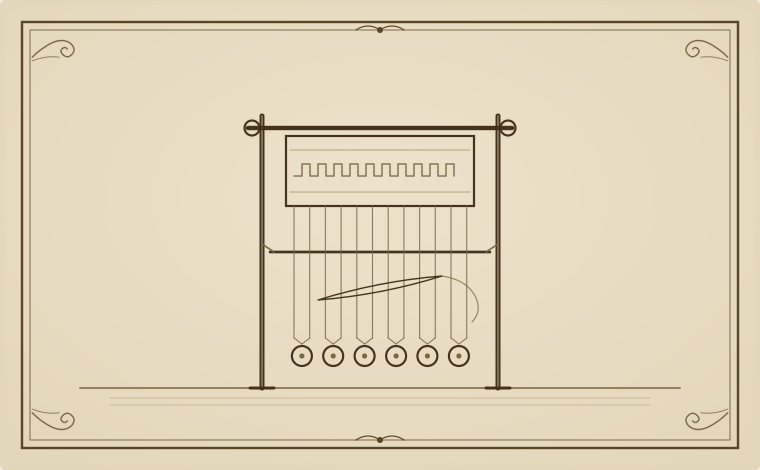
The setting
The famous rebuke. Telemachus sends his mother back upstairs to her own work — the loom and distaff — and to overseeing the maids. Speech, he declares, will be the men's concern, and his most of all: for the authority in this house is his.
A note on this passage
This is the passage everyone remembers, and it needs no exaggeration to land. Telemachus sends his mother upstairs to the loom, the distaff, and the women's work, and claims the hall's speech for the men — and above all for himself. The last clause is the whole claim in four words: the κράτος in this house is his.
The undercurrent is that this is a performance of manhood, not a fact of it. He is repeating a line Hector once spoke to Andromache in the Iliad — the same handing of the woman back to the loom — but Hector was a grown warrior, and Telemachus is a boy who cannot yet make the suitors leave a single room. He asserts the authority precisely because he does not have it. Penelope, astonishingly, obeys: the household hears the man in the boy's voice before the boy has earned it.
Read the full commentary — and tap any word for its dictionary entry — in the interlinear reader.
Open Odyssey 1.356 in the full reader
Always open passages in the reader
From the Great Library
You are reading a page of the Odyssey — the whole book is free in our interlinear reader.
The Great Library Project presses the classics in their original languages, glossed word by word — free to read, always. Browse the whole library.
Also on our shelves:
Odyssey 1.356 — The Great Library Project interlinear edition · greatlibraryproject.com/book/odyssey/1.356/