Phaedrus 247b · 247b
The Soul's Ultimate Struggle
Read the full text in our reader
Socrates — βρίθει γὰρ ὁ τῆς κάκης ἵππος μετέχων, ἐπὶ τὴν γῆν ῥέπων τε καὶ βαρύνων… ἔνθα δὴ πόνος τε καὶ ἀγὼν ἔσχατος ψυχῇ πρόκειται.
The climb to the vision is not serene. At the top of the sky the gods' well-matched, obedient teams pass over easily. Ours barely make it, because one of our horses shares in badness and drags the whole chariot down. It leans toward the earth, a dead weight on the charioteer who never trained it right, and the soul stalls at the very threshold of the vision. This, Socrates says, is where the soul's ultimate struggle is set before it — pónos kai agōn eschatos, its last and hardest contest. The prize is the sight of true reality; the obstacle is the soul's own downward-pulling appetite; and whether it wins depends entirely on the strength of the driver and the training of the horses. Reaching the truth, in this myth, is not a gift of grace but a fight.
Word by word
The setting
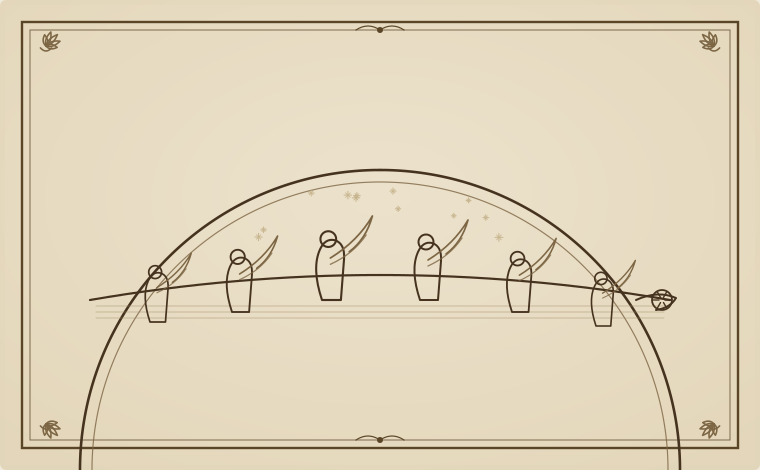
At the rim of heaven the ascent turns brutal. The gods' teams, balanced and obedient, rise easily; ours labor, because the bad horse — the one that shares in vice — weighs the chariot down, sinking toward the earth and burdening the driver who trained it poorly. Here, Socrates says, the ultimate toil and struggle is set before the soul.
A note on this passage
Two words make this the emotional peak of the ascent, and both come from the arena. The soul's effort at the rim of heaven is a pónos, a toil, and an agōn eschatos — the 'ultimate contest,' the last and furthest struggle. Agōn is the great Greek word for the public contest, the games and the battle where a person is tested and revealed; it gives us 'agony,' and the anguish is exact. Plato is deliberately casting the philosophical ascent — the soul straining to see the Forms — as the supreme athletic and heroic trial, the real Olympics, with reality itself as the wreath. And the drama is entirely internal. What the soul contends against is not an enemy or a fate but its own bad horse, the appetitive drive that shares in kakē, badness, and hangs on the chariot like lead, tilting everything back toward the earth. Notice what this does to the quarrel with the first speeches. They wanted the soul at rest, untroubled, self-possessed; here the soul that matters is the one in an all-out struggle, sweating up the sky. Peace is not the goal and never was; the goal is to win the contest, and the contest is with the downward part of oneself. The heavy horse is not a defect that disqualifies the soul from the race — it is the opponent that makes it a race at all. Without something to strain against, there is nothing to overcome, and no vision at the top worth the climb.
Read the full commentary — and tap any word for its dictionary entry — in the interlinear reader.
Open Phaedrus 247b in the full reader
Always open passages in the reader
From the Great Library
You are reading a page of the Phaedrus — the whole book is free in our interlinear reader.
The Great Library Project presses the classics in their original languages, glossed word by word — free to read, always. Browse the whole library.
Also on our shelves:
Phaedrus 247b — The Great Library Project interlinear edition · greatlibraryproject.com/book/phaedrus/247b/