
The United States is at war with Persia (Iran). The war began on 28 February 2026 with American and Israeli air strikes. Congress never authorised it. Eight months later tankers burn in the Strait of Hormuz, and the president has threatened to "give them the hammer."
Americans think of ourselves as Athens' heirs. Pericles said of Athens: "the city as a whole is the school of Greece"; in 1630 John Winthrop told the first Puritans the same: "we shall be as a city upon a hill. The eyes of all people are upon us." Where did Athens go wrong, and are we going wrong the same way?
Thucydides, an Athenian general, wrote it down for anyone who wants
"to look at the clear truth of what has happened, and of what will some day happen again in the same or a similar way, as human nature goes."
Isocrates told Athens in 355 BC that the empire of the sea was the thing "which overthrew that democratic government" its ancestors had built.
John Quincy Adams in 1821: America "goes not abroad in search of monsters to destroy."
Mark Twain, when the United States took the Philippines: "I am opposed to having the eagle put its talons on any other land."
Athens did not lose its democracy to an invader. It gave it away in seven steps, each one voted by its own assembly, and each one made the next easier. Americans are taking the same steps now. Under each step, Blowback is what it cost Athens.
1. It kept its allies by force.
2. It refused to bend, and chose a war.
3. It voted to kill a whole city.
4. It destroyed Melos.
5. It reached for Sicily.
6. It turned on its own.
7. It sold its democracy for Persian money.
Each excerpt is Thucydides' own Greek with the English under every word: tap a word to look it up, and every excerpt opens into its book.
The strong do what they can
 AthensMelos
Melos is a small island at the bottom of the Aegean. Its people wanted no part of the war. In the summer of 416 BC thirty-eight Athenian triremes anchored off the island, with nearly three thousand heavy infantry behind them.
Athens had no grievance. It wanted the island because an independent island made it look weak. The envoys told the Melians how the world works. Watch for ἀσθενεῖς, "the weak."
the strong do what they can and the weak give way…
The lines before (49 words)
The Athenians said: "Well then, we for our part will not use fine phrases and offer a long speech that would not be believed, saying either that we rule justly because we overthrew the Mede, or that we are attacking you now because we have been wronged. Nor do we expect you to think you will persuade us by saying either that you did not campaign with us because you are colonists of the Spartans, or that you have done us no wrong. Rather, work out what is possible from what each of us truly thinks,
since you understand, as you speak to those who know, that in human reckoning justice is decided when the compulsion on both sides is equal, but the strong do what they can and the weak give way."… the story goes on in the book ›
Books 1, 5, 6 and 7 are complete, with Pericles, Mytilene, Melos, Sicily and the coup of 411.
The old translations say the weak "suffer what they must." The Greek verb, ξυγχωροῦσιν, means to yield.
The Melians would not yield. And what happened? That winter Athens killed every adult man on the island, sold the women and children into slavery, and sent five hundred of its own citizens to farm their land. Thucydides' word for them is ἀποίκους: settlers.
The men who did this were citizens of the freest city in the Greek world, whose forefathers had beaten the largest empire on earth sixty-four years earlier. Yes, that bastion of democracy, Athens.
1. It kept its allies by force
Step 1 a democracy at home became a master abroad. By one count the United States keeps about 750 military bases in some 80 countries.
In 480 BC the Athenians had left their city to Xerxes, let the Persians burn it, and broken his fleet off Salamis while he watched from the shore. Two years later the islands of the Aegean asked Athens to lead them against Persia, and each paid its share in ships or silver into a treasury on Delos. Within a few years the island of Naxos decided it had paid enough, and Athens sent the fleet against it.
This was the first allied city to be enslaved contrary to the established rule…
After this they made war on the Naxians, who had revolted, and brought them to terms by siege. This was the first allied city to be enslaved contrary to the established rule. Then it happened to each of the others in its turn… the story goes on in the book ›
In 454 BC the treasury left Delos for the Acropolis of Athens, and some of that money paid for the Parthenon.
Will Durant, whose eleven-volume Story of Civilization sat on millions of American shelves, said that under Pericles Athens reached its height, and that the height was "unsound in its foundations." It stood on money paid by allies who did not want to pay it.
Blowback: the allies remembered. Sparta's allies called Athens a city "set up as tyrant" before the war began, and the day Athens looked weak, its own allies turned on it.
2. It refused to bend, and chose a war
Step 2 it would not bend, so it got a war. Ours began in the middle of nuclear talks.
In 432 BC Sparta sent Athens a last offer: repeal the decree that shut the neighbouring city of Megara out of every harbour in the empire, and "there would be no war." Pericles told the assembly not to give an inch. Athens could not feed itself; its bread came by sea. Durant called it "a choice between empire and starvation," and Pericles chose empire.
Thucydides saw a deeper cause. Watch for φόβον, "fear."
the Athenians were becoming great and causing fear to the Spartans, and so forced them into fighting…
For the truest cause, though the least visible in what was said, I think was this: the Athenians were becoming great and causing fear to the Spartans, and so forced them into fighting. But the causes spoken openly were these, on each side, and from them they broke the treaty and put themselves into the war… the story goes on in the book ›
That sentence is the Thucydides trap, and four of Graham Allison's sixteen cases stayed at peace: war is a choice.
In the first winter of the war Pericles stood over the city's first dead and gave the Funeral Oration.

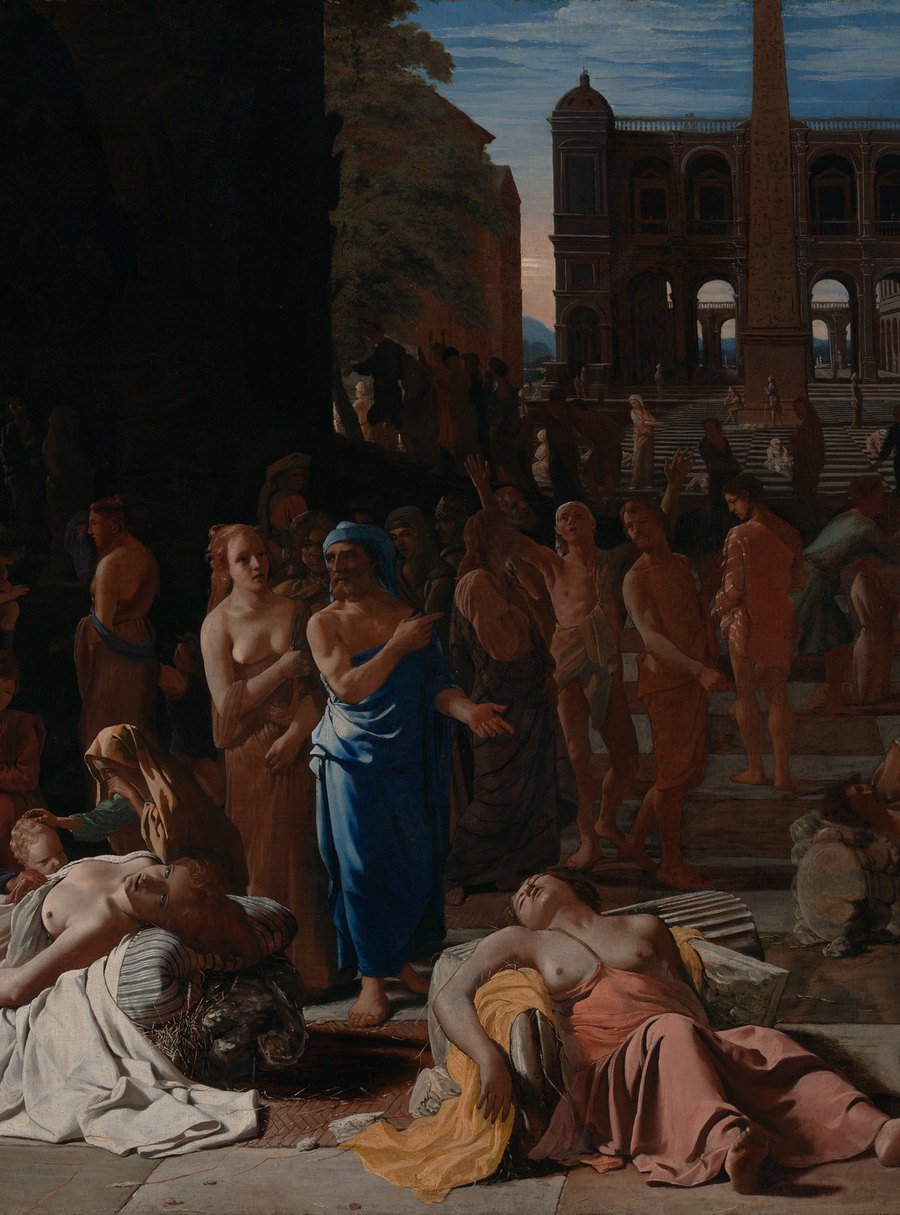
Pericles had packed all of Attica inside the walls, crowded into stifling huts, and in the second summer a sickness came in through the harbour. It began with burning heat in the head and red eyes. The sick could not bear a sheet on their skin, and threw themselves into the water tanks with a thirst that never stopped. They "died like sheep," and the half-dead rolled in the streets around every fountain. The birds that eat the dead would not touch the bodies.
In his last speech he told them what they held. Watch for τυραννίδα, "tyranny."
For you hold it now like a tyranny, which it seems unjust to have taken, but dangerous to let go…
Nor can you any longer step down from it, even if someone, afraid of this at the present moment, plays the good man through quietism. For you hold it now like a tyranny, which it seems unjust to have taken, but dangerous to let go… the story goes on in the book ›
Blowback: the plague took perhaps a quarter of the people, and Pericles' sister and both his legitimate sons. Plutarch says that when Pericles laid the funeral wreath on Paralus, the last of them, the man who had never been seen to weep broke down and sobbed, and the plague took him the next year.
3. It voted to kill a whole city
Step 3 the assembly voted death for a whole people. Sanctions that squeeze a whole country to move its rulers ask the same question.
In 428 BC Mytilene, the chief city of Lesbos, revolted. Athens took it back, and in anger the assembly voted to put to death "all the grown men of Mytilene, and to enslave the children and women." A trireme sailed with the order. The next day the Athenians woke to what they had done and met again. Cleon defended the first vote. Watch for δημοκρατίαν.
a democracy is incapable of ruling others…
Often before now, and on other occasions too, I have recognized that a democracy is incapable of ruling others, and most of all now, in your change of heart about the Mytileneans… the story goes on in the book ›
Cleon meant it as an insult to his own voters. Diodotus answered from Athens' own interest: kill every man in a rebel city, and the next rebels fight to the last. The show of hands was almost even, and Diodotus won it.

A second trireme set out a day behind the first, across nearly two hundred miles of sea. The rowers ate at their oars, barley meal kneaded with wine and olive oil, and slept in turns, so the ship never stopped.
Paches had read the decree and was about to carry out what had been decided, when the later ship put in after her and prevented the destruction…
By chance no wind blew against them, and the first ship was not sailing in haste on so strange a business, while the second was being driven hard in the manner described. So the first got ahead only so far that Paches had read the decree and was about to carry out what had been decided, when the later ship put in after her and prevented the destruction. Mytilene came within that much of danger… the story goes on in the book ›
And then the city killed anyway. The men Athens judged most to blame, "a little more than a thousand," were put to death on Cleon's motion. A thousand men, by a show of hands, in a democracy.
Blowback: eleven years later, on Melos, where Athens had no grievance at all, there was no second ship.
4. It destroyed Melos
Step 4 it stopped pretending to be just. The strong do what they can.
The Melians answered the envoys with the best argument a small country has. Fairness was in Athens' own interest, they said, "since if you fell, under the heaviest vengeance, you would become an example to the rest."
The Melians held out through a summer and a winter, and broke through the siege wall twice. Then, with traitors inside the town, they surrendered. Watch for ἀπέκτειναν, "they killed."
They killed all the grown Melian men whom they took, and made slaves of the children and women…
They killed all the grown Melian men whom they took, and made slaves of the children and women. They settled the place themselves, sending out five hundred colonists later… the story goes on in the book ›
The next spring Euripides staged The Trojan Women in Athens, a play about the widows of a conquered city waiting to be shared out among their captors, and the Athenians sat and watched it.
The comparison: The five hundred settlers have their heirs: Israel's settlements in the occupied West Bank are the example in the news, and the United States itself was built on land taken from its first peoples.
Blowback: the bill for Melos came due in Sicily, three years later.
5. It reached for Sicily
Step 5 a war of choice, far from home, sold on borrowed gold.
In 421 BC Athens and Sparta swore a peace for fifty years. Athens grew rich again, and wanted more. "No ambition, no empire, is ever content," Durant wrote.
A small Sicilian city, Egesta, asked Athens for help and promised to pay for the war. The Athenians sent envoys to see the money. The Egestaeans gathered every gold and silver cup in their town, borrowed more from their neighbours, and passed the same cups from house to house, and the envoys came home dazzled.
Nicias begged the assembly not to "reach for another empire before we have made secure the one we hold." Alcibiades answered him: the brilliant young ward of Pericles, who in Plato's Symposium bursts in drunk, crowned with ivy and violets. Listen for ταμιεύεσθαι, a steward's word, "to ration."
we cannot ration how far we wish to rule…
And we cannot ration how far we wish to rule. Since we have come to this position, we must plot against some and not let others go, because we ourselves would be in danger of being ruled by others unless we ruled them. And you must not judge quiet by the same standard as other people, unless you will also change your ways to be like theirs… the story goes on in the book ›
The comparison: In October 2002 Congress authorised force against Iraq on the case for weapons that were never found, and seven months later the president stood under a banner reading "Mission Accomplished." In 2011 the United States bombed Libya, and by 2017 CNN had filmed migrants being sold at auction there.
Blowback: two years later the fleet was gone, and the army marched inland, leaving its dead unburied and its wounded begging to be carried. Days later they reached the river Assinarus, mad with thirst, the enemy's horsemen behind them. They rushed into the water in no order, trampling each other, while the Syracusans threw spears down from the far bank and then came down into the river and slaughtered them where they stood. "The water was fouled at once, but it was drunk all the same, mixed with mud and bloodied, and most of the men fought over it."

About seven thousand prisoners were penned in the stone quarries of Syracuse, with no roof. The summer sun burned them, then the autumn nights froze them. The dead lay heaped among the living, and for eight months each man was given a half-pint of water a day and a pint of grain. Plutarch says many were sold as slaves, branded on the forehead with a horse, and that a few won their freedom by reciting Euripides. Three years after Athens sold the women and children of Melos, Athenians were sold in the slave markets of Sicily. Watch for ὀλίγοι, "few."
Nothing was left that was not lost, and few out of many came home…
For they were beaten in every way and altogether, and suffered no small hurt in any respect; they were destroyed utterly, as the saying goes, army and ships and everything. Nothing was left that was not lost, and few out of many came home. Such were the events in Sicily… the story goes on in the book ›
6. It turned on its own
Step 6 the fear it sowed abroad came home, and the city hunted its own. Americans had the Palmer Raids of 1919 and the loyalty hearings of the 1950s.
Just before the fleet sailed, someone smashed the herms of Athens in a single night: the square stone pillars, each with the bearded head of Hermes on top and an erect phallus carved on the front, that guarded doorways and crossroads. The Athenians saw "a conspiracy for revolution and the overthrow of the people," and rumour fastened on Alcibiades and his set of rich young men.

Every day they went further toward savagery and toward arresting still more…
And since they were angry at such a thing, many men of note were already in prison, and there was no sign of a pause. Every day they went further toward savagery and toward arresting still more. Then one of the prisoners, the one who seemed most to blame, is persuaded by one of his fellow prisoners to give information, whether what he revealed was really true or not. For guesses go both ways, and no one, either then or later, is able to say for certain who the men were who did the deed… the story goes on in the book ›
They recalled Alcibiades from Sicily to stand trial. He slipped away and went over to Sparta.
Blowback: Alcibiades. From Sparta he told the Spartans how to hurt Athens most, and then, Plutarch says, he seduced the wife of the Spartan king Agis. He went over to the Persian governor of the coast, Tissaphernes, and Persia paid for Sparta's ships.
The city kept turning on its own. In 406 BC the fleet won its last great victory, off the Arginusae islands, and then a storm came up and the generals could not reach the crews of twenty-five wrecked ships. One sailor who lived, floating on a meal tub, told the assembly that the drowning men had asked him to tell the people the generals had left them. The assembly tried the generals together in a single vote, against its own law, and put to death the six who had come home. One was Pericles' son by Aspasia, the boy the city had made a citizen out of pity for his grieving father. Socrates, presiding that day, refused to put the motion to the vote.
7. It sold its democracy for Persian money
Step 7 the democracy voted itself away. The Constitution gives Congress the power to declare war, and ours began without its vote.
After Sicily, Alcibiades sent word from the Persian court: the King would back Athens if Athens changed its government and called him home. Peisander carried the offer to the assembly. The people took it hard, then gave way, "out of fear and at the same time in the hope that it would be changed back as well." Peisander's word for oligarchy was σωφρονέστερον, "more moderately," the old word for knowing your limits.
The clubs of the rich stabbed Androcles, the leading democrat, and others with him. Outside the walls at Colonus the assembly voted to hand the city to four hundred men. Days later the Four Hundred, "each with a hidden dagger," walked into the council house with a hundred and twenty young men at their backs, paid the elected councillors the rest of their salaries, and told them to leave.Thucydides gives the reason it should have been hard.
it was hard, in about the hundredth year since the tyrants were put down, to deprive the Athenian people of its freedom…
The lines before (33 words)
And Theramenes, the son of Hagnon, was foremost among those who helped to overthrow the democracy, a man not unable either to speak or to judge. So the undertaking, carried out by many intelligent men, great though it was, not unnaturally succeeded.
For it was hard, in about the hundredth year since the tyrants were put down, to deprive the Athenian people of its freedom, a people not only not subject but, for more than half of that time, itself accustomed to rule others… the story goes on in the book ›
In plain words: a hundred years after Athens put down its tyrants, its own assembly handed its freedom away.
Blowback: read it again. A people who had ruled others by force for fifty years found they could be ruled the same way.
The Four Hundred lasted four months. The fleet at Samos, rowed by the poorest citizens, refused to accept them, and within a year full democracy came back.
The night they remembered Melos
In 405 BC Sparta, with a fleet paid for by the Persian prince Cyrus, caught the last Athenian fleet drawn up on the beach at Aegospotami and destroyed it. The Spartans put some three thousand captured Athenians to death. Xenophon says that when the news reached Athens at night a wail ran up the Long Walls from the harbour to the city, and no one slept. They mourned the dead, and still more themselves, because they expected to suffer what they had done to the Melians.
Sparta closed the sea, and the city that had fed itself on the grain of an empire starved. Corinth and Thebes asked Sparta to wipe the city out and turn it to sheep pasture. At the victors' banquet, Plutarch says, a man from Phocis sang a chorus from Euripides' Electra, and the commanders thought it a cruel thing to destroy a city that had produced such poets.
Lysander sent to the city for flute girls. To their music his men tore down the Long Walls and set fire to the Athenian triremes, while the allies wore garlands and called it the first day of freedom for Greece. Thirty men, the Thirty Tyrants, killed about fifteen hundred Athenians in eight months. They needed money, so they arrested rich resident foreigners; the speechwriter Lysias escaped over a back wall, and his brother Polemarchus was made to drink hemlock and was not even given a shroud.
The democracy came back in 403 and swore the first amnesty we know of, "not to remember wrongs." In 322 BC the Macedonians took the vote from every Athenian too poor to own two thousand drachmas, and the democracy Pericles praised was over.
The fatal flaw
Thucydides has a word for it: πλεονεξία, literally "having more," wanting more than your share. It is there at Melos, and in the passion for Sicily.
Durant called his chapter on this war "The Suicide of Greece." The war, he says, changed the people who fought it. After Salamis Greece was poor but proud. After this war it was poor again, and Athens carried
"a wound to her spirit."
John Quincy Adams said it of America in 1821: a country that goes abroad in search of monsters to destroy "would be no longer the ruler of her own spirit."
By the night of Aegospotami the Athenians knew what they had become.
If they could do it over
Their own speakers had told them what to do. Pericles: add no empire during the war. Diodotus: punish the guilty, spare the people. The Melians: fairness is in your interest, because one day, under the heaviest vengeance, you may need it yourself. Nicias: secure what you hold first. They heard every word and voted the other way each time.
The ones who took another road
❧ Sweden lost its Baltic empire, stopped fighting to win it back, and has not fought a war since 1814.
❧ George Washington handed his commission back to Congress in 1783, and refused a third term.
❧ The Marshall Plan rebuilt Western Europe after 1948: America paid its allies instead of taxing them, and most are allies still, by their own choice.
Seven steps, and the seventh was a vote. Athens wore itself out holding an empire, and then its own assembly voted the democracy away. Americans still have what the Athenians had in 432 BC, a vote and the time to use it.
Herodotus had seen the pattern before Thucydides was born:
For of the cities that were great long ago…
For of the cities that were great long ago, most have become small; and those that were great in my own time were small before. So, knowing that human prosperity never stays in the same place, I will mention both alike… the story goes on in the book ›
Books 1 to 3 are on the shelf, with the Persian Wars: Marathon, Xerxes at the Hellespont, Salamis and the end of the book.
Our guide to the shape of this story was Will Durant's The Life of Greece (1939), the second volume of The Story of Civilization. The scenes come from the ancient writers themselves: Thucydides, Xenophon, Plutarch and Herodotus.
If you enjoyed this story, help us make the next one. Every article like this is built from books we press word by word, and readers' gifts keep the press running. Help us make more ›
The books that tell the story
 The HistoriesHerodotus · Ἱστορίαιc. 430 BC · East and West, Marathon, Xerxes and Salamis37% printedIts excerpt here › · Help complete the book ›
 History of the Peloponnesian WarThucydides · Ἱστορίαι431–c. 400 BC · from the Persian Wars to Melos, Sicily and the coup of 41167% printedIts excerpt here › · Help complete the book ›