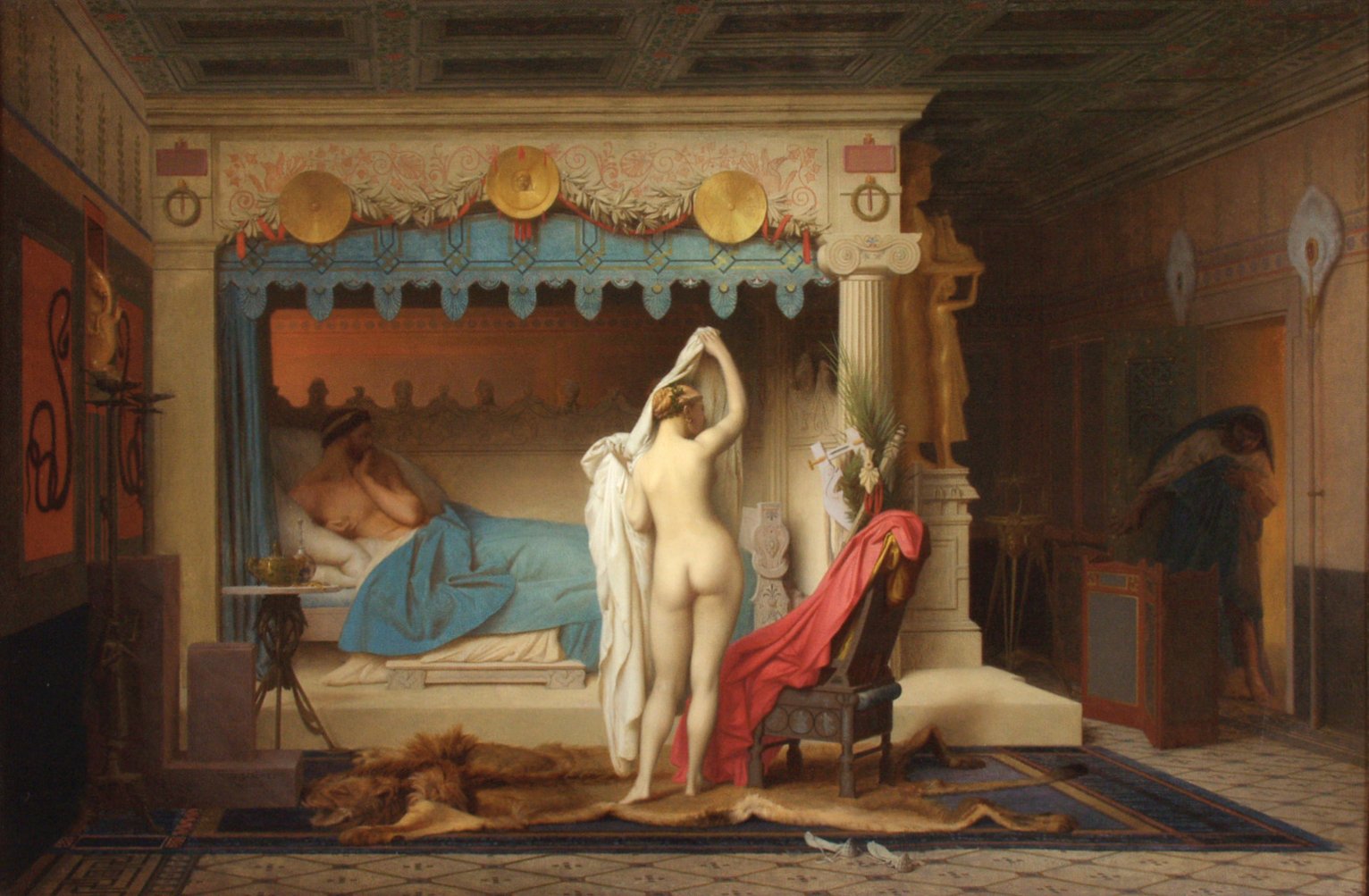
Herodotus, Histories 1.10.2 · 1.10.2
The queen saw him
Read the full text in our reader
Herodotus — ὡς δὲ κατὰ νώτου ἐγένετο ἰούσης τῆς γυναικὸς ἐς τὴν κοίτην, ὑπεκδὺς ἐχώρεε ἔξω, καὶ ἡ γυνὴ ἐπορᾷ μιν ἐξιόντα. μαθοῦσα δὲ τὸ ποιηθὲν ἐκ τοῦ ἀνδρὸς οὔτε ἀνέβωσε αἰσχυνθεῖσα οὔτε ἔδοξε μαθεῖν, ἐν νόῳ ἔχουσα τίσεσθαι τὸν Κανδαύλεα.
When he was behind her back as she went to the bed, he slipped out and went away; and the woman saw him going out. She understood what her husband had done; but she did not cry out for shame, nor seem to have noticed, keeping in mind to punish Candaules.
Word by word
The setting
The one thing the plan could not allow happens.
A note on this passage
Herodotus switches into the present tense for the turn: kai hē gynē eporāi min exionta, "and the woman sees him going out." The sudden present puts us in the room at the instant it happens, and it is the one thing Candaules said would not happen. Then comes the sentence the story has been built to deliver. The king had promised that she would not even learn (mathein) she was seen (1.9.1). Now she learns (mathousa) exactly what her husband did, and "did not seem to have learned" (oute edoxe mathein). Herodotus uses the king's own verb twice, once for what she knows and once for what she lets him think.
Her silence is not shock. It is strategy, and the last words say so: en noōi echousa tisesthai, "keeping in mind to make him pay." Tisis, repayment, retribution, is one of the engines of the whole Histories. The first chapters are a ledger of women seized and paid back, and this story ends the same way: when Gyges takes the throne, the Pythia at Delphi warns that tisis for the old royal house will come on Gyges' fifth descendant (1.13). That descendant is Croesus.
Read the full commentary — and tap any word for its dictionary entry — in the interlinear reader.
Open Herodotus, Histories 1.10.2 in the full reader
Always open passages in the reader
From the Great Library
You are reading a page of the Herodotus, Histories — the whole book is free in our interlinear reader.
The Great Library Project presses the classics in their original languages, glossed word by word — free to read, always. Browse the whole library.
Also on our shelves:
Herodotus, Histories 1.10.2 — The Great Library Project interlinear edition · greatlibraryproject.com/book/herodotus/1.10.2/