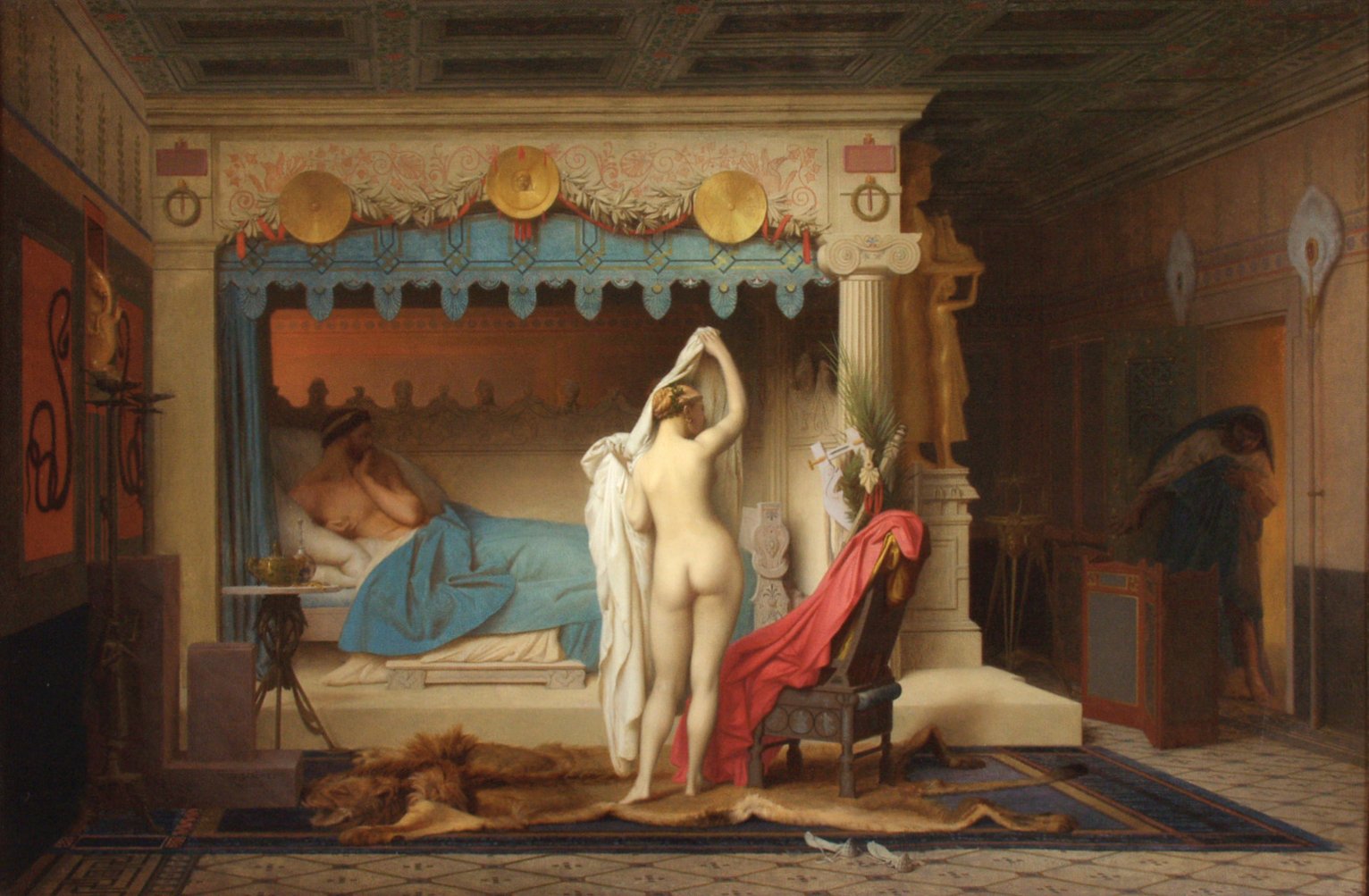
Herodotus, Histories 1.10.3 · 1.10.3
Herodotus explains a custom
Read the full text in our reader
παρὰ γὰρ τοῖσι Λυδοῖσι, σχεδὸν δὲ καὶ παρὰ τοῖσι ἄλλοισι βαρβάροισι καὶ ἄνδρα ὀφθῆναι γυμνὸν ἐς αἰσχύνην μεγάλην φέρει.
For among the Lydians, and nearly among the other barbarians too, even for a man to be seen naked brings great shame.
Word by word
The setting
The narrator steps out of the story for one sentence to explain the queen's silence to a Greek audience.
A note on this passage
This is Herodotus the ethnographer, pausing a thriller to explain a custom. His audience needed the note. Greek men exercised naked in the gymnasium and ran naked at Olympia, and a Greek listener might not feel at once why the sight of a body should be worth a king's life. So Herodotus tells them: among the Lydians, and nearly all non-Greeks, even a <em>man</em> seen naked is disgraced. If that is so for a man, the listener can work out what it is for a queen.
The sentence is small, but it is the method of the whole book in miniature. Herodotus explains behaviour by <em>nomos</em>, the custom of a people, rather than by judging it against his own. Plato has Socrates make the same observation from the other side: not long ago, he says in the <em>Republic</em>, the Greeks too thought it shameful for men to be seen naked, as most barbarians still do.
Read the full commentary — and tap any word for its dictionary entry — in the interlinear reader.
Open Herodotus, Histories 1.10.3 in the full reader
Always open passages in the reader
From the Great Library
You are reading a page of the Herodotus, Histories — the whole book is free in our interlinear reader.
The Great Library Project presses the classics in their original languages, glossed word by word — free to read, always. Browse the whole library.
Also on our shelves:
Herodotus, Histories 1.10.3 — The Great Library Project interlinear edition · greatlibraryproject.com/book/herodotus/1.10.3/