Herodotus, Histories 1.11.3 · 1.11.3
"Either he who planned this, or you"
Read the full text in our reader
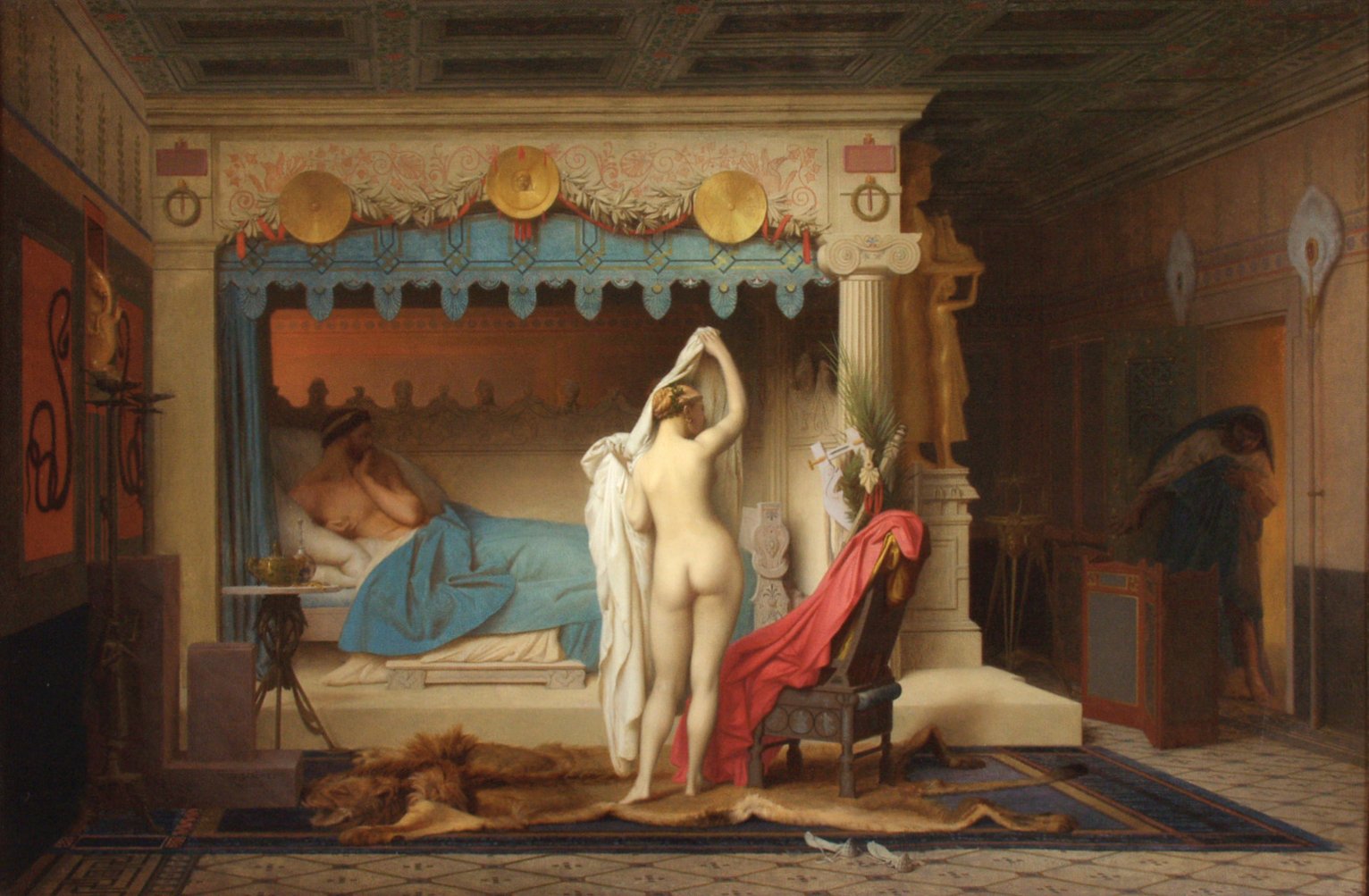
The Queen — ἀλλʼ ἤτοι κεῖνόν γε τὸν ταῦτα βουλεύσαντα δεῖ ἀπόλλυσθαι, ἢ σὲ τὸν ἐμὲ γυμνὴν θεησάμενον καὶ ποιήσαντα οὐ νομιζόμενα.
Herodotus — ὁ δὲ Γύγης τέως μὲν ἀπεθώμαζε τὰ λεγόμενα, μετὰ δὲ ἱκέτευε μή μιν ἀναγκαίῃ ἐνδέειν διακρῖναι τοιαύτην αἵρεσιν.
"Yes, one of you must die: either he who planned this, or you, who looked at me naked and did what is not done." For a while Gyges was amazed at what she said; then he begged her not to bind him by force to make such a choice.
Word by word
The setting
The queen passes sentence, and Gyges pleads.
A note on this passage
The queen's sentence repeats the argument Gyges himself made to the king. In 1.8.4 he begged Candaules not to ask him for <em>anoma</em>, "things outside <em>nomos</em>." Now she condemns him for doing <em>ou nomizomena</em>, "things not customary," the same <em>nomos</em> seen from the other side. He was right about the rule, and being right does not save him. In Herodotus, the man who breaks a custom pays whether or not he wanted to break it.
His plea uses the Ionic word <em>anankaiē</em>, necessity, compulsion. He asks not to be "bound" (<em>endeein</em>, literally tied up) by necessity to such a choice. The image is physical, as if a choice could be a rope. It is the second time in two days that someone with power over Gyges has forced him to do what he refused to do.
Read the full commentary — and tap any word for its dictionary entry — in the interlinear reader.
Open Herodotus, Histories 1.11.3 in the full reader
Always open passages in the reader
From the Great Library
You are reading a page of the Herodotus, Histories — the whole book is free in our interlinear reader.
The Great Library Project presses the classics in their original languages, glossed word by word — free to read, always. Browse the whole library.
Also on our shelves:
Herodotus, Histories 1.11.3 — The Great Library Project interlinear edition · greatlibraryproject.com/book/herodotus/1.11.3/