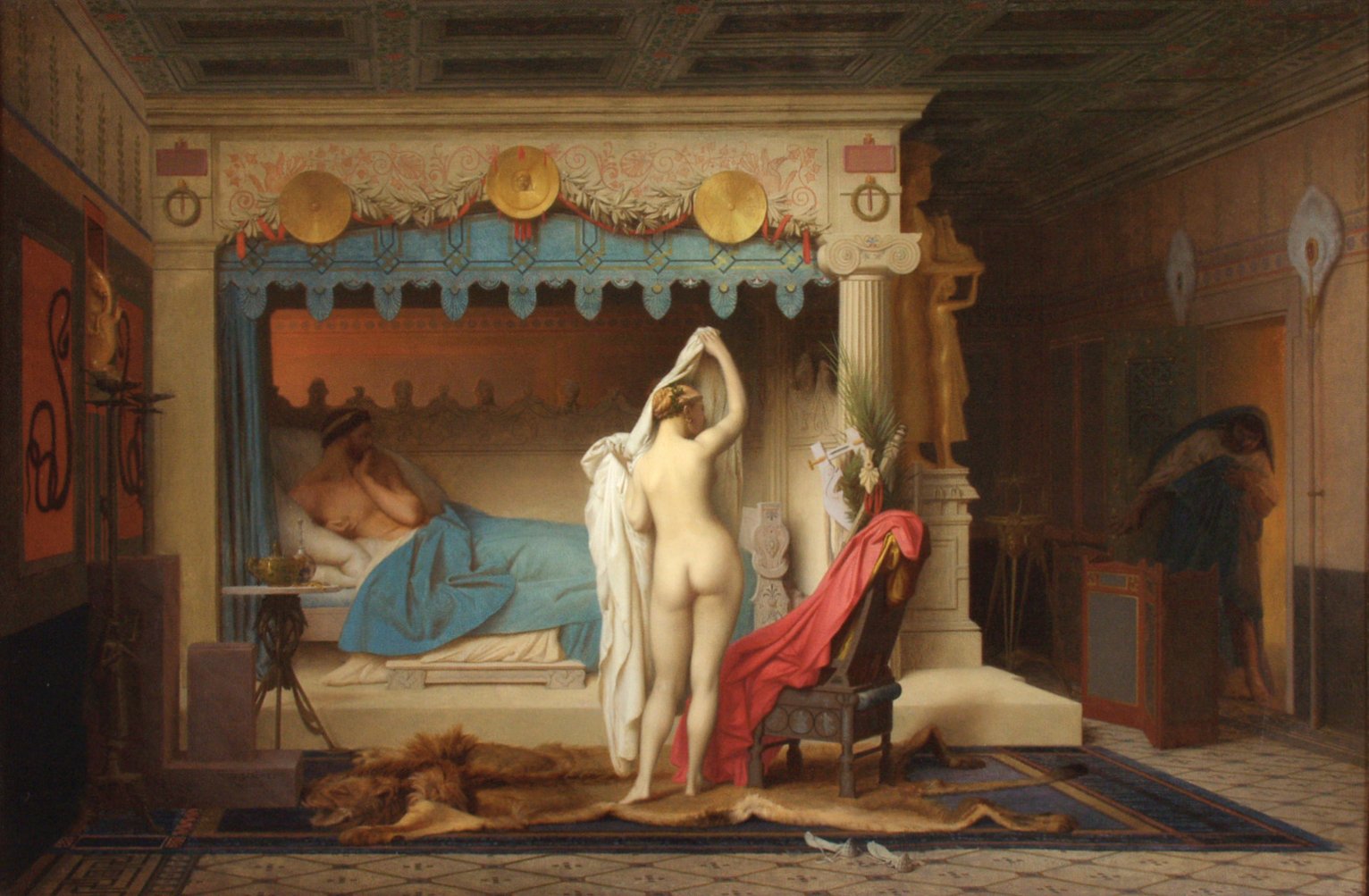
Herodotus, Histories 1.11.4 · 1.11.4
"He chooses to live"
Read the full text in our reader
Herodotus — οὔκων δὴ ἔπειθε, ἀλλʼ ὥρα ἀναγκαίην ἀληθέως προκειμένην ἢ τὸν δεσπότεα ἀπολλύναι ἢ αὐτὸν ὑπʼ ἄλλων ἀπόλλυσθαι· αἱρέεται αὐτὸς περιεῖναι. ἐπειρώτα δὴ λέγων τάδε.
Gyges — ἐπεί με ἀναγκάζεις δεσπότεα τὸν ἐμὸν κτείνειν οὐκ ἐθέλοντα, φέρε ἀκούσω τέῳ καὶ τρόπῳ ἐπιχειρήσομεν αὐτῷ.
He could not persuade her, but saw that the necessity truly lay before him either to destroy his master or himself to perish at the hands of others; he chooses to survive himself. So he asked her this: "Since you force me to kill my master against my will, come, let me hear in what way we will attack him."
Word by word
The setting
Gyges gives in. The grammar changes with him.
A note on this passage
Herodotus drops into the present tense for the decision: <em>haireetai autos perieinai</em>, "he chooses to survive himself." The verb is the one behind <em>hairesis</em>, the "choice" the queen offered in 1.11.2. She gave him a choice; he chooses. The narrator does not comment on it, praise it or blame it. He lets the grammar record the moment the road forks.
Then watch the pronouns in Gyges' question. It begins with the grievance, "since <em>you</em> force <em>me</em> to kill my master against my will," and ends with a partnership: "in what way will <em>we</em> attack him?" (<em>epicheirēsomen</em>, first person plural). In one sentence the unwilling servant becomes a fellow conspirator. The man who would not look at the queen because it was against custom is, a few words later, planning the king's murder with her.
Read the full commentary — and tap any word for its dictionary entry — in the interlinear reader.
Open Herodotus, Histories 1.11.4 in the full reader
Always open passages in the reader
From the Great Library
You are reading a page of the Herodotus, Histories — the whole book is free in our interlinear reader.
The Great Library Project presses the classics in their original languages, glossed word by word — free to read, always. Browse the whole library.
Also on our shelves:
Herodotus, Histories 1.11.4 — The Great Library Project interlinear edition · greatlibraryproject.com/book/herodotus/1.11.4/