Herodotus, Histories 1.12.1 · 1.12.1
Behind the same door
Read the full text in our reader
Herodotus — Ὡς δὲ ἤρτυσαν τὴν ἐπιβουλήν, νυκτὸς γενομένης ( οὐ γὰρ ἐμετίετο ὁ Γύγης, οὐδέ οἱ ἦν ἀπαλλαγὴ οὐδεμία, ἀλλʼ ἔδεε ἢ αὐτὸν ἀπολωλέναι ἢ Κανδαύλεα) εἵπετο ἐς τὸν θάλαμον τῇ γυναικί, καί μιν ἐκείνη, ἐγχειρίδιον δοῦσα, κατακρύπτει ὑπὸ τὴν αὐτὴν θύρην.
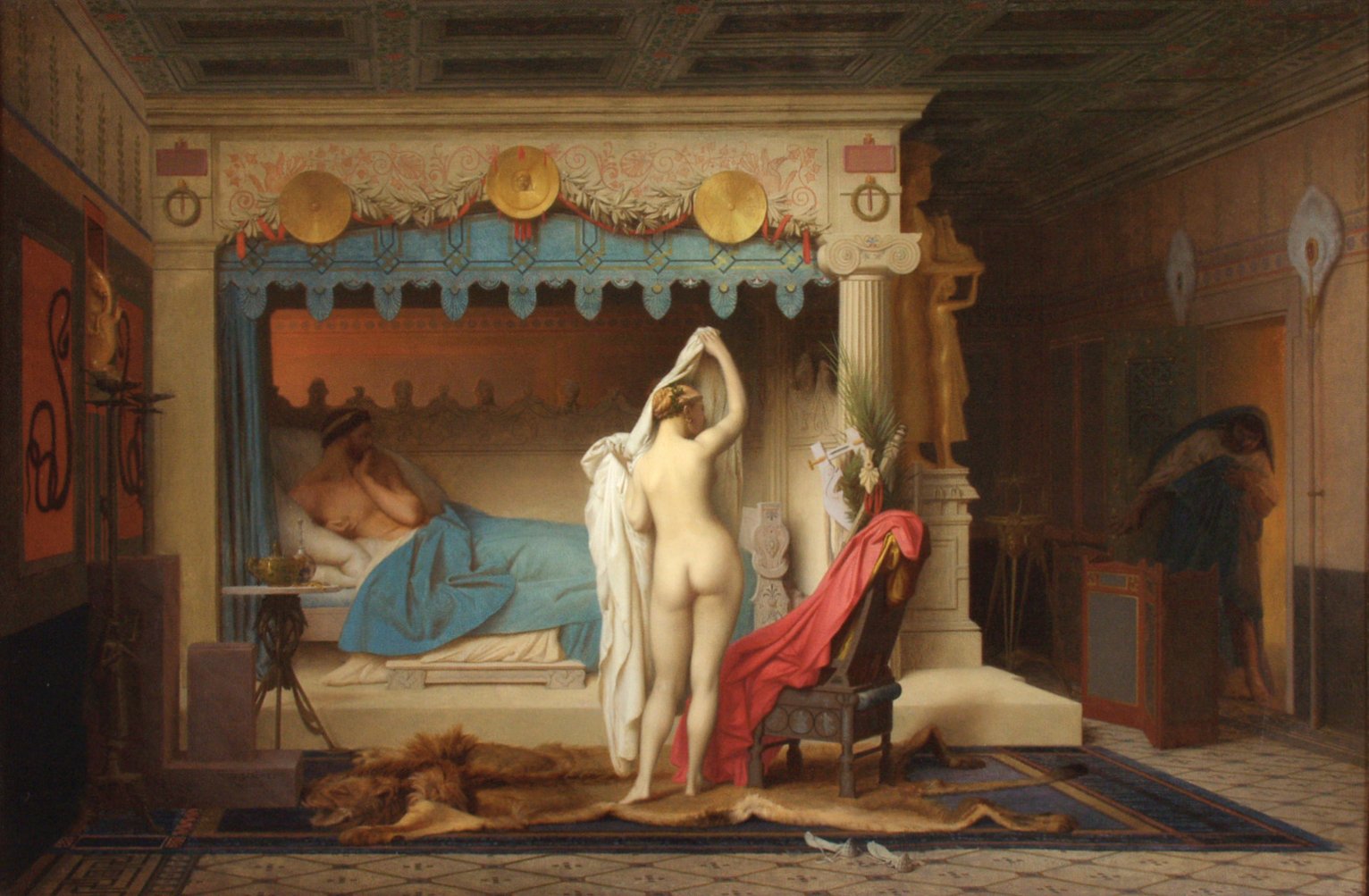
When they had arranged the plot and night had come (for Gyges was not let off, nor was there any way out for him, but either he or Candaules had to die), he followed the woman into the bedroom; and she gave him a dagger and hid him behind the same door.
Word by word
The setting
Night comes again. The scene of 1.10 is staged a second time, with the parts reversed.
A note on this passage
The last three words carry the story: <em>hypo tēn autēn thyrēn</em>, "behind the same door." Everything from the first night is repeated with the roles reversed. Then Candaules led Gyges into the bedroom; now the queen does. Then the king posted him behind the door to look; now she posts him there with a dagger. The hiding place built for watching becomes a hiding place for killing.
The parenthesis echoes the one before Candaules' first speech. There Herodotus said "it had to go badly for Candaules" (<em>chrēn</em>, 1.8.2); here he says <em>edee</em>, "it had to be," either Gyges or Candaules. Both are verbs of necessity, and they bracket the story. The narrator told us at the start where this was going. What he did not tell us was that the road would lead back through the same door.
Read the full commentary — and tap any word for its dictionary entry — in the interlinear reader.
Open Herodotus, Histories 1.12.1 in the full reader
Always open passages in the reader
From the Great Library
You are reading a page of the Herodotus, Histories — the whole book is free in our interlinear reader.
The Great Library Project presses the classics in their original languages, glossed word by word — free to read, always. Browse the whole library.
Also on our shelves:
Herodotus, Histories 1.12.1 — The Great Library Project interlinear edition · greatlibraryproject.com/book/herodotus/1.12.1/