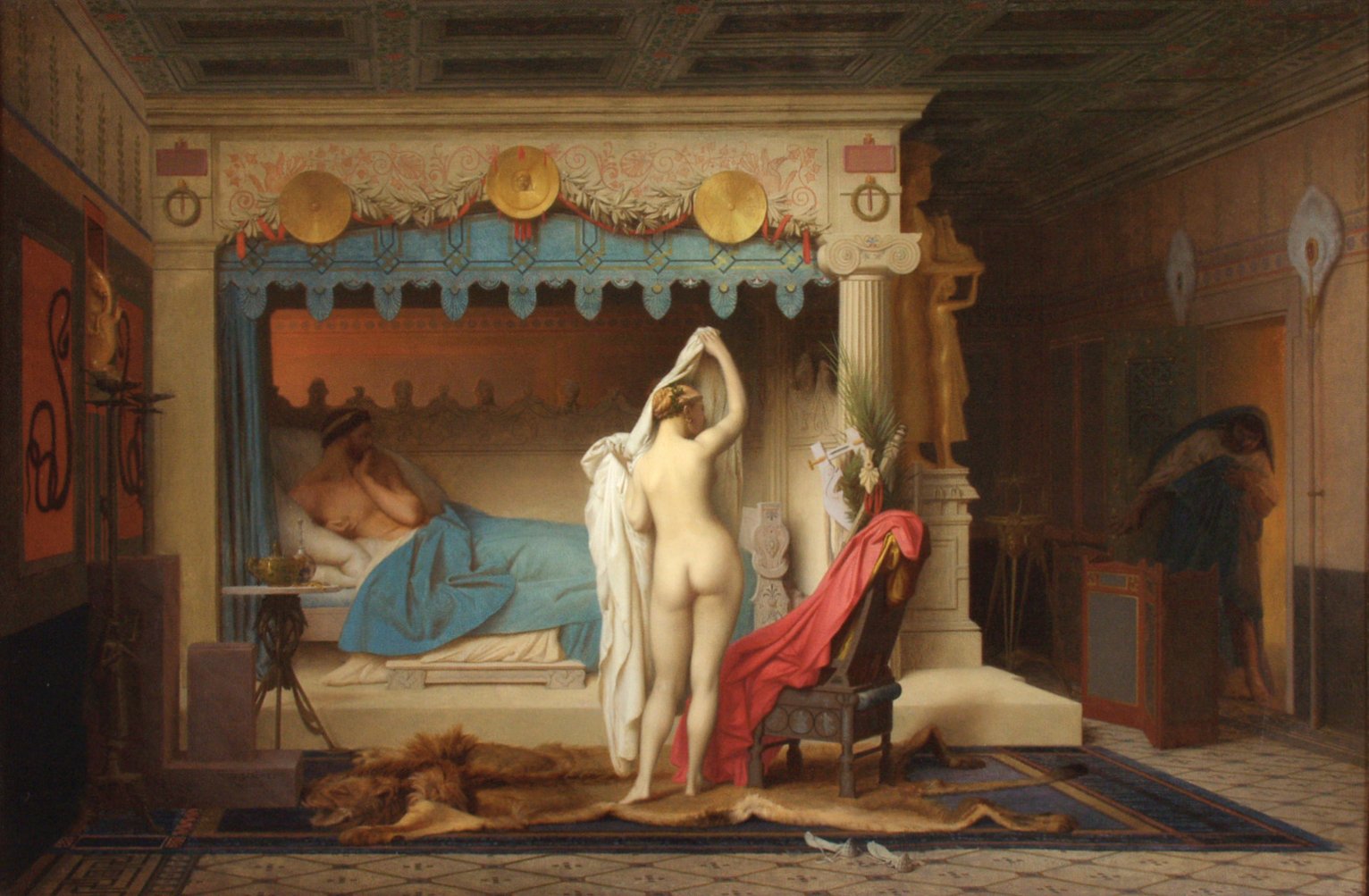
Herodotus, Histories 1.12.2 · 1.12.2
Gyges takes the wife and the kingdom
Read the full text in our reader
Herodotus — καὶ μετὰ ταῦτα ἀναπαυομένου Κανδαύλεω ὑπεκδύς τε καὶ ἀποκτείνας αὐτὸν ἔσχε καὶ τὴν γυναῖκα καὶ τὴν βασιληίην Γύγης τοῦ καὶ Ἀρχίλοχος ὁ Πάριος κατὰ τὸν αὐτὸν χρόνον γενόμενος ἐν ἰάμβῳ τριμέτρῳ ἐπεμνήσθη.
And after this, as Candaules slept, Gyges slipped out and killed him, and won both the wife and the kingdom; Archilochus of Paros, who lived at the same time, also mentioned him in iambic trimeter.
Word by word
The setting
The murder is told in half a sentence. Herodotus ends by naming a poet.
A note on this passage
The killing gets two participles, hypekdys te kai apokteinas, "slipping out and killing." Hypekdys is the verb from the first night (1.10.2), when Gyges "slipped out" unseen after watching the queen undress. The same small movement, repeated, now ends a dynasty. Gyges "had" (esche) the wife and the kingdom: one verb, two possessions, and the woman first.
Then Herodotus names a witness. Archilochus of Paros, the seventh-century poet, did mention Gyges; a surviving fragment, quoted by Aristotle, has a speaker who does not care for "the wealth of Gyges rich in gold." But the sentence here may not be Herodotus's own. Godley's Loeb notes that the editor Stein bracketed "whom Archilochus… mentioned" as superfluous and probably spurious, a later reader's note that slipped into the text. We print it, as Godley does, and flag it, because an inquiry should show its doubts.
Read the full commentary — and tap any word for its dictionary entry — in the interlinear reader.
Open Herodotus, Histories 1.12.2 in the full reader
Always open passages in the reader
From the Great Library
You are reading a page of the Herodotus, Histories — the whole book is free in our interlinear reader.
The Great Library Project presses the classics in their original languages, glossed word by word — free to read, always. Browse the whole library.
Also on our shelves:
Herodotus, Histories 1.12.2 — The Great Library Project interlinear edition · greatlibraryproject.com/book/herodotus/1.12.2/