Herodotus, Histories 1.23.1 · 1.23.1
The greatest marvel of Periander's day
Read the full text in our reader
Περίανδρος δὲ ἦν Κυψέλου παῖς, οὗτος ὁ τῷ Θρασυβούλῳ τὸ χρηστήριον μηνύσας· ἐτυράννευε δὲ ὁ Περίανδρος Κορίνθου· τῷ δὴ λέγουσι Κορίνθιοι ( ὁμολογέουσι δέ σφι Λέσβιοι) ἐν τῷ βίῳ θῶμα μέγιστον παραστῆναι, Ἀρίονα τὸν Μηθυμναῖον ἐπὶ δελφῖνος ἐξενειχθέντα ἐπὶ Ταίναρον, ἐόντα κιθαρῳδὸν τῶν τότε ἐόντων οὐδενὸς δεύτερον, καὶ διθύραμβον πρῶτον ἀνθρώπων τῶν ἡμεῖς ἴδμεν ποιήσαντά τε καὶ ὀνομάσαντα καὶ διδάξαντα ἐν Κορίνθῳ.
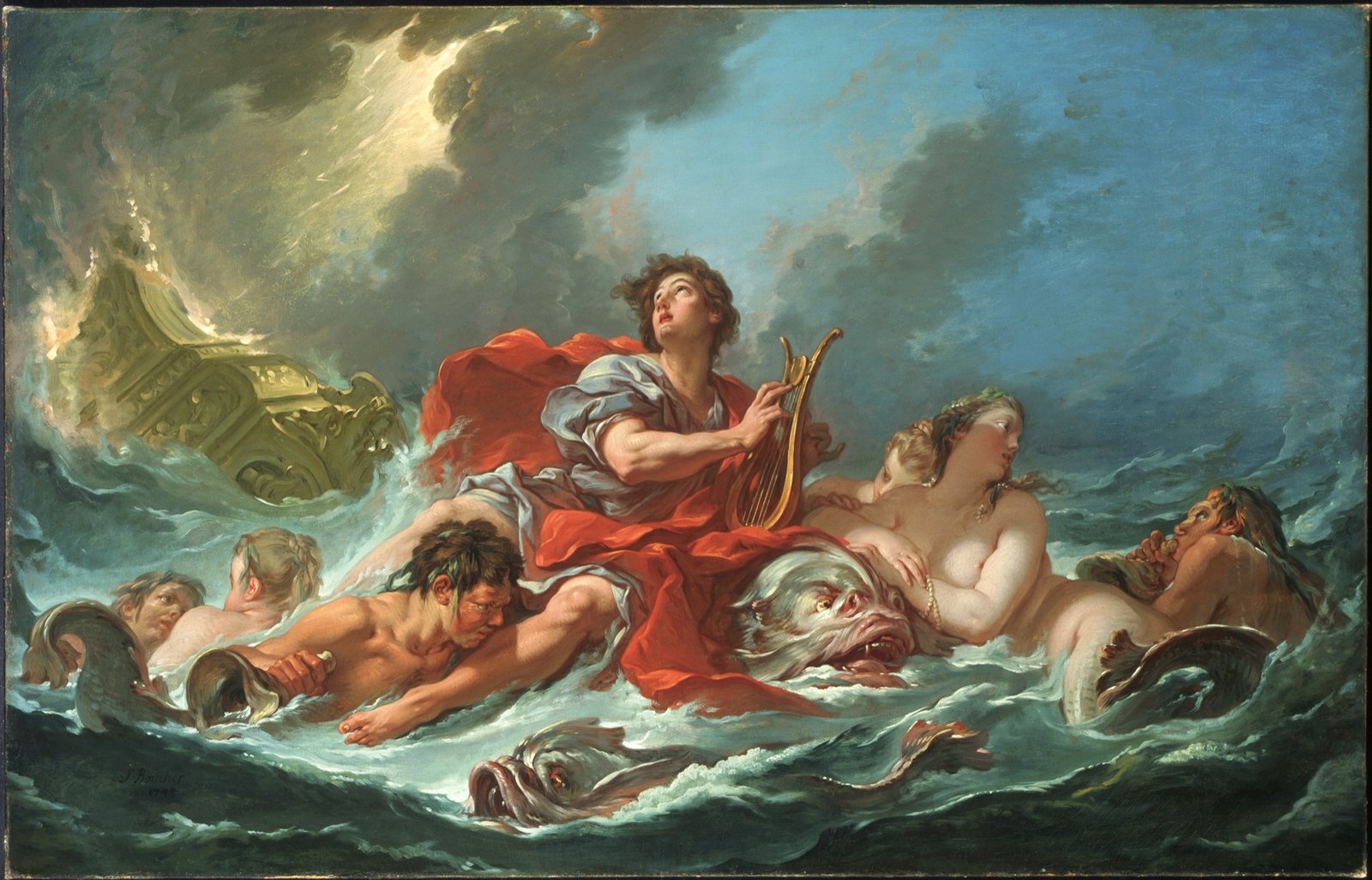
Periander was the son of Cypselus, the one who revealed the oracle to Thrasybulus; Periander was tyrant of Corinth. In his lifetime, the Corinthians say (and the Lesbians agree with them), the greatest marvel happened to him: Arion of Methymna was carried to Taenarum on a dolphin. He was a lyre-singer second to none of those then living, and the first man we know of to compose a dithyramb, give it its name, and produce it at Corinth.
Word by word
The setting
Herodotus has been telling of Lydia's war with Miletus and of Periander, tyrant of Corinth, who passed a secret oracle to his friend Thrasybulus of Miletus. He breaks off for a story the Corinthians tell about Periander's time.
A note on this passage
Before he tells the story, Herodotus tells us who tells it: <em>legousi Korinthioi, homologeousi de sphi Lesbioi</em>, "the Corinthians say, and the Lesbians agree with them." The two communities sit at the two ends of the tale. Arion came from Methymna on Lesbos, and the story ends at Corinth. A report that both ends of it confirm is the nearest thing to a check that a story like this can have, and Herodotus names both. He calls the event a <em>thōma</em>, a marvel, a thing to stare at. He does not say it happened. He says what the people who would know say.
The second half of the sentence is a scrap of music history, one of the oldest notices of its kind. The dithyramb was the choral song sung for Dionysus. Herodotus credits Arion with being the first to compose one, name it, and "teach" it: <em>didaxanta</em>, the Greek word for training a chorus and so for putting on a show. Aristotle says tragedy grew out of the dithyramb. So the man about to be thrown into the sea stands near the beginning of Greek theatre.
Read the full commentary — and tap any word for its dictionary entry — in the interlinear reader.
Open Herodotus, Histories 1.23.1 in the full reader
Always open passages in the reader
From the Great Library
You are reading a page of the Herodotus, Histories — the whole book is free in our interlinear reader.
The Great Library Project presses the classics in their original languages, glossed word by word — free to read, always. Browse the whole library.
Also on our shelves:
Herodotus, Histories 1.23.1 — The Great Library Project interlinear edition · greatlibraryproject.com/book/herodotus/1.23.1/