Herodotus, Histories 1.59.1 · 1.59.1
The cauldrons that boiled without fire
Read the full text in our reader
Τούτων δὴ ὦν τῶν ἐθνέων τὸ μὲν Ἀττικὸν κατεχόμενόν τε καὶ διεσπασμένον ἐπυνθάνετο ὁ Κροῖσος ὑπὸ Πεισιστράτου τοῦ Ἱπποκράτεος τοῦτον τὸν χρόνον τυραννεύοντος Ἀθηναίων. Ἱπποκράτεϊ γὰρ ἐόντι ἰδιώτῃ καὶ θεωρέοντι τὰ Ὀλύμπια τέρας ἐγένετο μέγα· θύσαντος γὰρ αὐτοῦ τὰ ἱρὰ οἱ λέβητες ἐπεστεῶτες καὶ κρεῶν τε ἐόντες ἔμπλεοι καὶ ὕδατος ἄνευ πυρὸς ἔζεσαν καὶ ὑπερέβαλον.
Of these peoples, Croesus learned that the Attic one was held down and divided under the rule of Peisistratus, son of Hippocrates, who was at that time tyrant of the Athenians. For Hippocrates, when he was still a private citizen watching the Olympic games, saw a great portent: when he had made his sacrifice, the cauldrons standing there, full of meat and water, boiled and overflowed with no fire under them.
Word by word
The setting
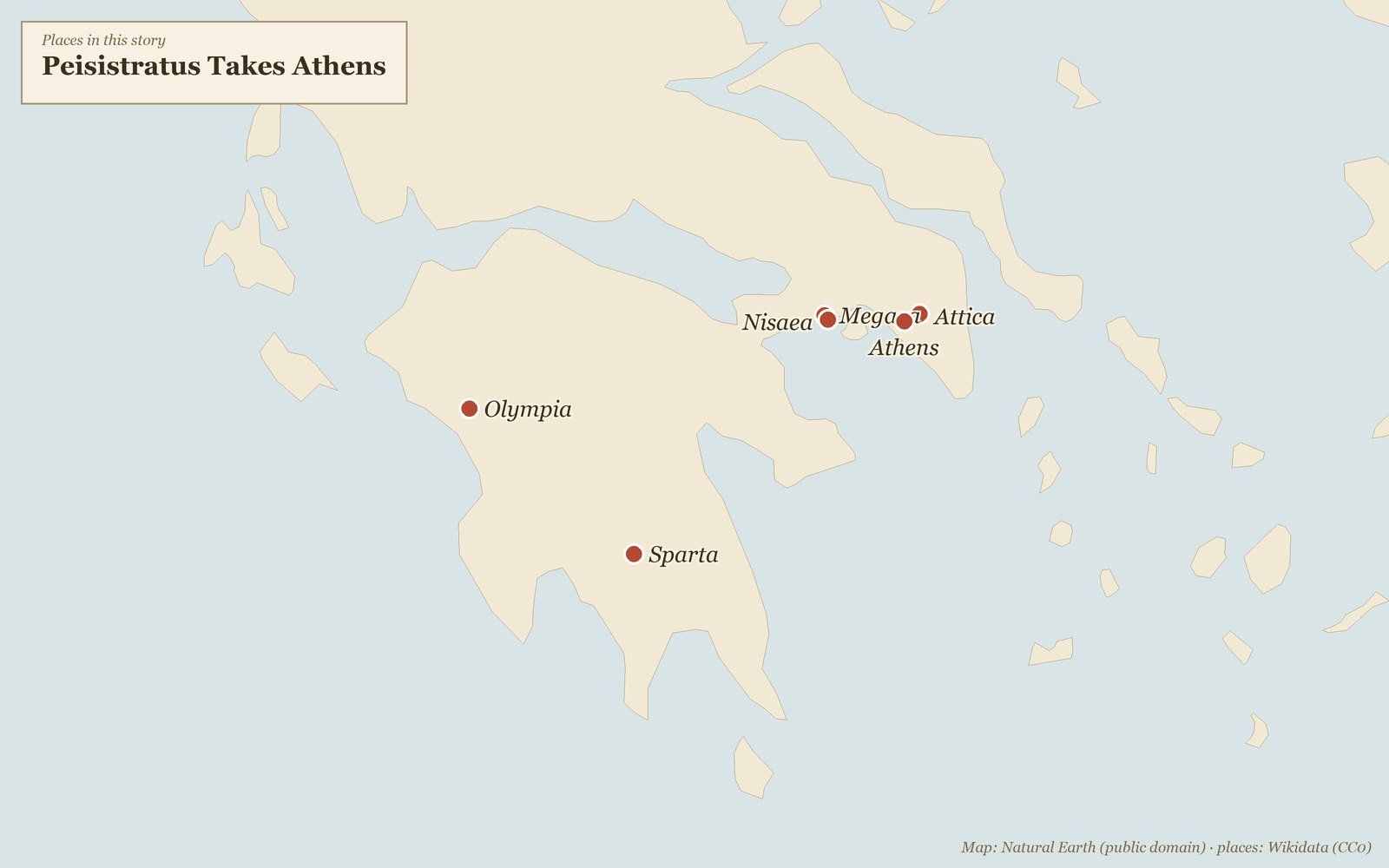
Herodotus returns to Croesus's search for allies: Athens turns out to be divided under a tyrant, and a strange story about that tyrant's father is told first.
A note on this passage
After two chapters of ethnography, Herodotus snaps back to Croesus with a single demonstrative, toutōn, "of these," reminding the reader why any of this mattered: the king is still shopping for allies. What he learns about the Attic people is bruising, two participles stacked back to back, katechomenon, "held down," and diespasmenon, "torn apart," a city gripped and fractured at once. The man gripping it is Peisistratou tou Hippokrateos, Peisistratus son of Hippocrates, named here by his father the way Herodotus names most men of consequence, as if lineage itself were part of the explanation for power.
The digression that follows belongs to the father rather than the son: while Hippocrates was still idiōtēi, "a private citizen," merely watching the games at Olympia, a teras mega, "a great portent," happened to him. The cauldrons standing ready for his sacrifice, already full of meat and water, ezesan kai hyperebalon, "boiled and overflowed," with no fire lit beneath them. Herodotus does not pause to explain how this could happen; a sign that violates nature is exactly the kind of fact his method is built to record first and interpret only through the mouth of someone wiser, which is precisely what the next section supplies.
Read the full commentary — and tap any word for its dictionary entry — in the interlinear reader.
Open Herodotus, Histories 1.59.1 in the full reader
Always open passages in the reader
From the Great Library
You are reading a page of the Herodotus, Histories — the whole book is free in our interlinear reader.
The Great Library Project presses the classics in their original languages, glossed word by word — free to read, always. Browse the whole library.
Also on our shelves:
Herodotus, Histories 1.59.1 — The Great Library Project interlinear edition · greatlibraryproject.com/book/herodotus/1.59.1/