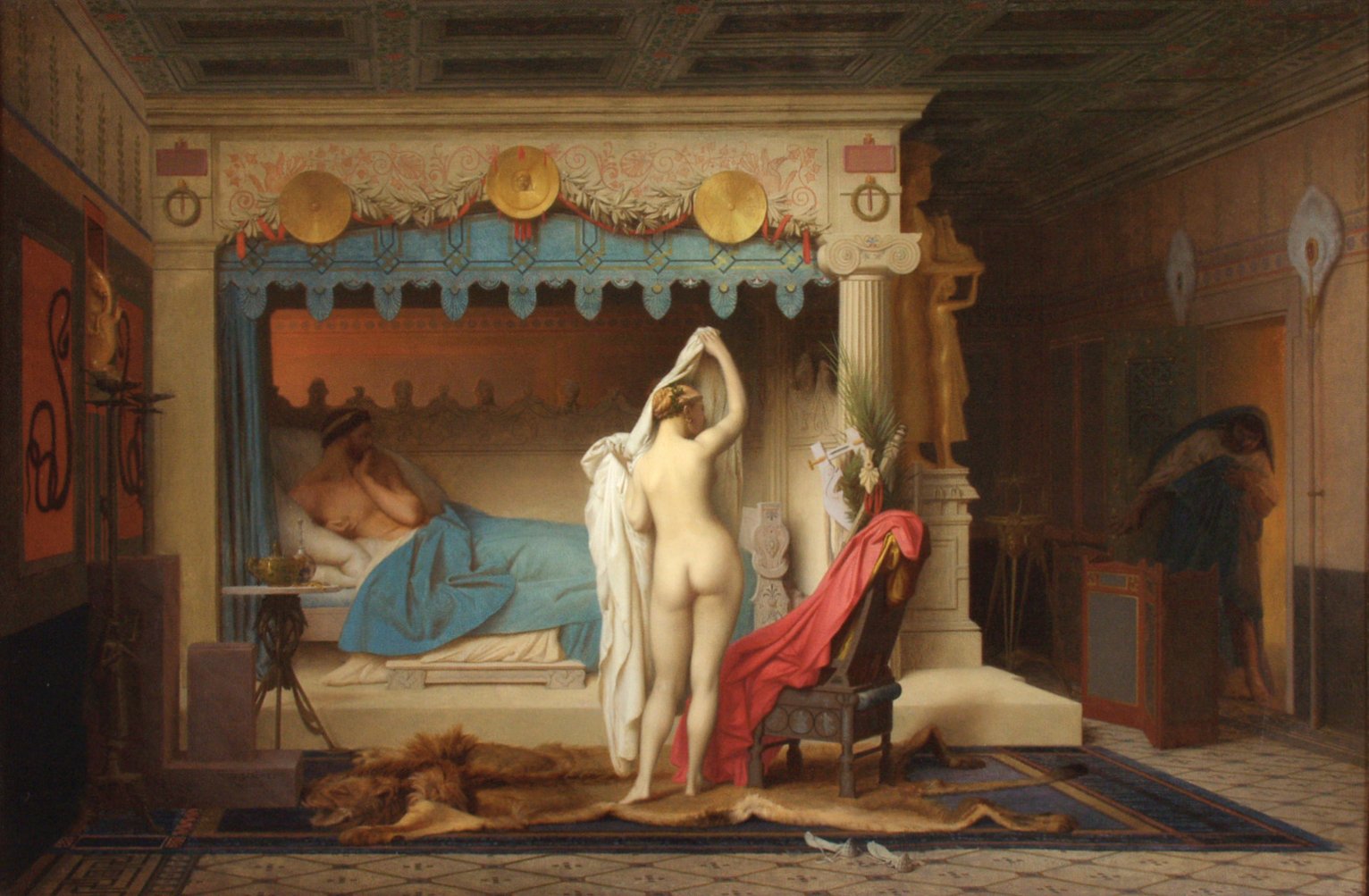
Herodotus, Histories 1.60.4 · 1.60.4
Dressing up a goddess
Read the full text in our reader
ἐν τῷ δήμῳ τῷ Παιανιέι ἦν γυνὴ τῇ οὔνομα ἦν Φύη, μέγαθος ἀπὸ τεσσέρων πηχέων ἀπολείπουσα τρεῖς δακτύλους καὶ ἄλλως εὐειδής· ταύτην τὴν γυναῖκα σκευάσαντες πανοπλίῃ, ἐς ἅρμα ἐσβιβάσαντες καὶ προδέξαντες σχῆμα οἷόν τι ἔμελλε εὐπρεπέστατον φανέεσθαι ἔχουσα, ἤλαυνον ἐς τὸ ἄστυ, προδρόμους κήρυκας προπέμψαντες· οἳ τὰ ἐντεταλμένα ἠγόρευον ἀπικόμενοι ἐς τὸ ἄστυ, λέγοντες τοιάδε·
In the deme of Paeania there was a woman whose name was Phye, three fingers short of four cubits in height, and otherwise fair to look at. They dressed this woman in full armor, mounted her in a chariot, and gave her such a bearing as was likely to appear most becoming, and drove into the city, sending heralds ahead of them, who, on arriving at the city, proclaimed as they had been instructed, saying this.
Word by word
The setting
The trick itself: a tall, striking woman named Phye is dressed as Athena and driven toward the city, heralds running ahead.
A note on this passage
The measuring is the tell: Herodotus gives Phye's height almost to the inch, apo tesserōn pēcheōn apoleipousa treis daktylous, "three finger-breadths short of four cubits," a little under six feet. He is not awed by her; he is sizing her up the way a casting director would, and the next clause confirms it: allōs eueidēs, "otherwise good-looking." This is a woman chosen for a part, height and face both, and the plotters know exactly what they are doing when they pick her.
Then comes the staging, three participles in a row, skeuasantes, "having equipped her," esbibasantes, "having mounted her," prodexantes schēma, "having arranged a pose" for her, each verb a stage direction before the actual performance. Heralds go ahead of the chariot, which is its own piece of theater, since heralds normally carry a king's word, not an advance notice for a parade. By the time the woman in armor comes into view, the entire approach has been rehearsed down to how she will look holding the pose, and Herodotus has shown the reader every seam in the costume before a single Athenian sees it.
Read the full commentary — and tap any word for its dictionary entry — in the interlinear reader.
Open Herodotus, Histories 1.60.4 in the full reader
Always open passages in the reader
From the Great Library
You are reading a page of the Herodotus, Histories — the whole book is free in our interlinear reader.
The Great Library Project presses the classics in their original languages, glossed word by word — free to read, always. Browse the whole library.
Also on our shelves:
Herodotus, Histories 1.60.4 — The Great Library Project interlinear edition · greatlibraryproject.com/book/herodotus/1.60.4/