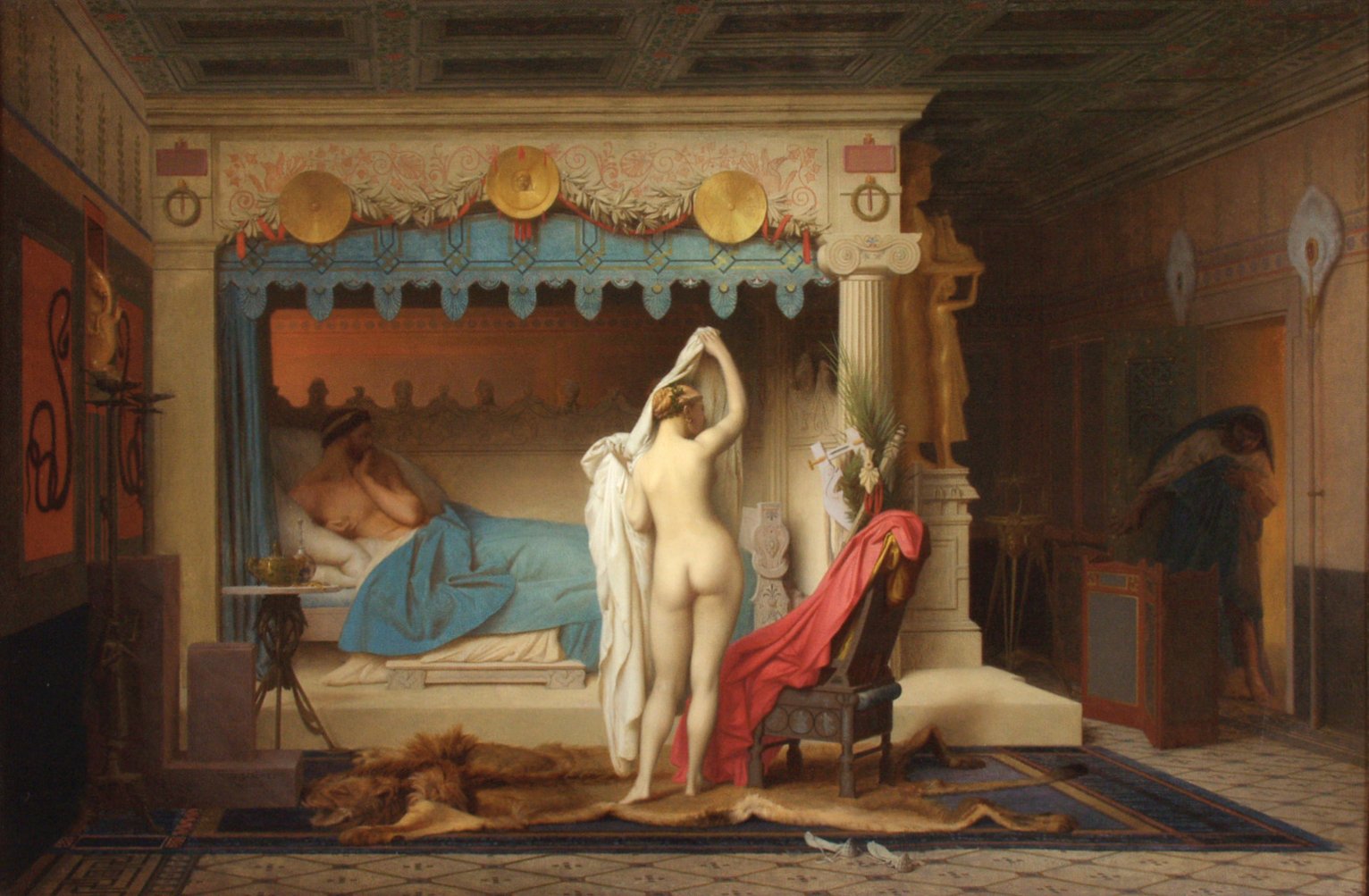
Herodotus, Histories 1.8.1 · 1.8.1
The king who was in love with his wife
Read the full text in our reader
Οὗτος δὴ ὦν ὁ Κανδαύλης ἠράσθη τῆς ἑωυτοῦ γυναικός, ἐρασθεὶς δὲ ἐνόμιζέ οἱ εἶναι γυναῖκα πολλὸν πασέων καλλίστην. ὥστε δὲ ταῦτα νομίζων, ἦν γάρ οἱ τῶν αἰχμοφόρων Γύγης ὁ Δασκύλου ἀρεσκόμενος μάλιστα, τούτῳ τῷ Γύγῃ καὶ τὰ σπουδαιέστερα τῶν πρηγμάτων ὑπερετίθετο ὁ Κανδαύλης καὶ δὴ καὶ τὸ εἶδος τῆς γυναικὸς ὑπερεπαινέων.
Now this Candaules fell in love with his own wife, and being in love, he believed that his wife was by far the most beautiful of all women. Believing this, since there was among his bodyguards one Gyges, son of Dascylus, whom he favoured most, Candaules confided to this Gyges even his weightiest affairs, and above all he kept over-praising his wife's beauty.
Word by word
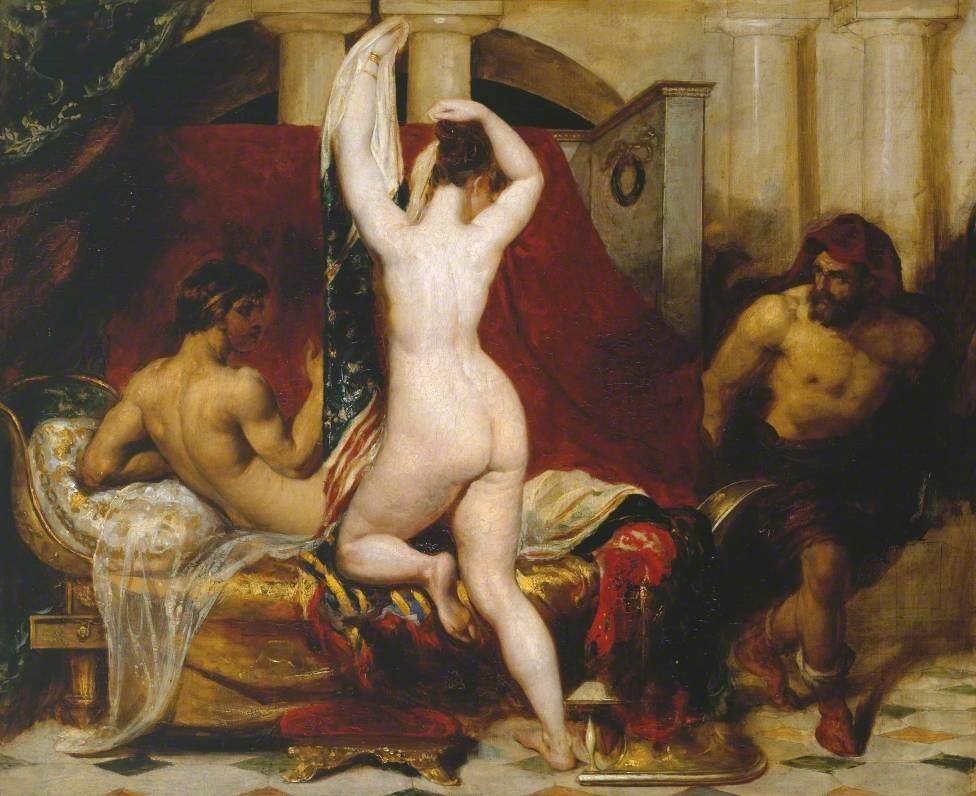
The setting
Herodotus has just said that the kingdom of Lydia passed from the family of Heracles to the family of Croesus. This is how it happened. Candaules, king of Lydia in Sardis in the early seventh century BC, is the last of the old line.
A note on this passage
The first sentence is stranger in Greek than in English. <em>Ērasthē</em> is the verb of <em>erōs</em>, the desire that seizes and unhinges, and Herodotus says Candaules felt it for his own wife. A Greek audience would hear the oddity: a marriage was an alliance and a household, and nobody expected it to run on <em>erōs</em>. Candaules does not simply love his wife. He is possessed by her, and his possession wants a witness.
The word that carries the story is <em>eidos</em>, her "beauty," literally her look, from the same root as <em>idein</em>, "to see." Everything that follows turns on who sees whom. Plato tells a different story about a Gyges who finds a ring that makes him invisible (<em>Republic</em> 2). Herodotus has no ring and no magic. His Gyges becomes invisible the plain way, by standing behind a door.
Read the full commentary — and tap any word for its dictionary entry — in the interlinear reader.
Open Herodotus, Histories 1.8.1 in the full reader
Always open passages in the reader
From the Great Library
You are reading a page of the Herodotus, Histories — the whole book is free in our interlinear reader.
The Great Library Project presses the classics in their original languages, glossed word by word — free to read, always. Browse the whole library.
Also on our shelves:
Herodotus, Histories 1.8.1 — The Great Library Project interlinear edition · greatlibraryproject.com/book/herodotus/1.8.1/