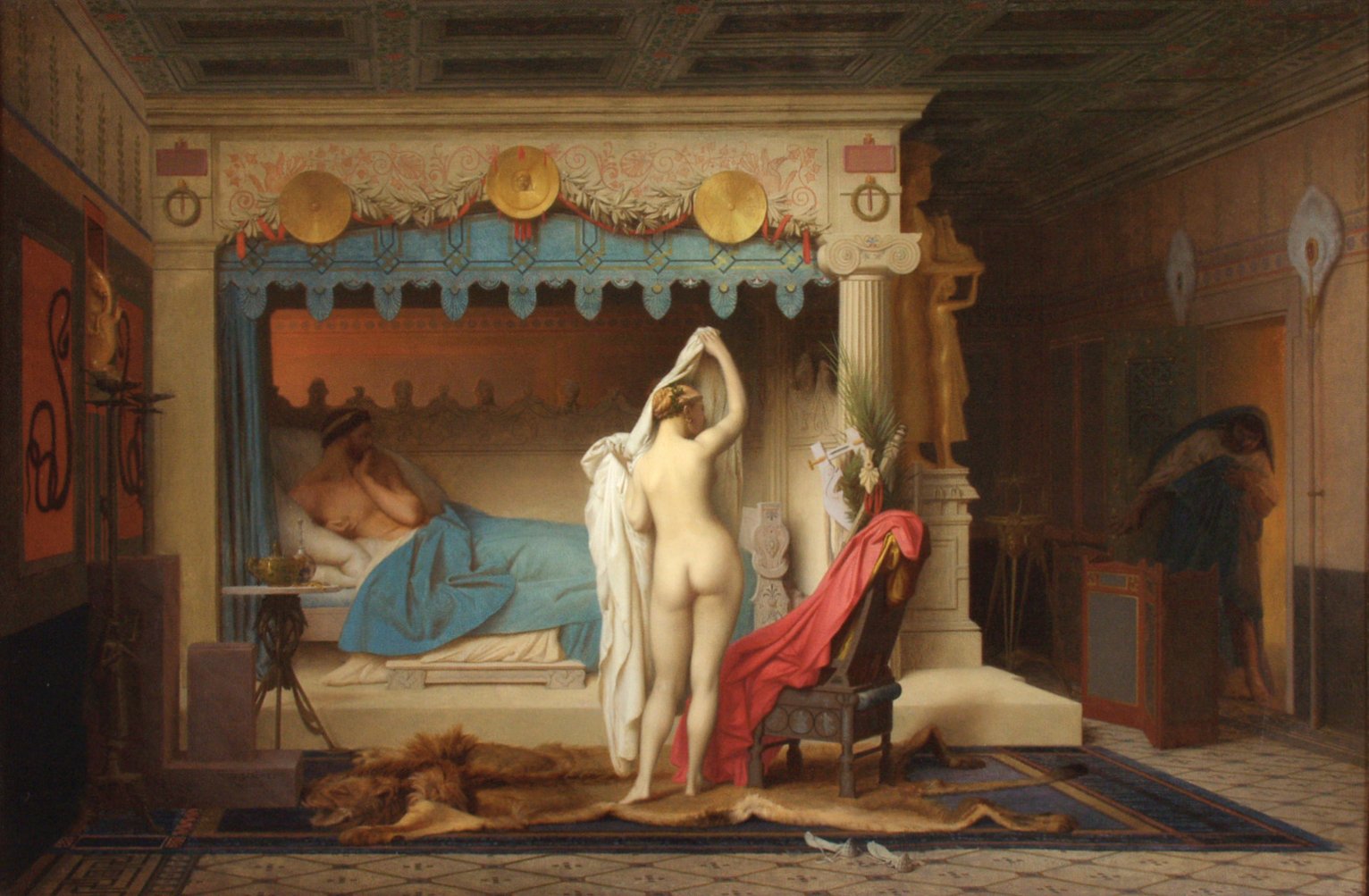
Herodotus, Histories 1.8.3 · 1.8.3
"Along with her tunic, she takes off her shame"
Read the full text in our reader
Herodotus — ὃ δʼ ἀμβώσας εἶπε
Gyges — δέσποτα, τίνα λέγεις λόγον οὐκ ὑγιέα, κελεύων με δέσποιναν τὴν ἐμὴν θεήσασθαι γυμνήν; ἅμα δὲ κιθῶνι ἐκδυομένῳ συνεκδύεται καὶ τὴν αἰδῶ γυνή.
But he cried out and said: "Master, what an unsound word you are speaking, ordering me to look at my mistress naked! A woman takes off her modesty along with her tunic as it comes off."
Word by word
The setting
Gyges answers the king. His reply contains the most quoted sentence in the story.
A note on this passage
Gyges' objection turns on one word, aidōs. English has to choose between "modesty," "shame," and "reverence," and the Greek means all three. Aidōs is the feeling of being seen by people whose regard matters: what keeps a warrior in the line, a guest from overstepping, a woman covered. Gyges says a woman lays it aside with her clothes. He does not mean she becomes shameless. He means that nakedness before an eye that has no right to see her strips her of the one protection she has.
The verbs make the point by doubling. Ekduomenōi and synekduetai, "being stripped off" and "strips off along with it," are the same verb twice, the second with syn, "together." Tunic and honour come away in a single motion. Plutarch, writing about marriage centuries later, disagreed: a good woman, he said, puts on modesty in place of her dress. The sentence was quoted and argued with for as long as Greeks read Herodotus.
Read the full commentary — and tap any word for its dictionary entry — in the interlinear reader.
Open Herodotus, Histories 1.8.3 in the full reader
Always open passages in the reader
From the Great Library
You are reading a page of the Herodotus, Histories — the whole book is free in our interlinear reader.
The Great Library Project presses the classics in their original languages, glossed word by word — free to read, always. Browse the whole library.
Also on our shelves:
Herodotus, Histories 1.8.3 — The Great Library Project interlinear edition · greatlibraryproject.com/book/herodotus/1.8.3/