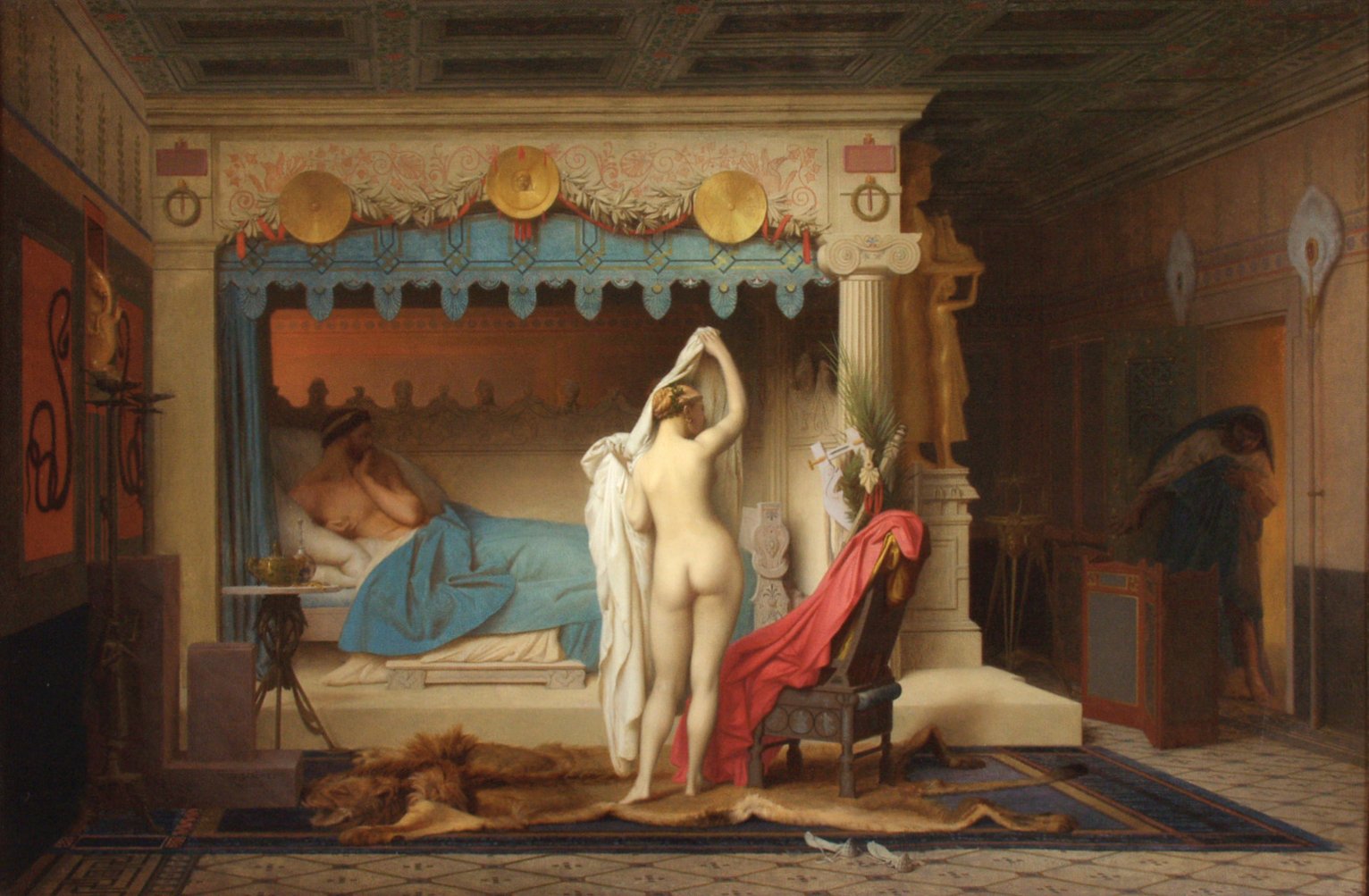
Herodotus, Histories 1.8.4 · 1.8.4
"Let each man look at what is his own"
Read the full text in our reader
Gyges — πάλαι δὲ τὰ καλὰ ἀνθρώποισι ἐξεύρηται, ἐκ τῶν μανθάνειν δεῖ· ἐν τοῖσι ἓν τόδε ἐστί, σκοπέειν τινὰ τὰ ἑωυτοῦ. ἐγὼ δὲ πείθομαι ἐκείνην εἶναι πασέων γυναικῶν καλλίστην, καὶ σέο δέομαι μὴ δέεσθαι ἀνόμων.
"Long ago men discovered the fine rules from which we must learn; and among them is this one: that each man should look at what is his own. I am convinced that she is the most beautiful of all women, and I beg you not to ask for what is lawless."
Word by word
The setting
Gyges goes on pleading. He answers the king's beauty-talk with a proverb.
A note on this passage
Gyges reaches for old wisdom, and the proverb he chooses is about the eyes. Skopeein tina ta heōutou, "that each man should look at his own," usually means "mind your own business." Here it is meant literally. The verb skopeō is the verb of watching and aiming (a skopos is a lookout, and a target). In a story about who may look at whom, the old rule turns into a rule about where to point your eyes.
His last word is anomōn, things outside nomos. Nomos is custom and law at once, and it is the great subject of Herodotus. Later he will tell how Darius asked Greeks and Indians what it would take to make them treat their dead fathers the other's way, and both were horrified; he concludes, quoting Pindar, that custom is king of all (3.38). Gyges does not argue that looking would be ugly or cruel. He argues that it is against nomos, and for Herodotus that is the strongest argument there is.
Read the full commentary — and tap any word for its dictionary entry — in the interlinear reader.
Open Herodotus, Histories 1.8.4 in the full reader
Always open passages in the reader
From the Great Library
You are reading a page of the Herodotus, Histories — the whole book is free in our interlinear reader.
The Great Library Project presses the classics in their original languages, glossed word by word — free to read, always. Browse the whole library.
Also on our shelves:
Herodotus, Histories 1.8.4 — The Great Library Project interlinear edition · greatlibraryproject.com/book/herodotus/1.8.4/