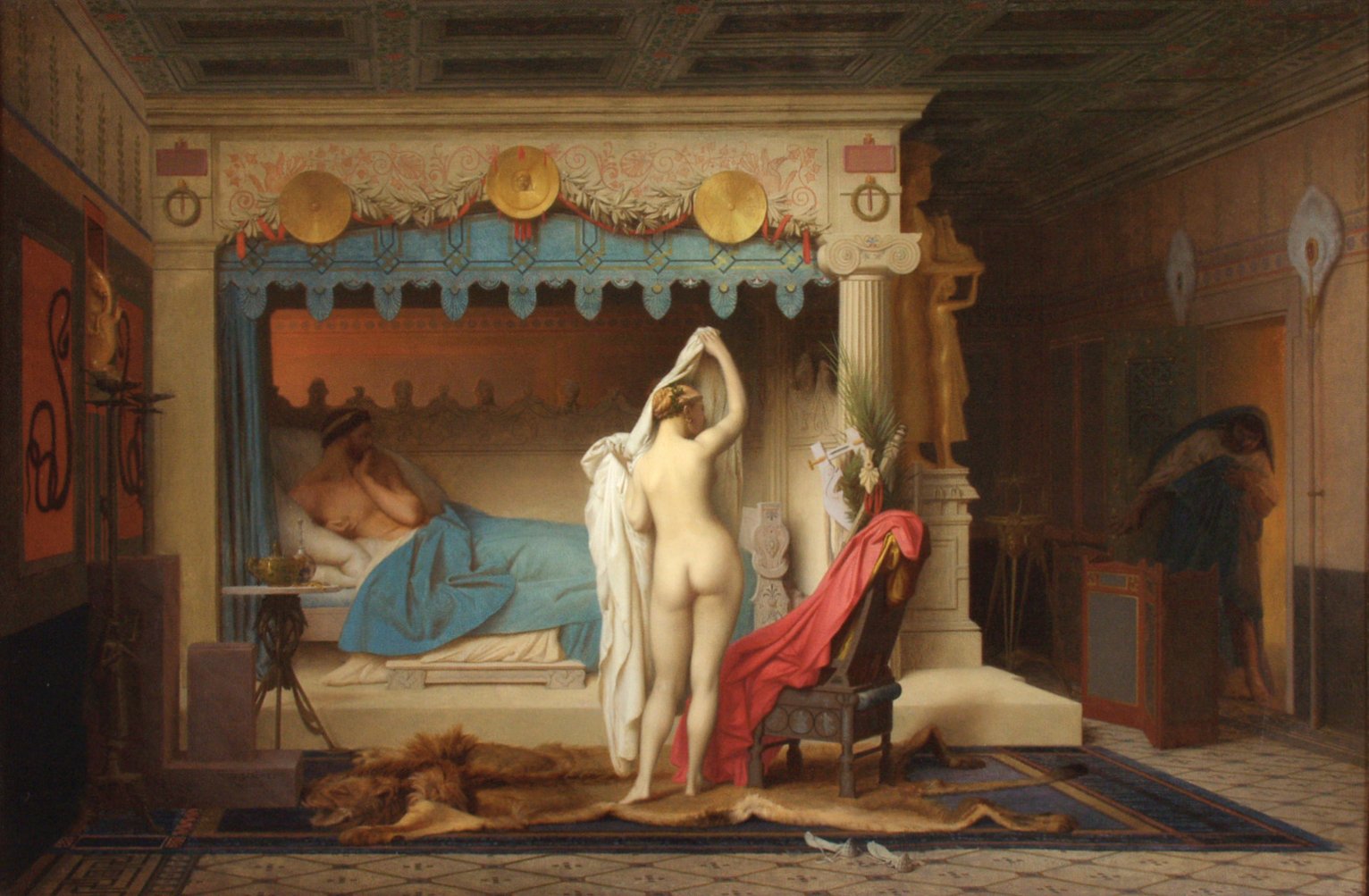
Herodotus, Histories 1.9.1 · 1.9.1
"She will not even know she was seen"
Read the full text in our reader
Herodotus — Ὃ μὲν δὴ λέγων τοιαῦτα ἀπεμάχετο, ἀρρωδέων μή τί οἱ ἐξ αὐτῶν γένηται κακόν, ὃ δʼ ἀμείβετο τοῖσιδε.
Candaules — θάρσεε, Γύγη, καὶ μὴ φοβεῦ μήτε ἐμέ, ὡς σέο πειρώμενος λέγω λόγον τόνδε, μήτε γυναῖκα τὴν ἐμήν, μή τί τοι ἐξ αὐτῆς γένηται βλάβος. ἀρχὴν γὰρ ἐγὼ μηχανήσομαι οὕτω ὥστε μηδὲ μαθεῖν μιν ὀφθεῖσαν ὑπὸ σεῦ.
So he said such things and fought it off, afraid that some harm might come to him from it; but the king answered with these words: "Take heart, Gyges, and do not be afraid, either of me, as if I speak this word to test you, or of my wife, lest some harm come to you from her. For I will contrive it so that she will not even know that she was seen by you at all."
Word by word
The setting
Gyges has refused. Candaules answers the fear Gyges has not quite said aloud.
A note on this passage
Candaules reads Gyges' fear correctly and then answers the wrong half of it. A bodyguard asked to look at the queen would suspect a trap, a test of loyalty, and the king rules that out first: I am not testing you. (The printed Loeb page records that the editor Heinrich Stein proposed changing one letter here, <em>peirōmenon</em> for <em>peirōmenos</em>, which would make it "that I say this to test you"; the sense is the same.) Then he rules out the wife, which is where the danger actually lies.
His confidence rests on a verb of craft, <em>mēchanēsomai</em>, "I will contrive it," the verb behind <em>mēchanē</em>, a device or machine. And his guarantee is exact: she will not even <em>learn</em> (<em>mathein</em>) that she was seen. Herodotus keeps that verb in reserve. When it comes back in the next chapter, it is the queen who learns.
Read the full commentary — and tap any word for its dictionary entry — in the interlinear reader.
Open Herodotus, Histories 1.9.1 in the full reader
Always open passages in the reader
From the Great Library
You are reading a page of the Herodotus, Histories — the whole book is free in our interlinear reader.
The Great Library Project presses the classics in their original languages, glossed word by word — free to read, always. Browse the whole library.
Also on our shelves:
Herodotus, Histories 1.9.1 — The Great Library Project interlinear edition · greatlibraryproject.com/book/herodotus/1.9.1/