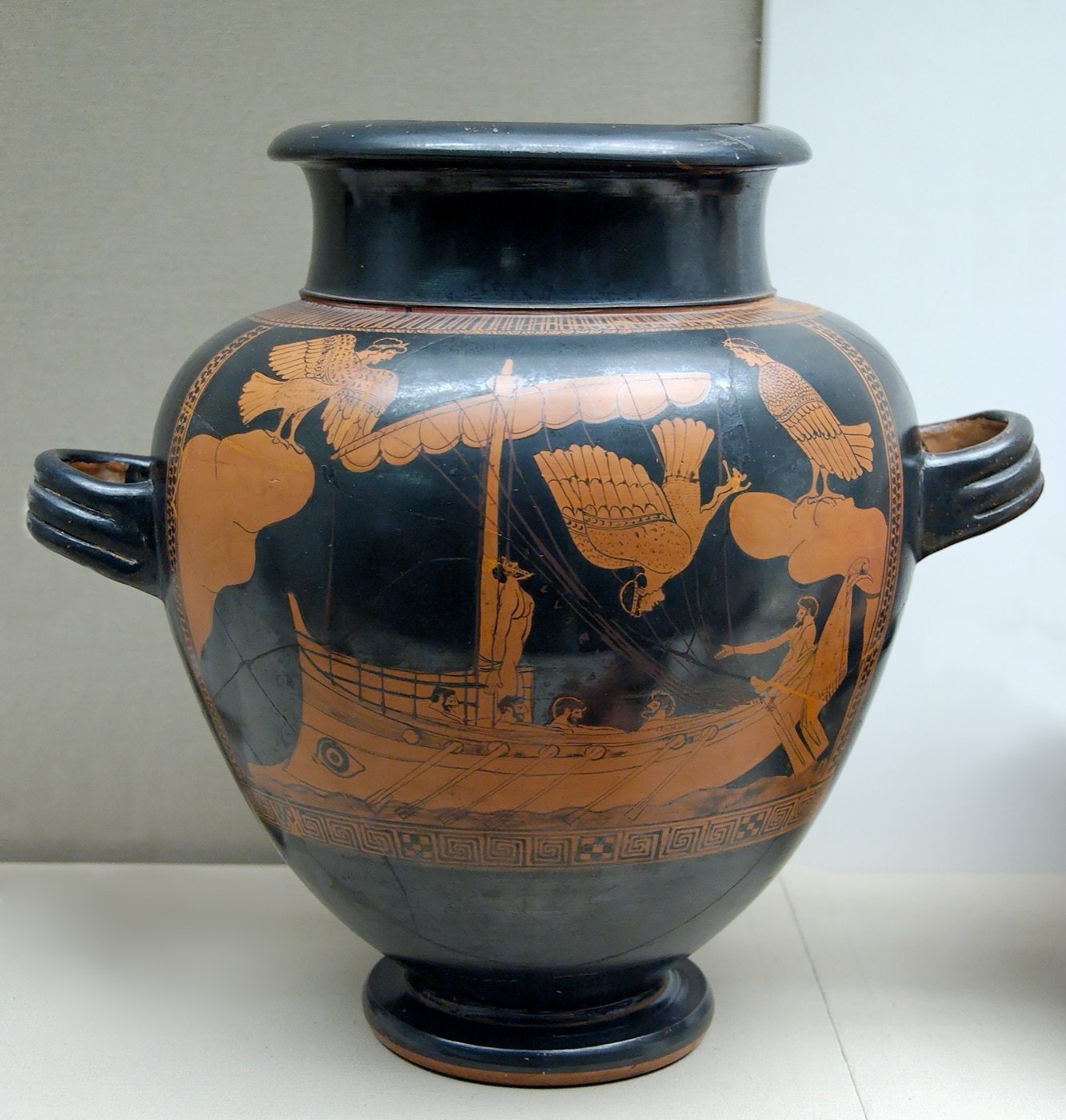
Odyssey 9.468 · Book 9, lines 468–472
No time to weep
Read the full text in our reader
ἀλλʼ ἐγὼ οὐκ εἴων, ἀνὰ δʼ ὀφρύσι νεῦον ἑκάστῳ, κλαίειν, ἀλλʼ ἐκέλευσα θοῶς καλλίτριχα μῆλα πόλλʼ ἐν νηὶ βαλόντας ἐπιπλεῖν ἁλμυρὸν ὕδωρ. οἱ δʼ αἶψʼ εἴσβαινον καὶ ἐπὶ κληῖσι καθῖζον, ἑξῆς δʼ ἑζόμενοι πολιὴν ἅλα τύπτον ἐρετμοῖς.
But I would not allow it, and with my brows I nodded to each man not to weep, but ordered them quickly to fling the many fair-fleeced sheep into the ship and sail the salt water. They at once went aboard and at the oarlocks they sat down, seated in rows, they struck the grey sea with their oars.
Word by word
The setting
The crew begin to mourn their lost shipmates, but Odysseus silences them with a jerk of his brows, orders the plundered sheep loaded aboard, and gets the ship rowing hard out to open water.
A note on this passage
Command in miniature. He forbids the weeping with a look rather than a word, has the sheep loaded, and gets the men aboard and pulling at the oars at once.
The brow-signal is the point: grief is real but dangerous here, and the leader's task is to move the living out of range before they can feel it. The same drive that got them out of the cave now overrides mourning. It keeps them alive — and it is an early glimpse of the hardness that will cost Odysseus dearly later on.
Read the full commentary — and tap any word for its dictionary entry — in the interlinear reader.
Open Odyssey 9.468 in the full reader
Always open passages in the reader
From the Great Library
You are reading a page of the Odyssey — the whole book is free in our interlinear reader.
The Great Library Project presses the classics in their original languages, glossed word by word — free to read, always. Browse the whole library.
Also on our shelves:
Odyssey 9.468 — The Great Library Project interlinear edition · greatlibraryproject.com/book/odyssey/9.468/