Phaedrus 227a · 227a
Socrates Meets Phaedrus
Read the full text in our reader
Socrates — ὦ φίλε Φαῖδρε ποῖ δὴ καὶ πόθεν;
Phaedrus — παρὰ Λυσίου ὦ Σώκρατες τοῦ Κεφάλου, πορεύομαι δὲ πρὸς περίπατον ἔξω τείχους· συχνὸν γὰρ ἐκεῖ διέτριψα χρόνον καθήμενος ἐξ ἑωθινοῦ.
The dialogue opens not in a lecture hall but on a road — two friends meeting by chance, Socrates catching Phaedrus fresh from a whole morning with a speech of the orator Lysias. Everything to come, the great myth of the soul and the attack on writing, grows out of this walk outside the city wall. Plato almost always begins in the ordinary: a greeting, a question about where someone has been.
Word by word
The setting
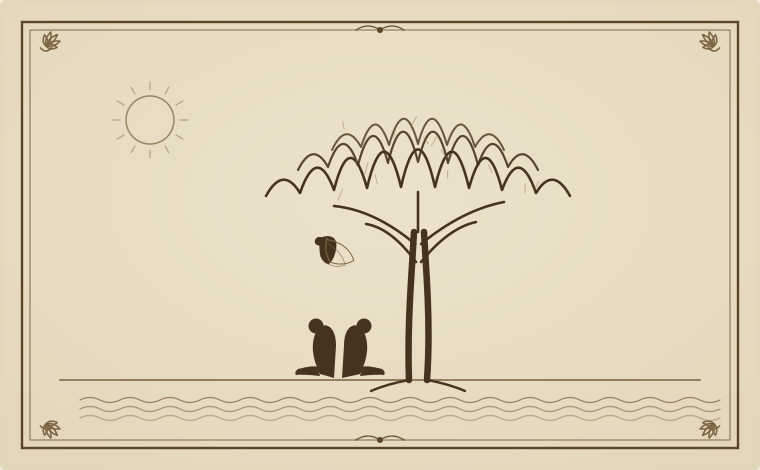
The dialogue's opening. Socrates runs into Phaedrus on a road; Phaedrus is coming from a morning spent with a speech by the orator Lysias and is off for a walk outside the city wall.
A note on this passage
The setting is quietly pointed. Socrates is famously a creature of the city — he says later in this very dialogue (230d) that he learns nothing from trees and open country, only from people in the town. That he is being drawn <em>outside the walls</em>, and will soon be walking barefoot in the Ilissus, is the first sign that this conversation will be an exception. Eros and inspired speech are about to lure even Socrates out of his element — and the whole <em>Phaedrus</em> unfolds in that unusual open air.
Read the full commentary — and tap any word for its dictionary entry — in the interlinear reader.
Open Phaedrus 227a in the full reader
Always open passages in the reader
From the Great Library
You are reading a page of the Phaedrus — the whole book is free in our interlinear reader.
The Great Library Project presses the classics in their original languages, glossed word by word — free to read, always. Browse the whole library.
Also on our shelves:
Phaedrus 227a — The Great Library Project interlinear edition · greatlibraryproject.com/book/phaedrus/227a/