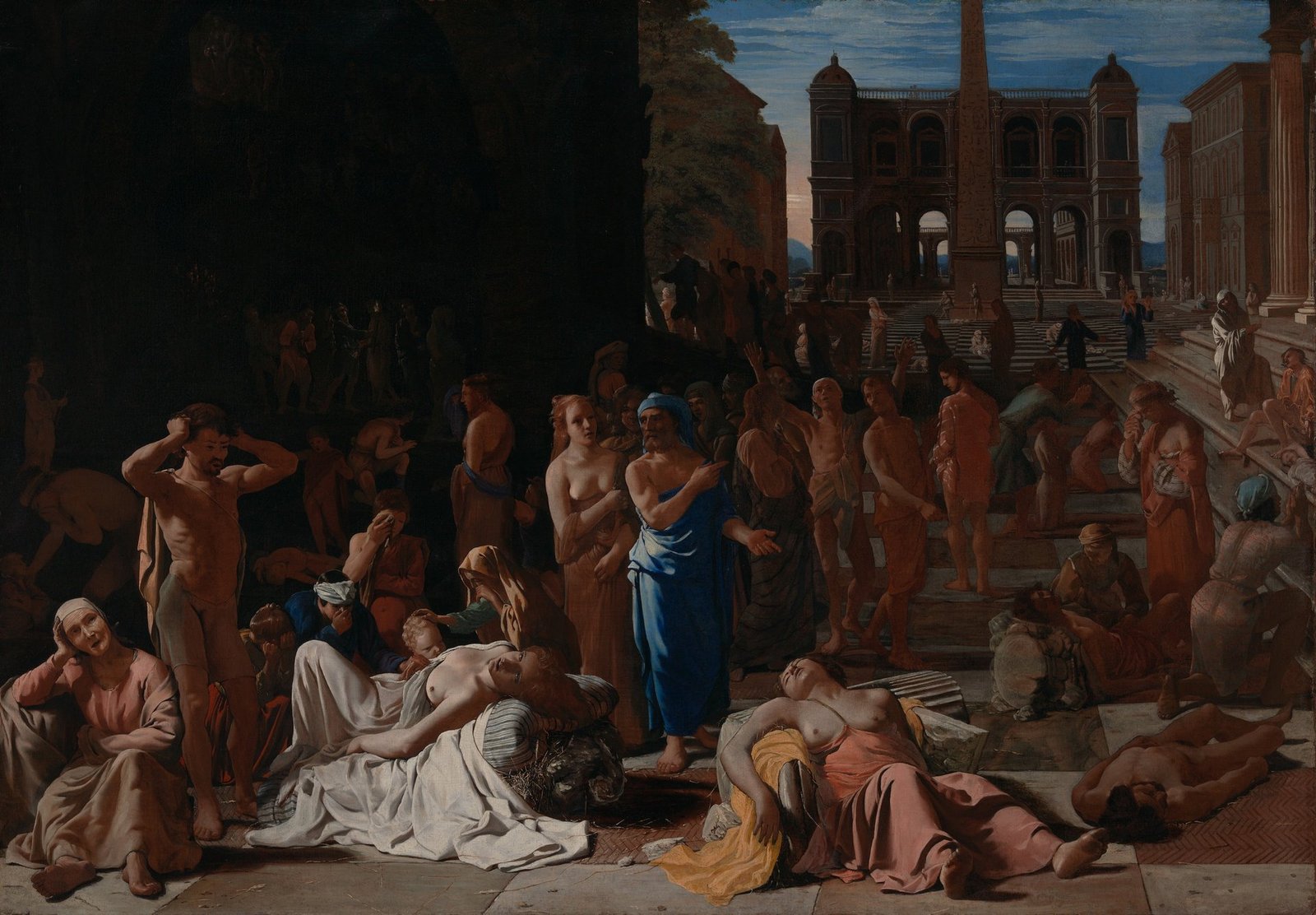
Thucydides, History of the Peloponnesian War 2.51.3 · 2.51.3
No body was strong enough
Read the full text in our reader
σῶμά τε αὔταρκες ὂν οὐδὲν διεφάνη πρὸς αὐτὸ ἰσχύος πέρι ἢ ἀσθενείας, ἀλλὰ πάντα ξυνῄρει καὶ τὰ πάσῃ διαίτῃ θεραπευόμενα.
No body showed itself sufficient against it, whether in strength or in weakness, but it carried off everything, even those treated with every kind of regimen.
Word by word
The setting
Strong or weak, no constitution held out against the disease, and it killed even those who were treated with every kind of regimen.
A note on this passage
The noun sōma, "body," stands here for a person's whole physical make-up, and the adjective autarkes, "self-sufficient," asks whether it could hold out by its own resources. The answer is given with ischys and astheneia, "strength" and "weakness," placed together so that neither the strong nor the weak could count on it. This is a plain denial: a sturdy body was no protection.
The verb xynēirei is old Attic for synairei, "swept away," used with panta, "everything." The last phrase points back to 2.51.2. The word diaita is "way of living," and for those who looked after the sick it meant their whole management of the patient, so pasēi diaitēi is "every regimen." Thucydides says the disease took even these.
Read the full commentary — and tap any word for its dictionary entry — in the interlinear reader.
Open Thucydides, History of the Peloponnesian War 2.51.3 in the full reader
Always open passages in the reader
From the Great Library
You are reading a page of the Thucydides, History of the Peloponnesian War — the whole book is free in our interlinear reader.
The Great Library Project presses the classics in their original languages, glossed word by word — free to read, always. Browse the whole library.
Also on our shelves:
Thucydides, History of the Peloponnesian War 2.51.3 — The Great Library Project interlinear edition · greatlibraryproject.com/book/thucydides/2.51.3/