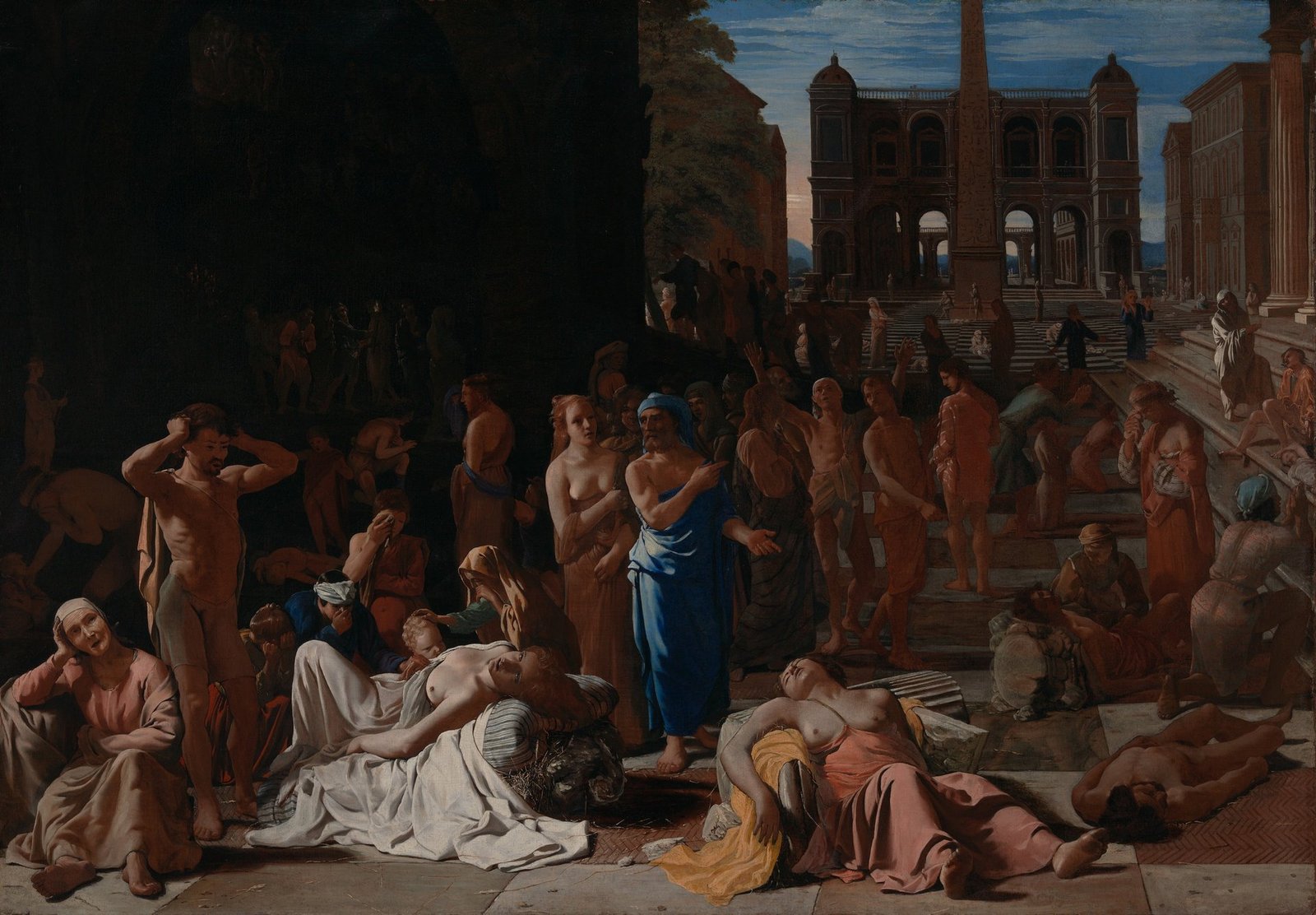
Thucydides, History of the Peloponnesian War 2.54.1 · 2.54.1
Pressed from two sides
Read the full text in our reader
τοιούτῳ μὲν πάθει οἱ Ἀθηναῖοι περιπεσόντες ἐπιέζοντο, ἀνθρώπων τ’ ἔνδον θνῃσκόντων καὶ γῆς ἔξω δῃουμένης.
Such was the disaster into which the Athenians had fallen, and it pressed them hard: their people were dying inside the walls, and outside, their land was being laid waste.
Word by word
The setting
Thucydides sums up the Athenian position after the plague has set in: people dying inside the walls, and the land outside being laid waste.
A note on this passage
The sentence is built as a pair of genitive absolutes, one for each side of the squeeze. Anthrōpōn … ethnēiskontōn, "people dying," is set against gēs … dēioumenēs, "land being ravaged," and the two small adverbs endon, "inside," and exō, "outside," mark the walls as the line between them. Thucydides does not add a comment on either half. The Athenians stand at the middle of the sentence, and the verb epiezonto, "were being pressed," is imperfect, so the pressure goes on while it is described.
The verb peripiptō, literally "to fall around," is the ordinary word for running into a misfortune, and the noun pathos means whatever one suffers. Together they say the Athenians had run into something that happened to them. The ravaging of the land is the Peloponnesian army's work, and the dying is the plague's, so the sentence puts a human enemy and a sickness in one grammatical frame.
Read the full commentary — and tap any word for its dictionary entry — in the interlinear reader.
Open Thucydides, History of the Peloponnesian War 2.54.1 in the full reader
Always open passages in the reader
From the Great Library
You are reading a page of the Thucydides, History of the Peloponnesian War — the whole book is free in our interlinear reader.
The Great Library Project presses the classics in their original languages, glossed word by word — free to read, always. Browse the whole library.
Also on our shelves:
Thucydides, History of the Peloponnesian War 2.54.1 — The Great Library Project interlinear edition · greatlibraryproject.com/book/thucydides/2.54.1/