Thucydides, History of the Peloponnesian War 2.54.5 · 2.54.5
The plague stays out of the Peloponnese
Read the full text in our reader
περὶ μὲν οὖν τοῦ χρηστηρίου τὰ γιγνόμενα ᾔκαζον ὁμοῖα εἶναι· ἐσβεβληκότων δὲ τῶν Πελοποννησίων ἡ νόσος ἤρξατο εὐθύς, καὶ ἐς μὲν Πελοπόννησον οὐκ ἐσῆλθεν, ὅτι καὶ ἄξιον εἰπεῖν, ἐπενείματο δὲ Ἀθήνας μὲν μάλιστα, ἔπειτα δὲ καὶ τῶν ἄλλων χωρίων τὰ πολυανθρωπότατα. ταῦτα μὲν τὰ κατὰ τὴν νόσον γενόμενα.
Now, as to the oracle, people judged that what was happening matched it. For the sickness began as soon as the Peloponnesians invaded, and it did not enter the Peloponnese, at least not to any degree worth mentioning. It spread over Athens most of all, and then over the other places that were the most crowded. So much for what happened with the sickness.
Word by word
The setting
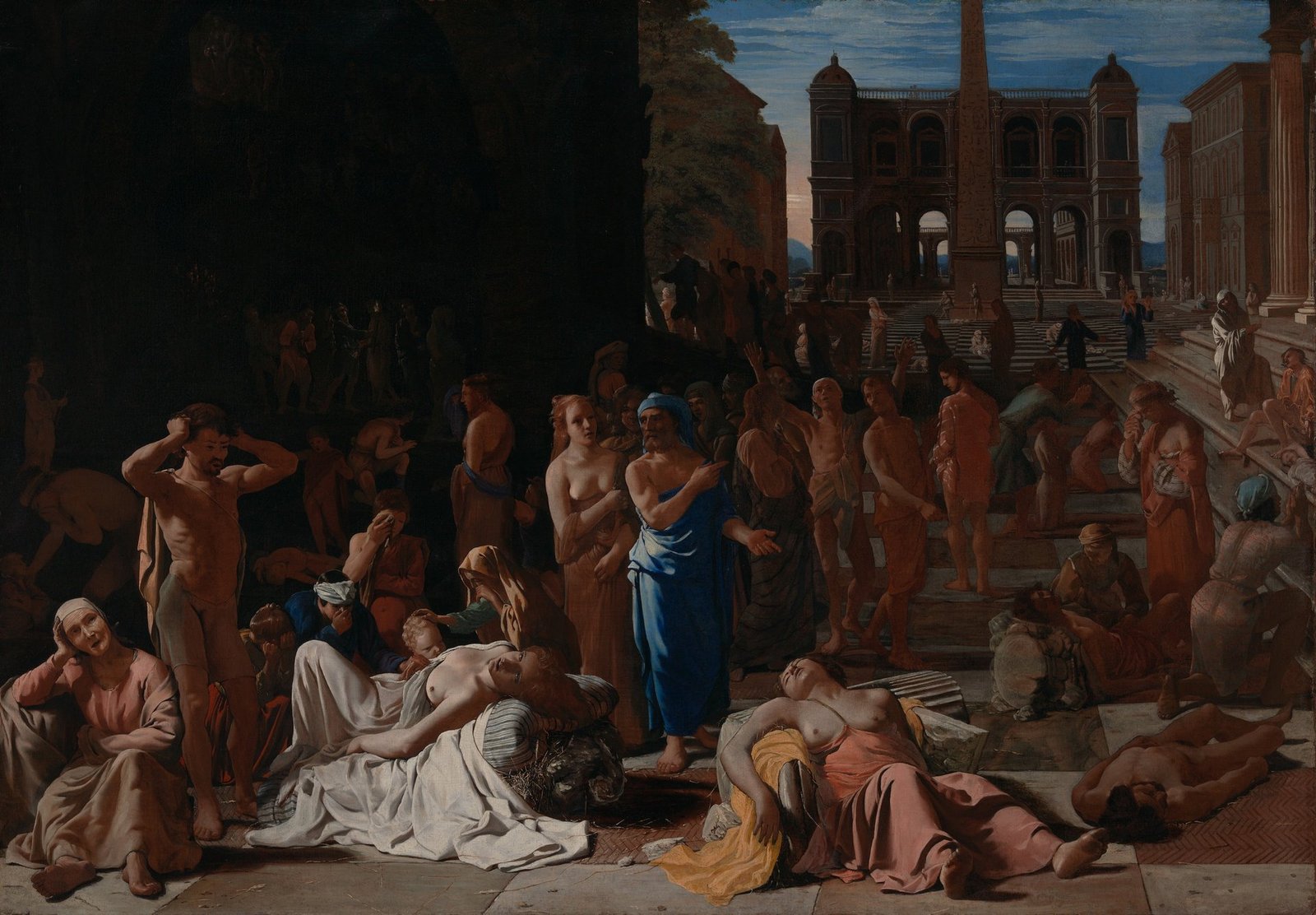
Thucydides ends the oracle discussion: events seemed to match the god's answer, and the plague, which began as the Peloponnesians invaded, spared the Peloponnese but spread over Athens and the most crowded places.
A note on this passage
The first sentence uses eikazō, "to guess" or "to judge by likeness," and its object is homoia, "like." The Athenians compare what is happening, ta gignomena, with the oracle and conclude that the two fit. This is the same reasoning Thucydides has just described in 2.54.3, and he lets the word eikazō carry it without saying whether he agrees. The plague, hē nosos, is called here by the plain word for "sickness," not loimos, so the argument over the verse is left standing.
The verb epeneimato comes from epinemō, which LSJ gives first for turning cattle to graze on another man's land, and then, in the middle voice, for fire or disease spreading. Thucydides applies it to the sickness as it covers Athens first and then the other places with the largest populations, ta polyanthrōpotata. His aside hoti kai axion eipein, "to an extent worth mentioning," admits that the Peloponnese was touched a little and says the amount did not matter. The section closes with tauta men ta kata tēn noson genomena, "so much for what happened regarding the sickness," a short sentence of the kind a writer uses to shut a topic.
Read the full commentary — and tap any word for its dictionary entry — in the interlinear reader.
Open Thucydides, History of the Peloponnesian War 2.54.5 in the full reader
Always open passages in the reader
From the Great Library
You are reading a page of the Thucydides, History of the Peloponnesian War — the whole book is free in our interlinear reader.
The Great Library Project presses the classics in their original languages, glossed word by word — free to read, always. Browse the whole library.
Also on our shelves:
Thucydides, History of the Peloponnesian War 2.54.5 — The Great Library Project interlinear edition · greatlibraryproject.com/book/thucydides/2.54.5/