Plato, Timaeus 22c · 22c
Many destructions of mankind
Read the full text in our reader
Critias — δὲ τούτων αἴτιον τόδε. πολλαὶ κατὰ πολλὰ φθοραὶ γεγόνασιν ἀνθρώπων καὶ ἔσονται, πυρὶ μὲν καὶ ὕδατι μέγισται, μυρίοις δὲ ἄλλοις ἕτεραι βραχύτεραι. τὸ γὰρ οὖν καὶ παρʼ ὑμῖν λεγόμενον, ὥς ποτε Φαέθων Ἡλίου παῖς τὸ τοῦ πατρὸς ἅρμα ζεύξας διὰ τὸ μὴ δυνατὸς εἶναι κατὰ τὴν τοῦ πατρὸς ὁδὸν ἐλαύνειν τά τʼ ἐπὶ γῆς συνέκαυσεν καὶ αὐτὸς κεραυνωθεὶς διεφθάρη, τοῦτο μύθου μὲν σχῆμα ἔχον λέγεται, τὸ δὲ
Critias: reason for this is the following. Many destructions of mankind have happened in many ways, and will happen again, the greatest by fire and by water, and countless others, smaller ones, by other means. For the story told among you too, that Phaethon, the son of Helios, once harnessed his father's chariot and, because he could not drive it along his father's road, burnt up everything on earth and was himself destroyed by a thunderbolt, is told in the shape of a myth. But
Word by word
The setting
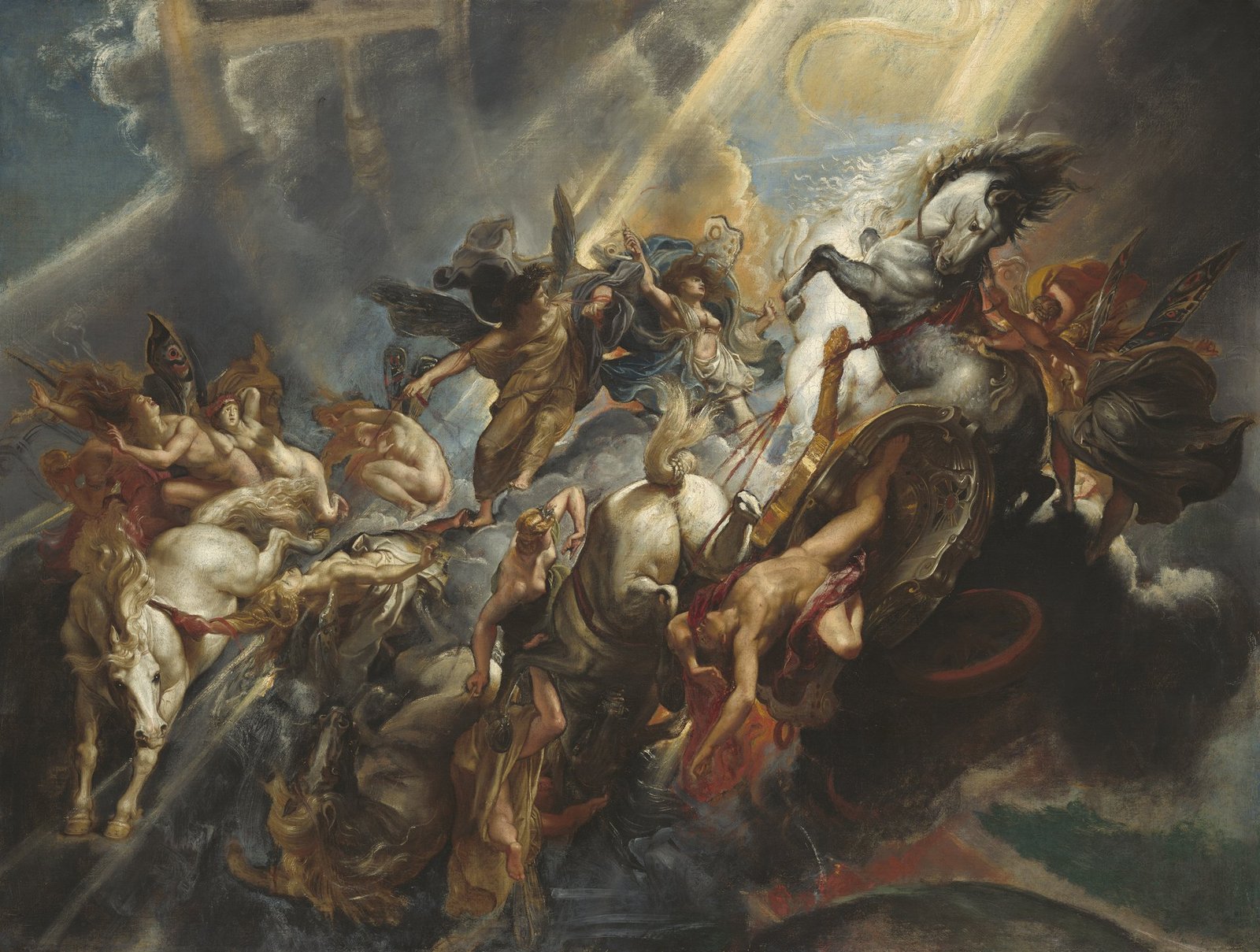
The priest begins to explain why the Greeks have lost their past: mankind has been destroyed many times, and Phaethon is the Greek version of one of them.
A note on this passage
The section opens by finishing the sentence from 22b: to de toutōn aition tode, "the cause of this is the following." The answer is a list built on phthorai, "destructions," which have happened and esontai, will happen. Fire and water are named as the two greatest, pyri men kai hydati, and then myriois de allois, "countless others," each one smaller. The tenses cover past and future together, so the priest is speaking of a repeating pattern.
The Phaethon tale is introduced as something Greeks already tell, to legomenon, "the thing said." Phaethon zeuxas yokes his father's harma, the chariot of Helios, cannot keep to the hodos, the road, burns the earth and is struck down. The priest then labels it mythou schēma, "the shape of a myth." The word schēma means outline or form, so the story has the outline of a myth. The sentence ends with to de, "but the," and the contrast is completed at the start of 22d.
Read the full commentary — and tap any word for its dictionary entry — in the interlinear reader.
Open Plato, Timaeus 22c in the full reader
Always open passages in the reader
From the Great Library
You are reading a page of the Plato, Timaeus — the whole book is free in our interlinear reader.
The Great Library Project presses the classics in their original languages, glossed word by word — free to read, always. Browse the whole library.
Also on our shelves:
Plato, Timaeus 22c — The Great Library Project interlinear edition · greatlibraryproject.com/book/timaeus/22c/