
Odyssey 1.328 · Book 1, lines 328–331
Penelope comes down the stairs
Read the full text in our reader
τοῦ δʼ ὑπερωιόθεν φρεσὶ σύνθετο θέσπιν ἀοιδὴν κούρη Ἰκαρίοιο, περίφρων Πηνελόπεια· κλίμακα δʼ ὑψηλὴν κατεβήσετο οἷο δόμοιο, οὐκ οἴη, ἅμα τῇ γε καὶ ἀμφίπολοι δύʼ ἕποντο.
From her upper chamber the daughter of Icarius, circumspect Penelope, caught his god-inspired song in her mind; and she came down the high stairway of her own house, not alone — two handmaids came with her too.
Word by word
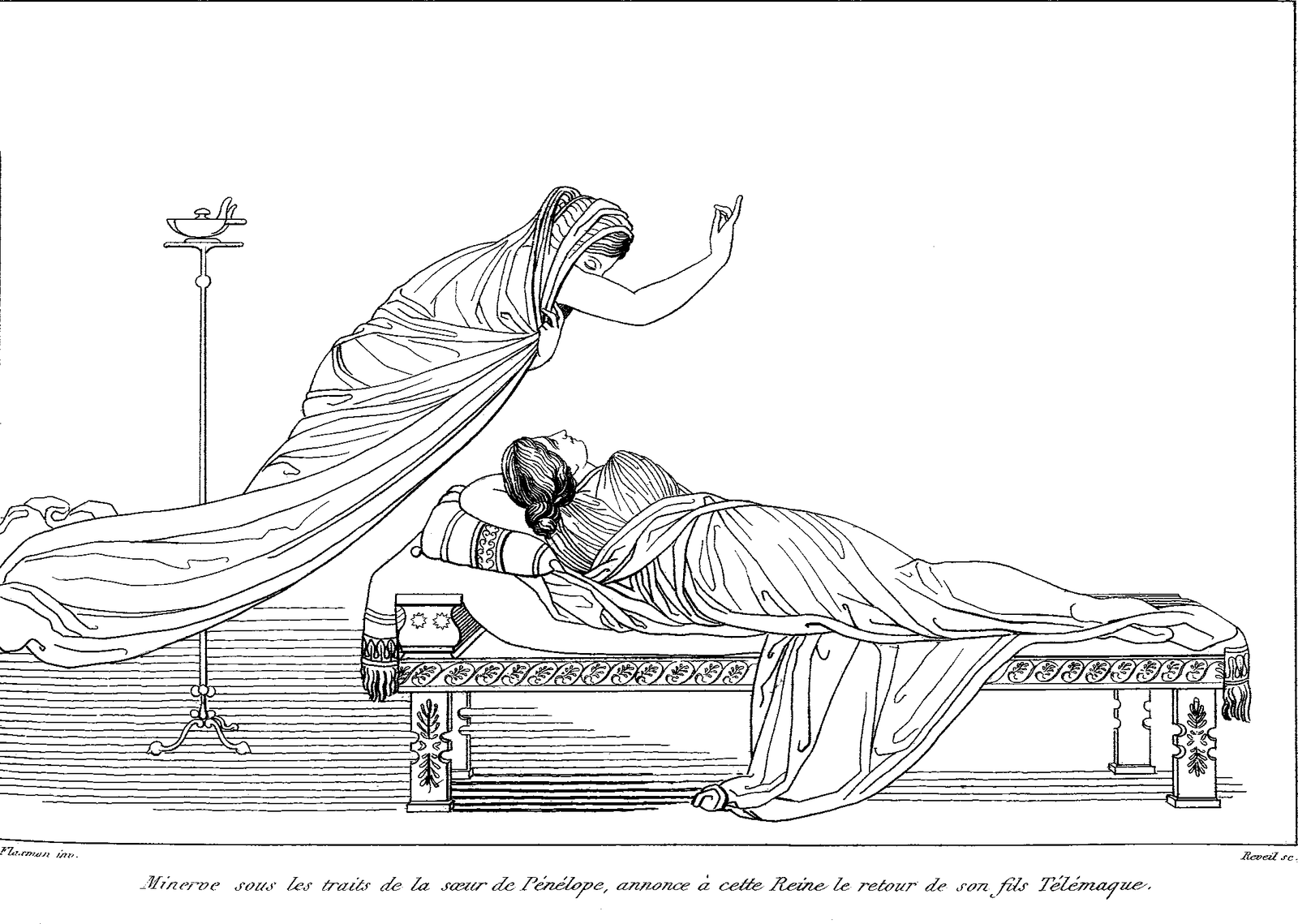
The setting
Upstairs in the women's quarters, Penelope has overheard Phemius's song of the returns from Troy. This is her first appearance in the poem.
A note on this passage
Penelope enters the poem. From the women's quarters upstairs she has been hearing the bard, and the song reaches her — the god-inspired song of the Achaeans' returns. The queen comes down the great staircase of her house, and not by herself: two handmaids attend her.
The undercurrent is that her first appearance is a wound. Of all the poem's people, Penelope is introduced not acting but listening — and to the one subject she cannot bear: the homecomings of the men who came back, when hers did not. She descends already grieving, drawn against her will by the very song. The poem gives us the faithful wife first as a woman undone by a story about coming home.
Read the full commentary — and tap any word for its dictionary entry — in the interlinear reader.
Open Odyssey 1.328 in the full reader
Always open passages in the reader
From the Great Library
You are reading a page of the Odyssey — the whole book is free in our interlinear reader.
The Great Library Project presses the classics in their original languages, glossed word by word — free to read, always. Browse the whole library.
Also on our shelves:
Odyssey 1.328 — The Great Library Project interlinear edition · greatlibraryproject.com/book/odyssey/1.328/