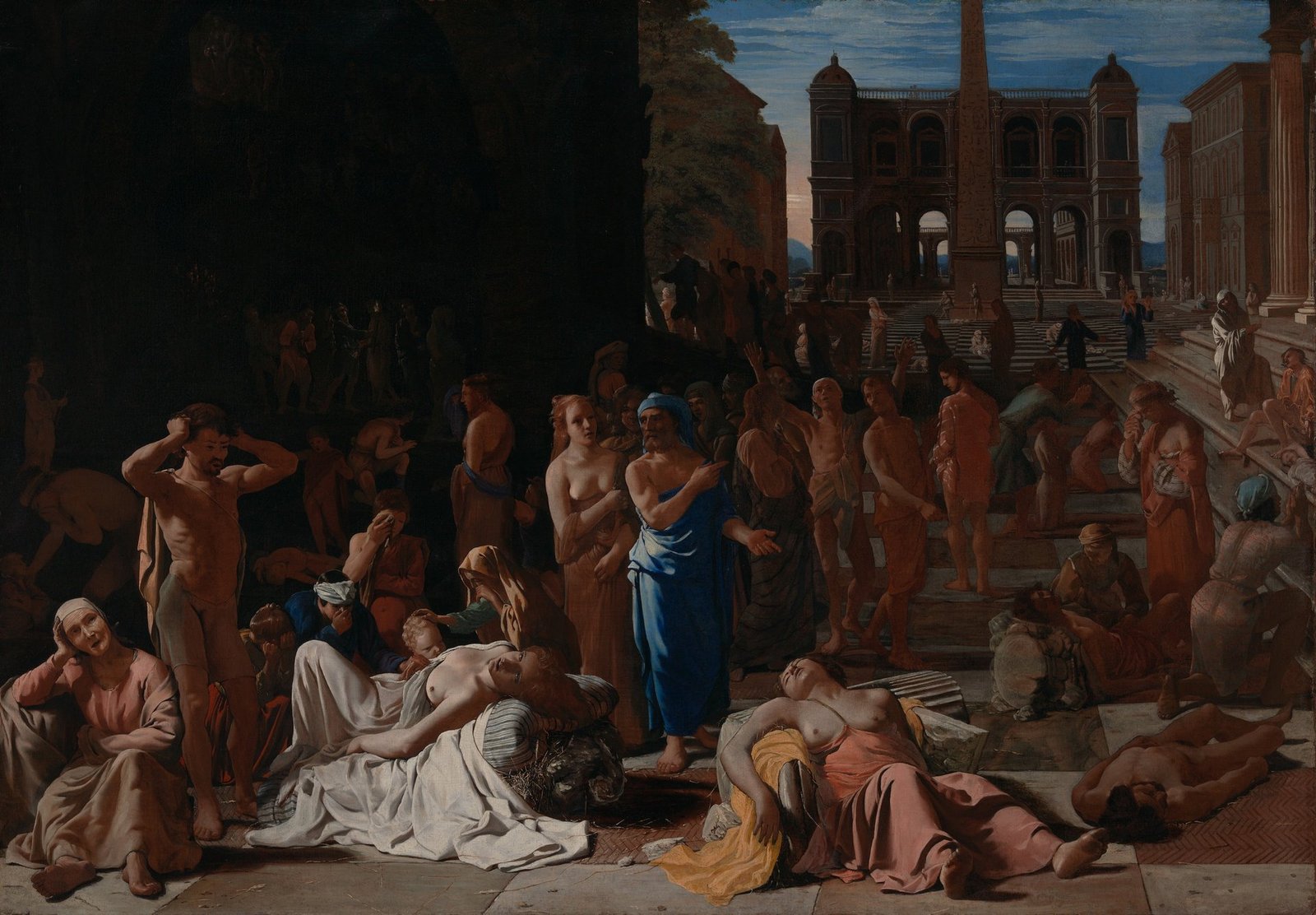
Thucydides, History of the Peloponnesian War 2.49.2 · 2.49.2
Fever, red eyes, a bloody throat
Read the full text in our reader
τοὺς δὲ ἄλλους ἀπ’ οὐδεμιᾶς προφάσεως, ἀλλ’ ἐξαίφνης ὑγιεῖς ὄντας πρῶτον μὲν τῆς κεφαλῆς θέρμαι ἰσχυραὶ καὶ τῶν ὀφθαλμῶν ἐρυθήματα καὶ φλόγωσις ἐλάμβανε, καὶ τὰ ἐντός, ἥ τε φάρυγξ καὶ ἡ γλῶσσα, εὐθὺς αἱματώδη ἦν καὶ πνεῦμα ἄτοπον καὶ δυσῶδες ἠφίει·
The others had been in good health, and with no apparent cause they were suddenly seized, first of all, by strong heats in the head and by redness and burning in the eyes. The parts inside, the throat and the tongue, were bloody at once and gave off a strange and foul breath.
Word by word
The setting
In people who had been well, the sickness starts with strong heat in the head and inflamed eyes, and the throat and tongue turn bloody with foul breath.
A note on this passage
The list is built as a series of nouns in the plural: thermai, heats, erythēmata, reddenings, and phlogōsis, from phlox, "flame," so the eyes are literally "flaming." One singular verb, elambane, "seized," agrees with the nearest of these subjects and serves them all, as if the symptoms arrived together. Prophasis, "stated cause," is the word for an excuse or alleged reason, and ap' oudemias prophaseōs, "from no cause," says nothing in the patient's earlier life accounted for the attack.
The inner parts are named by the neuter ta entos, "the things inside," and then pinned down as pharynx and glōssa, throat and tongue. The adjective haimatōdē is haima, "blood," plus a suffix meaning "like," so they were blood-colored at once. Two more adjectives describe the breath: atopon, "out of place," and dysōdes, from dys-, "bad," and ozō, "to smell."
Read the full commentary — and tap any word for its dictionary entry — in the interlinear reader.
Open Thucydides, History of the Peloponnesian War 2.49.2 in the full reader
Always open passages in the reader
From the Great Library
You are reading a page of the Thucydides, History of the Peloponnesian War — the whole book is free in our interlinear reader.
The Great Library Project presses the classics in their original languages, glossed word by word — free to read, always. Browse the whole library.
Also on our shelves:
Thucydides, History of the Peloponnesian War 2.49.2 — The Great Library Project interlinear edition · greatlibraryproject.com/book/thucydides/2.49.2/