Thucydides, History of the Peloponnesian War 2.49.5 · 2.49.5
Burning inside, cisterns outside
Read the full text in our reader
καὶ τὸ μὲν ἔξωθεν ἁπτομένῳ σῶμα οὔτ’ ἄγαν θερμὸν ἦν οὔτε χλωρόν, ἀλλ’ ὑπέρυθρον, πελιτνόν, φλυκταίναις μικραῖς καὶ ἕλκεσιν ἐξηνθηκός· τὰ δὲ ἐντὸς οὕτως ἐκάετο ὥστε μήτε τῶν πάνυ λεπτῶν ἱματίων καὶ σινδόνων τὰς ἐπιβολὰς μηδ’ ἄλλο τι ἢ γυμνοὶ ἀνέχεσθαι, ἥδιστά τε ἂν ἐς ὕδωρ ψυχρὸν σφᾶς αὐτοὺς ῥίπτειν. καὶ πολλοὶ τοῦτο τῶν ἠμελημένων ἀνθρώπων καὶ ἔδρασαν ἐς φρέατα, τῇ δίψῃ ἀπαύστῳ ξυνεχόμενοι· καὶ ἐν τῷ ὁμοίῳ καθειστήκει τό τε πλέον καὶ ἔλασσον ποτόν.
To the touch the body was not very hot on the outside, nor pale, but reddish and livid, broken out in small blisters and sores. Inside, the burning was so great that the sick could not bear the lightest cloaks and linens laid over them, or anything but nakedness, and they would most gladly have thrown themselves into cold water. Many of the neglected sick did exactly that, into cisterns, gripped by a thirst that never stopped. And drinking more or drinking less made no difference.
Word by word
The setting
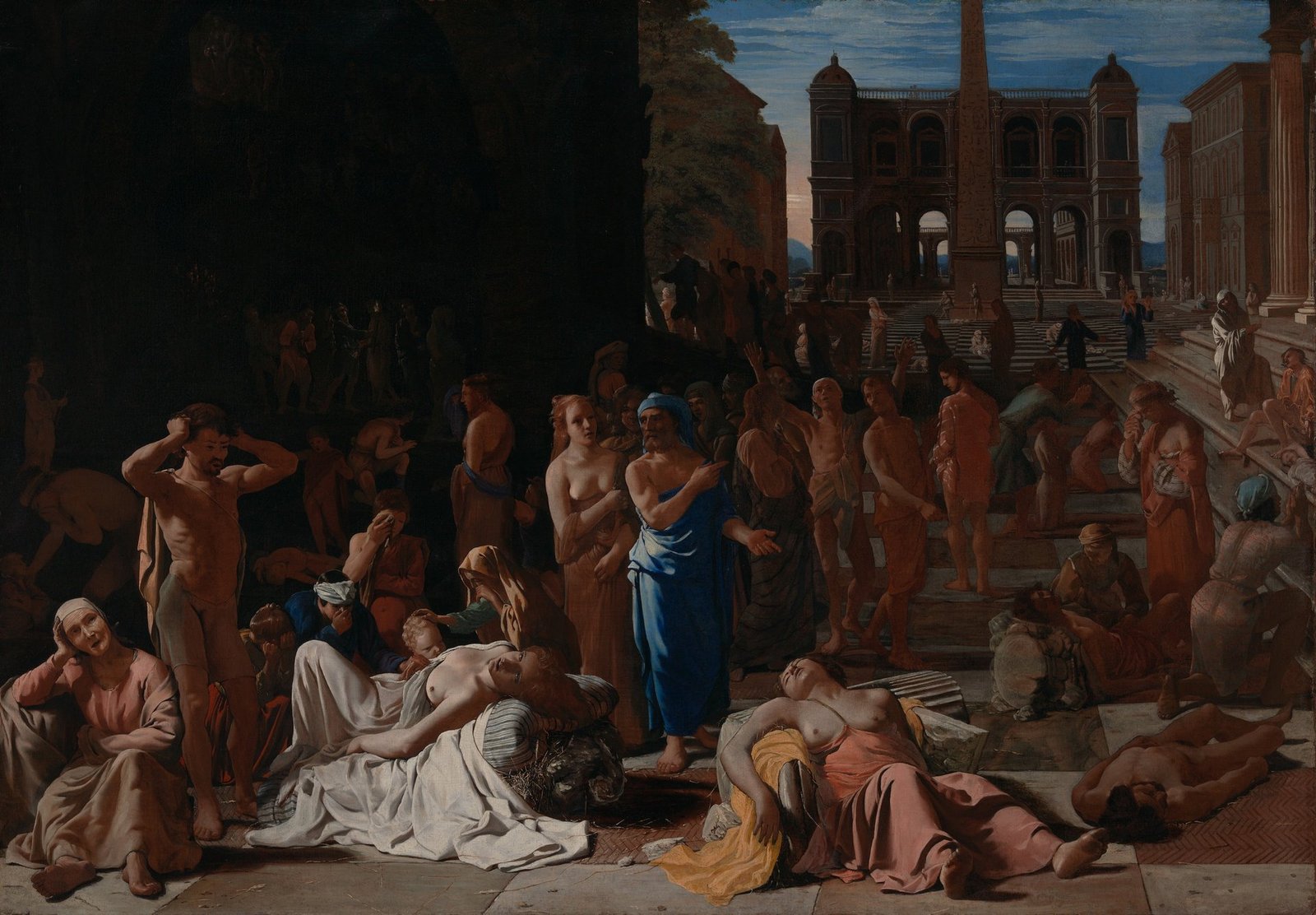
The skin shows reddish and livid with small blisters and sores, yet the burning is all within, so fierce that the sick want to be naked and throw themselves into cold water.
A note on this passage
Thucydides sorts the body into outside and inside with to men exōthen and ta de entos, "the outer parts" and "the inner parts," and the two halves contradict each other: cool enough to the hand, yet inwardly on fire. For the skin he lists hyperythron, "reddish," and pelitnon, "livid," then the eruption itself, phlyktainai, small blisters, and helkē, sores. The perfect participle exēnthēkos comes from anthos, "flower," so the body has "bloomed out" in these marks and stays that way.
The rest of the passage is told from the bedside. The sick will not bear even sindones, fine linen sheets, and want psychron hydōr, cold water. Hēdista an, "most gladly," marks the wish, and the next sentence reports that many neglected patients, tōn ēmelēmenōn anthrōpōn, acted on it by jumping into phreata, cisterns or wells, with dipsa apaustōi, "a thirst without pause." The last clause is a flat observation: whether they drank much or little came to the same, en tōi homoiōi.
Read the full commentary — and tap any word for its dictionary entry — in the interlinear reader.
Open Thucydides, History of the Peloponnesian War 2.49.5 in the full reader
Always open passages in the reader
From the Great Library
You are reading a page of the Thucydides, History of the Peloponnesian War — the whole book is free in our interlinear reader.
The Great Library Project presses the classics in their original languages, glossed word by word — free to read, always. Browse the whole library.
Also on our shelves:
Thucydides, History of the Peloponnesian War 2.49.5 — The Great Library Project interlinear edition · greatlibraryproject.com/book/thucydides/2.49.5/