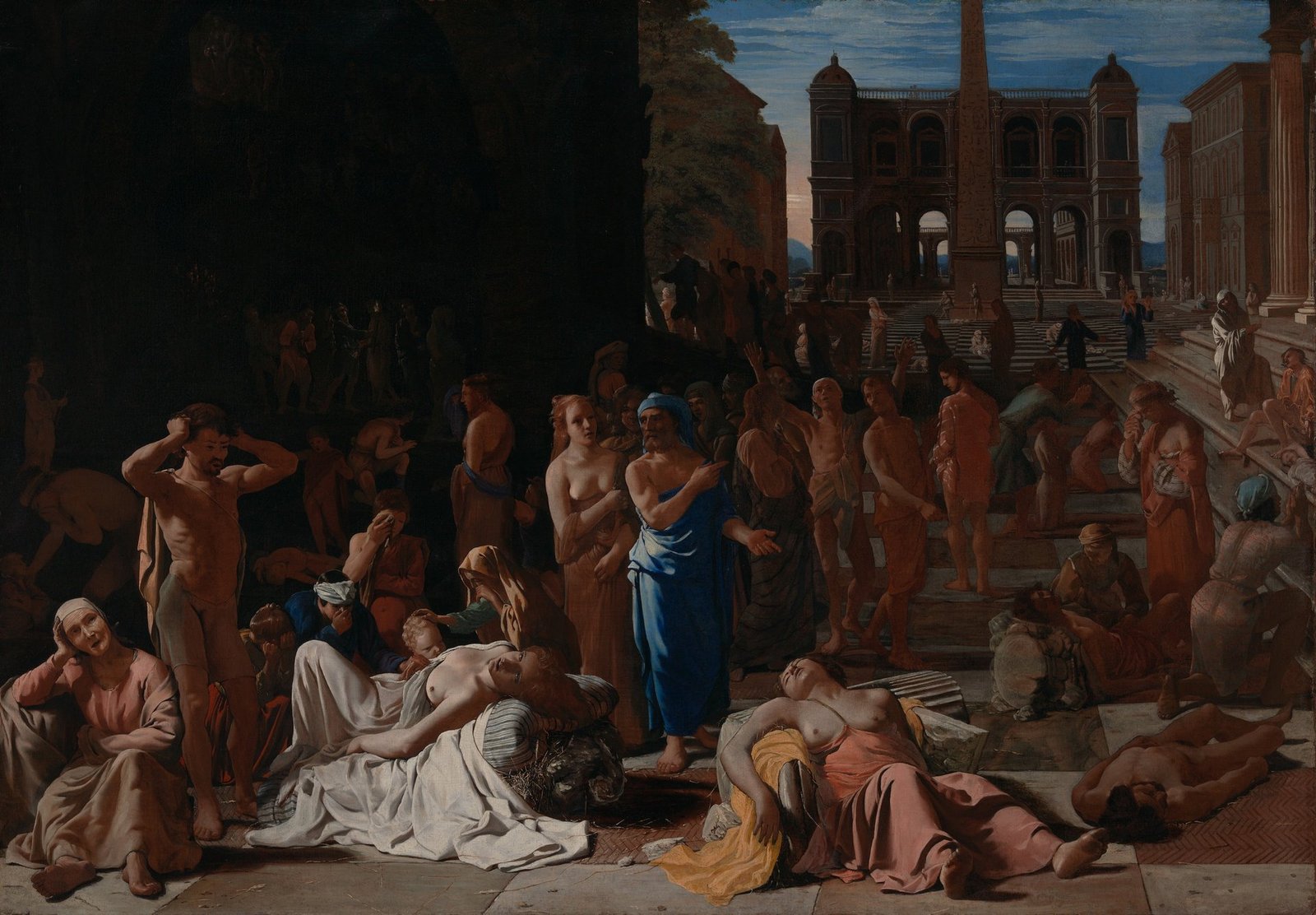
Thucydides, History of the Peloponnesian War 2.49.6 · 2.49.6
Death by the burning, or by the bowels
Read the full text in our reader
καὶ ἡ ἀπορία τοῦ μὴ ἡσυχάζειν καὶ ἡ ἀγρυπνία ἐπέκειτο διὰ παντός. καὶ τὸ σῶμα, ὅσονπερ χρόνον καὶ ἡ νόσος ἀκμάζοι, οὐκ ἐμαραίνετο, ἀλλ’ ἀντεῖχε παρὰ δόξαν τῇ ταλαιπωρίᾳ, ὥστε ἢ διεφθείροντο οἱ πλεῖστοι ἐναταῖοι καὶ ἑβδομαῖοι ὑπὸ τοῦ ἐντὸς καύματος, ἔτι ἔχοντές τι δυνάμεως, ἢ εἰ διαφύγοιεν, ἐπικατιόντος τοῦ νοσήματος ἐς τὴν κοιλίαν καὶ ἑλκώσεώς τε αὐτῇ ἰσχυρᾶς ἐγγιγνομένης καὶ διαρροίας ἅμα ἀκράτου ἐπιπιπτούσης οἱ πολλοὶ ὕστερον δι’ αὐτὴν ἀσθενείᾳ διεφθείροντο.
There was the helplessness of being unable to keep still, and sleeplessness weighed on them all the while. The body, for as long as the disease was at its height, did not waste away but held out against the suffering beyond expectation. So most of them died of the burning heat inside, on the ninth or the seventh day, while they still had some strength. Or if they got past that, the illness went down into the bowels, severe ulceration formed there, and unmixed diarrhea set in as well, and many died later of the weakness this caused.
Word by word
The setting
Sleepless and restless, the body still held out. Most died of the inner burning on the ninth or seventh day, and those who got past it died later of ulceration and diarrhea in the bowels.
A note on this passage
The stretch about the body turns on a contrast of verbs. Emaraineto belongs to marainō, which is used of a flame dying down, and Thucydides says the body did not burn out in that way, but anteiche, "held out against," the talaipōria, the hardship, "beyond expectation" (para doxan). The adjectives enataioi and hebdomaioi are day-words: they mean "ninth-day men" and "seventh-day men," so each sick person is labelled by the day on which he died, and the ninth comes first in the Greek.
The second death is written as a genitive absolute running through four items: the illness descending, helkōsis forming in the belly, diarroia falling on, and the result, astheneia, "weakness." Akratou describes the diarrhea as "unmixed." The word koilia is the hollow of the body, belly or bowels. Both diephtheironto verbs mean literally "were destroyed" and close the two halves of the long sentence in the same way.
Read the full commentary — and tap any word for its dictionary entry — in the interlinear reader.
Open Thucydides, History of the Peloponnesian War 2.49.6 in the full reader
Always open passages in the reader
From the Great Library
You are reading a page of the Thucydides, History of the Peloponnesian War — the whole book is free in our interlinear reader.
The Great Library Project presses the classics in their original languages, glossed word by word — free to read, always. Browse the whole library.
Also on our shelves:
Thucydides, History of the Peloponnesian War 2.49.6 — The Great Library Project interlinear edition · greatlibraryproject.com/book/thucydides/2.49.6/