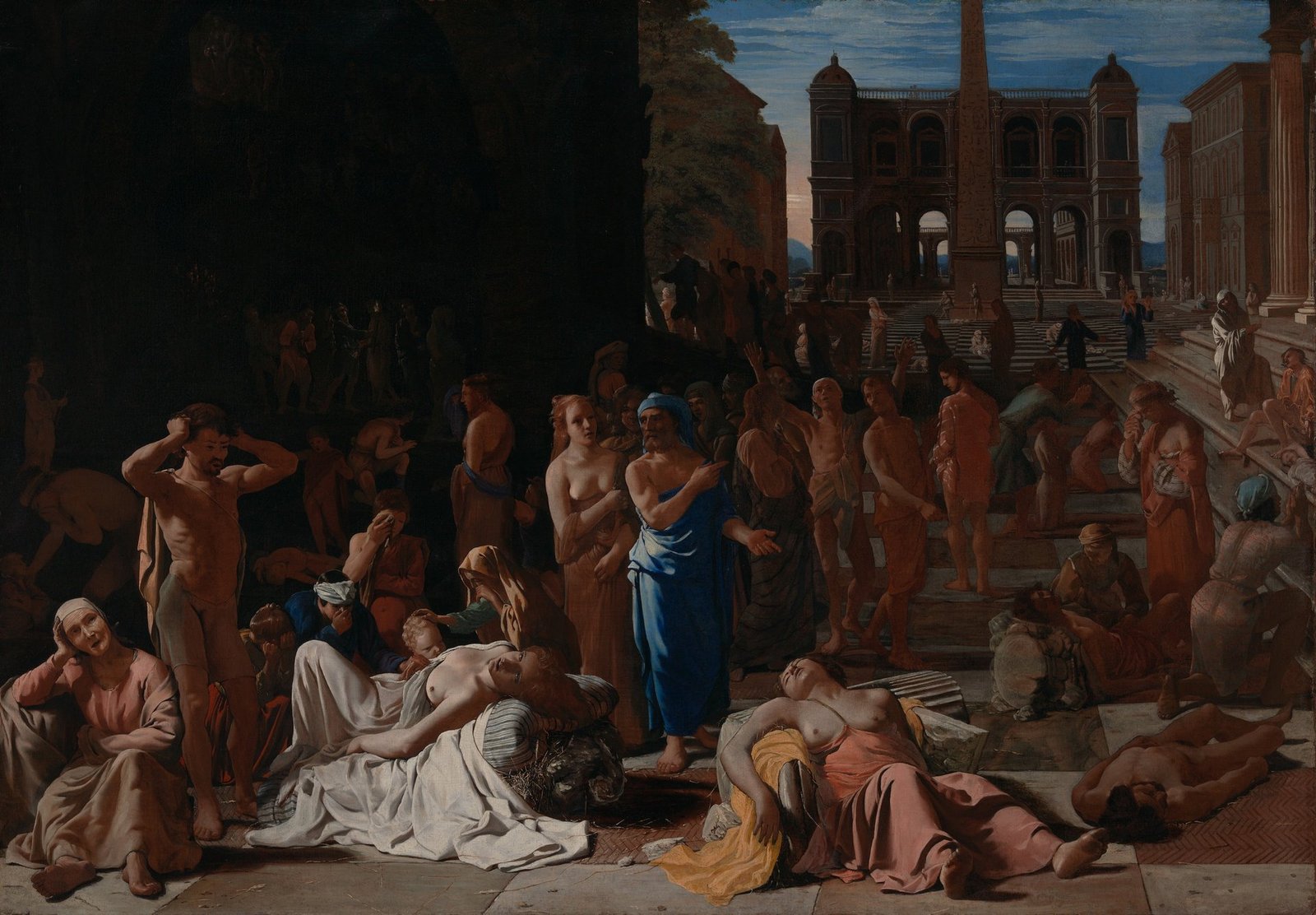
Thucydides, History of the Peloponnesian War 2.50.2 · 2.50.2
The dogs show what happened
Read the full text in our reader
τεκμήριον δέ· τῶν μὲν τοιούτων ὀρνίθων ἐπίλειψις σαφὴς ἐγένετο, καὶ οὐχ ἑωρῶντο οὔτε ἄλλως οὔτε περὶ τοιοῦτον οὐδέν· οἱ δὲ κύνες μᾶλλον αἴσθησιν παρεῖχον τοῦ ἀποβαίνοντος διὰ τὸ ξυνδιαιτᾶσθαι.
The proof was this. The disappearance of such birds was plain, and they were not seen either elsewhere or near any such thing. The dogs, which lived together with people, gave a better chance to notice the result.
Word by word
The setting
The birds were plainly gone from the scene, and the dogs, which lived among people, gave the clearest evidence of what the disease did to animals.
A note on this passage
The evidence is called tekmērion, a word for a sign from which a conclusion can be drawn, and Thucydides uses it for what the reader can check. The noun epileipsis comes from epileipō, "to fall short," so the birds are literally "running out." The doubled oute ... oute then rules out two places at once: they were seen neither anywhere else nor near any such thing, that is, near a corpse.
The dogs are the better witnesses for a reason he gives himself, with the infinitive xyndiaitasthai, "to live together," built on diaita, "way of living." They shared the household. The noun aisthēsis, "perception," stands for the chance to see the effect, and tou apobainontos, literally "of what was coming out," names that effect without saying what it was.
Read the full commentary — and tap any word for its dictionary entry — in the interlinear reader.
Open Thucydides, History of the Peloponnesian War 2.50.2 in the full reader
Always open passages in the reader
From the Great Library
You are reading a page of the Thucydides, History of the Peloponnesian War — the whole book is free in our interlinear reader.
The Great Library Project presses the classics in their original languages, glossed word by word — free to read, always. Browse the whole library.
Also on our shelves:
Thucydides, History of the Peloponnesian War 2.50.2 — The Great Library Project interlinear edition · greatlibraryproject.com/book/thucydides/2.50.2/