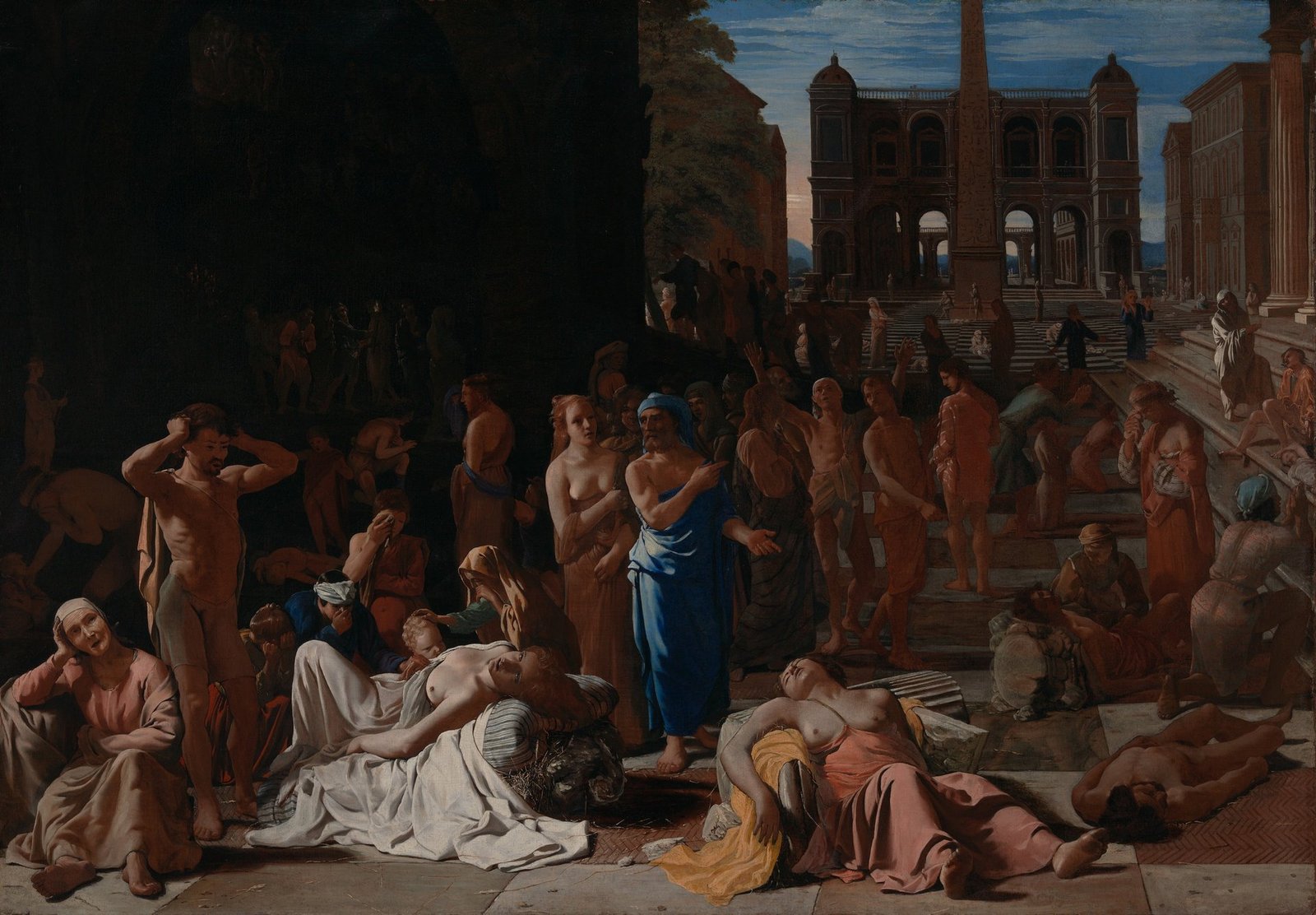
Thucydides, History of the Peloponnesian War 2.50.1 · 2.50.1
Birds and beasts keep away from the dead
Read the full text in our reader
γενόμενον γὰρ κρεῖσσον λόγου τὸ εἶδος τῆς νόσου τά τε ἄλλα χαλεπωτέρως ἢ κατὰ τὴν ἀνθρωπείαν φύσιν προσέπιπτεν ἑκάστῳ καὶ ἐν τῷδε ἐδήλωσε μάλιστα ἄλλο τι ὂν ἢ τῶν ξυντρόφων τι· τὰ γὰρ ὄρνεα καὶ τετράποδα ὅσα ἀνθρώπων ἅπτεται, πολλῶν ἀτάφων γιγνομένων ἢ οὐ προσῄει ἢ γευσάμενα διεφθείρετο.
For the disease, as it came, was beyond description, and in other ways it fell on each person more harshly than human nature could bear. In this above all it showed itself to be something different from the familiar illnesses. The birds and four-footed animals that feed on human bodies, though many lay unburied, either did not come near them or, if they tasted, died.
Word by word
The setting
Thucydides says the disease was beyond description and shows it by what happened to the birds and animals that feed on human bodies.
A note on this passage
The phrase kreisson logou, "beyond speech," is a plain admission that the account cannot be fully told, and it comes from a writer who has just said he will describe the symptoms so that others can recognize the disease. The word eidos, "form" or "kind," is the same word he will use again at 2.51.1 for the general character of the sickness. The last adjective, xyntrophōn (syntrophōn in later Attic spelling), is built on trephō, "to rear," and means "reared together," so "familiar" here is the sicknesses that grew up alongside the Athenians.
The proof he offers is about animals. Tetrapoda is simply "four-footed things," and atapha in the genitive absolute (pollōn atapōn gignomenōn) says that many bodies were becoming unburied, because there was no one to bury them. The two verbs at the end are set against each other with a doubled ē: either the animals ou prosiei, "did not approach," or, having geusamena, "tasted," they diephtheireto, "were destroyed." The sentence gives no other outcome.
Read the full commentary — and tap any word for its dictionary entry — in the interlinear reader.
Open Thucydides, History of the Peloponnesian War 2.50.1 in the full reader
Always open passages in the reader
From the Great Library
You are reading a page of the Thucydides, History of the Peloponnesian War — the whole book is free in our interlinear reader.
The Great Library Project presses the classics in their original languages, glossed word by word — free to read, always. Browse the whole library.
Also on our shelves:
Thucydides, History of the Peloponnesian War 2.50.1 — The Great Library Project interlinear edition · greatlibraryproject.com/book/thucydides/2.50.1/