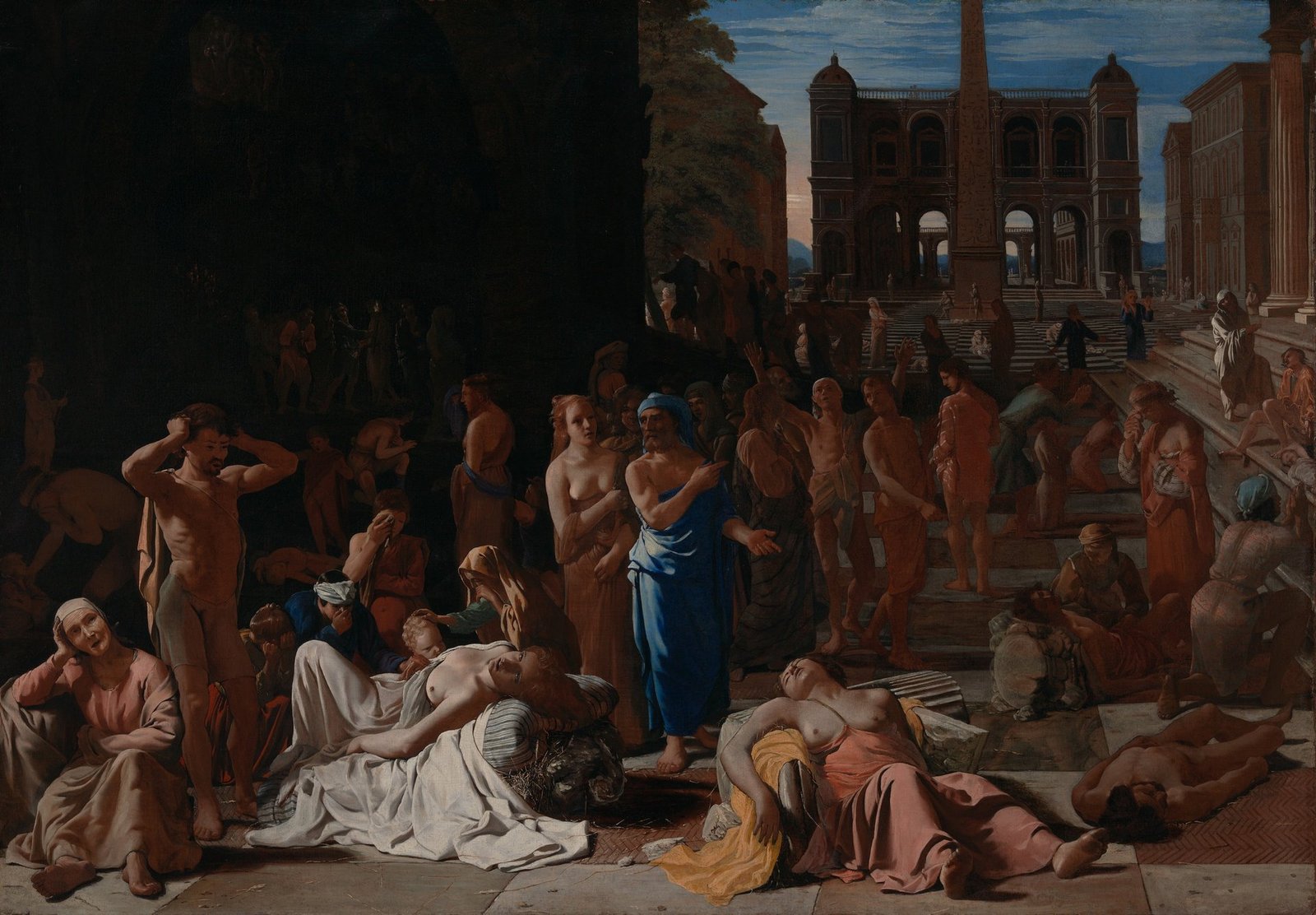
Thucydides, History of the Peloponnesian War 2.51.6 · 2.51.6
The survivors pity the sick
Read the full text in our reader
ἐπὶ πλέον δ’ ὅμως οἱ διαπεφευγότες τόν τε θνῄσκοντα καὶ τὸν πονούμενον ᾠκτίζοντο διὰ τὸ προειδέναι τε καὶ αὐτοὶ ἤδη ἐν τῷ θαρσαλέῳ εἶναι· δὶς γὰρ τὸν αὐτόν, ὥστε καὶ κτείνειν, οὐκ ἐπελάμβανεν. καὶ ἐμακαρίζοντό τε ὑπὸ τῶν ἄλλων, καὶ αὐτοὶ τῷ παραχρῆμα περιχαρεῖ καὶ ἐς τὸν ἔπειτα χρόνον ἐλπίδος τι εἶχον κούφης μηδ’ ἂν ὑπ’ ἄλλου νοσήματός ποτε ἔτι διαφθαρῆναι.
Still, those who had come through felt all the more pity for the dying and the suffering, because they knew the sickness beforehand and were by now themselves out of danger. It did not take the same man twice, at least not so as to kill. They were congratulated by everyone else, and in the elation of the moment they themselves held a vague hope for the future as well, that they would never again be destroyed by any other disease.
Word by word
The setting
Those who had come through the sickness felt most pity for the sick, since they knew it and were safe, for it did not take a man twice with a fatal grip.
A note on this passage
The survivors are described by their own verbs. Diapephugotes, "those who have fled through," is a perfect participle, so they stand permanently on the far side of the sickness. Thucydides then makes the pity depend on knowledge: dia to proeidenai, "because of knowing beforehand," a phrase that echoes his remark at 2.48.3 that he writes as one who had the illness himself and saw others have it. The phrase en to tharsaleo puts them "in the confident [state]," an adjective turned into a noun by the article.
The sentence about the second attack is careful: it does not say a man was never struck again, only that it did not seize him "so as even to kill," hoste kai kteinein. Then the sentence turns on the survivors themselves. They are called makarizonto, "counted blessed," and their perichares, "excess of joy," fills them with a hope Thucydides labels kouphe, "light." The word can mean weightless and also flighty, and the particle an with the aorist infinitive makes what they hoped for a supposition about the future.
Read the full commentary — and tap any word for its dictionary entry — in the interlinear reader.
Open Thucydides, History of the Peloponnesian War 2.51.6 in the full reader
Always open passages in the reader
From the Great Library
You are reading a page of the Thucydides, History of the Peloponnesian War — the whole book is free in our interlinear reader.
The Great Library Project presses the classics in their original languages, glossed word by word — free to read, always. Browse the whole library.
Also on our shelves:
Thucydides, History of the Peloponnesian War 2.51.6 — The Great Library Project interlinear edition · greatlibraryproject.com/book/thucydides/2.51.6/