Thucydides, History of the Peloponnesian War 2.52.2 · 2.52.2
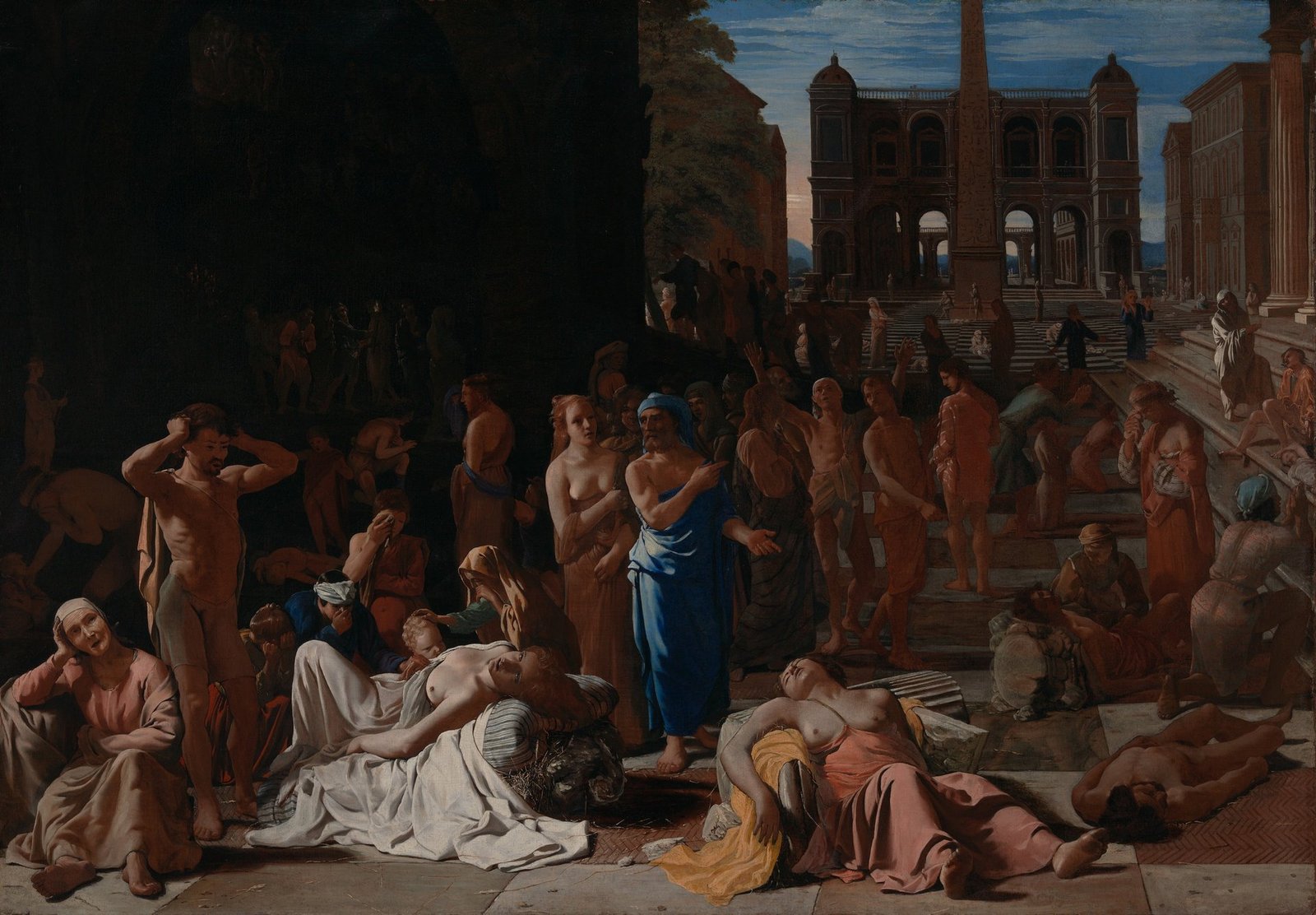
Dying in the huts and the streets
Read the full text in our reader
οἰκιῶν γὰρ οὐχ ὑπαρχουσῶν, ἀλλ’ ἐν καλύβαις πνιγηραῖς ὥρᾳ ἔτους διαιτωμένων ὁ φθόρος ἐγίγνετο οὐδενὶ κόσμῳ, ἀλλὰ καὶ νεκροὶ ἐπ’ ἀλλήλοις ἀποθνῄσκοντες ἔκειντο καὶ ἐν ταῖς ὁδοῖς ἐκαλινδοῦντο καὶ περὶ τὰς κρήνας ἁπάσας ἡμιθνῆτες τοῦ ὕδατος ἐπιθυμίᾳ.
For there were no houses for them, and they were living in stifling huts at that time of year, so the dying went on in no order at all. Dying men lay on top of one another like corpses, and half-dead people rolled about in the streets and around every fountain in their longing for water.
Word by word
The setting
With no houses for the newcomers, the dying went on in stifling huts, in complete disorder, with the dead lying in heaps and the half-dead crawling to the springs.
A note on this passage
The sentence opens with a genitive absolute built on a plain negative, oikion ouch huparchousōn, "there being no houses," and then names what there was instead: kalubai, "huts," called pnigērai. The adjective comes from pnigō, "to choke or stifle," so the huts are airless, and Thucydides adds the time of year, hōra etous, as part of the reason.
The word for the dying itself is phthoros, "destruction," and Thucydides says it happened oudeni kosmōi, "in no order." Kosmos is the ordinary word for arrangement, so the dead are described by the lack of one. Two verbs of heaps and wallowing follow, ekeinto and ekalindounto, and the half-dead are drawn to the springs by epithumia, "desire," for water. The adjective hēmithnētes is "half-dying," a compound of hēmi-, "half," and the root of thnēskō, "to die."
Read the full commentary — and tap any word for its dictionary entry — in the interlinear reader.
Open Thucydides, History of the Peloponnesian War 2.52.2 in the full reader
Always open passages in the reader
From the Great Library
You are reading a page of the Thucydides, History of the Peloponnesian War — the whole book is free in our interlinear reader.
The Great Library Project presses the classics in their original languages, glossed word by word — free to read, always. Browse the whole library.
Also on our shelves:
Thucydides, History of the Peloponnesian War 2.52.2 — The Great Library Project interlinear edition · greatlibraryproject.com/book/thucydides/2.52.2/