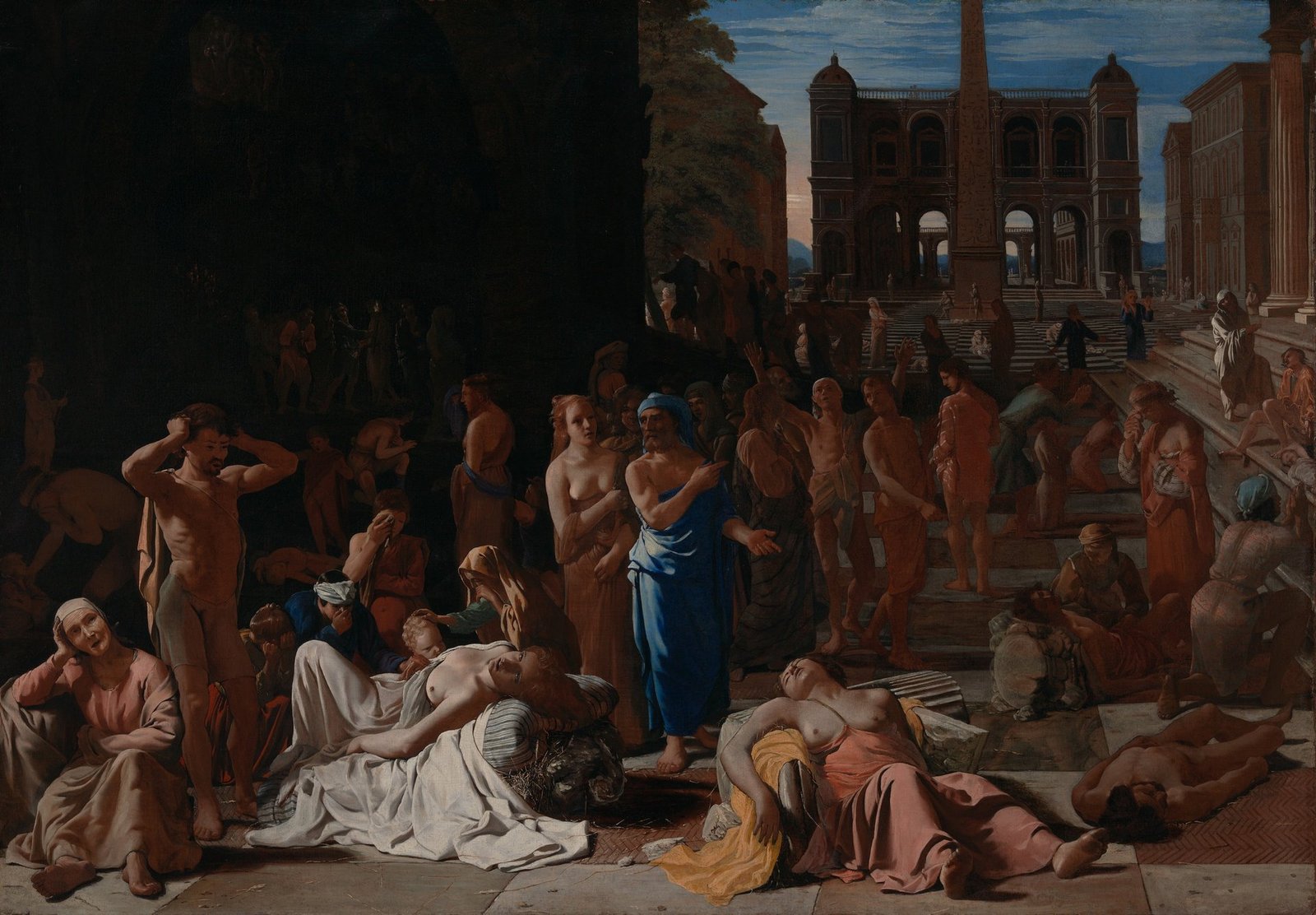
Thucydides, History of the Peloponnesian War 2.53.1 · 2.53.1
The plague breeds lawlessness
Read the full text in our reader
πρῶτόν τε ἦρξε καὶ ἐς τἆλλα τῇ πόλει ἐπὶ πλέον ἀνομίας τὸ νόσημα. ῥᾷον γὰρ ἐτόλμα τις ἃ πρότερον ἀπεκρύπτετο μὴ καθ’ ἡδονὴν ποιεῖν, ἀγχίστροφον τὴν μεταβολὴν ὁρῶντες τῶν τε εὐδαιμόνων καὶ αἰφνιδίως θνῃσκόντων καὶ τῶν οὐδὲν πρότερον κεκτημένων, εὐθὺς δὲ τἀκείνων ἐχόντων.
The disease first began to bring more lawlessness to the city in other ways too. A man now more readily dared what he had once kept hidden, so as not to be seen doing as he pleased. People saw how sudden the change was: the prosperous died in an instant, and men who had owned nothing at once held what the dead had owned.
Word by word
The setting
Thucydides says the disease first led to more lawlessness in the city, since people saw how fast fortunes changed and dared what they had hidden before.
A note on this passage
The word for lawlessness, anomia, is nomos, "law" or "custom," with a negating prefix. Thucydides says the plague began it "to a greater degree" (epi pleon), which grants that some lawlessness was there already. The verb apekrypteto is an imperfect, "used to hide," so he is describing a standing habit of concealment that the plague loosened. The phrase kath' hēdonēn, "according to pleasure," names the motive he returns to in the next sentences.
The cause he gives is what people saw. Anchistrophon is a compound with strephō, "turn," and describes a change that turns around fast. He pairs two groups: the eudaimones, the prosperous, who die aiphnidiōs, suddenly, and those who had owned nothing, who at once hold the dead men's goods. The participles thnēiskontōn and echontōn set the two events side by side, so the reader sees the whole reversal in one sweep.
Read the full commentary — and tap any word for its dictionary entry — in the interlinear reader.
Open Thucydides, History of the Peloponnesian War 2.53.1 in the full reader
Always open passages in the reader
From the Great Library
You are reading a page of the Thucydides, History of the Peloponnesian War — the whole book is free in our interlinear reader.
The Great Library Project presses the classics in their original languages, glossed word by word — free to read, always. Browse the whole library.
Also on our shelves:
Thucydides, History of the Peloponnesian War 2.53.1 — The Great Library Project interlinear edition · greatlibraryproject.com/book/thucydides/2.53.1/